Narrow Network

Narrow Network Health Insurance: What Employers and Employees Should Know
Narrow Network health insurance is coverage that limits you to a smaller group of doctors, hospitals, and other providers in exchange for access to negotiated care that may help keep premiums lower.
The word “narrow” doesn’t automatically mean the care is poor. It means your choice of providers is more restricted than it would be under a broader network, so the plan’s value depends heavily on whether the doctors, facilities, and prescriptions you need are covered.
For an employer, a narrow network can make a health plan look affordable without telling the whole story. For an employee, it can work perfectly well—or create an expensive headache—depending on where you live and who provides your care.
Meta description
Learn what a Narrow Network health plan is, how provider restrictions work, and what employers and employees should check before choosing coverage.
What is a Narrow Network?
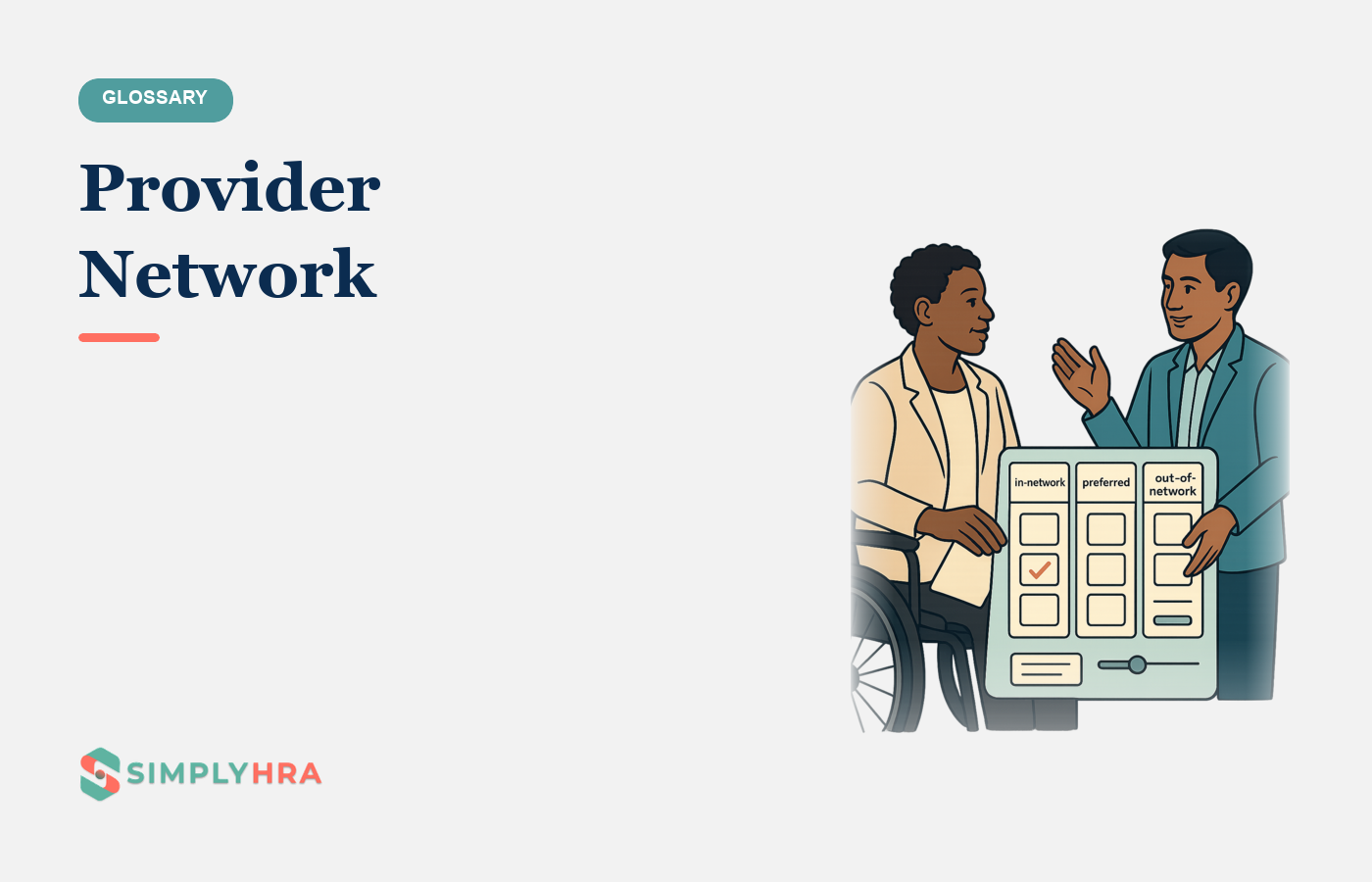
A provider network is the group of doctors, hospitals, laboratories, pharmacies, and other healthcare providers that have contracted with an insurance company. A narrow network includes fewer of those providers than other plans available in the same area.
These plans often appear as Health Maintenance Organization (HMO) or Exclusive Provider Organization (EPO) coverage, though network size and plan type aren’t the same thing. A Preferred Provider Organization (PPO) can also have a relatively limited network.
Federal law doesn’t set one provider-count threshold that makes every plan “narrow.” For Qualified Health Plans (QHPs) sold through a government Health Insurance Marketplace, issuers must maintain a network with enough provider types and access to services under Title 45, Section 156.230 of the Code of Federal Regulations. The Centers for Medicare & Medicaid Services also applies network-adequacy review standards to plans on the federally facilitated Marketplace, while states may impose additional requirements.
That regulatory review is a floor, not a promise that your preferred doctor participates. A network may satisfy applicable standards even when a particular medical group or major local hospital is excluded.
How does a narrow provider network work in practice?
You’ll generally pay the plan’s negotiated in-network rate when you use participating providers. If you go outside the network, the plan may pay less or nothing, except where emergency-care rules or other legal protections apply.
The federal No Surprises Act provides protections for many emergency services and certain out-of-network services received at participating facilities, as explained in the Centers for Medicare & Medicaid Services guidance titled “What Are the New Protections?” It doesn’t turn routine, voluntary out-of-network care into covered care.
Before enrolling, check more than the insurer’s logo. Provider networks can differ between plans from the same insurance company. Confirm:
- Your doctors are in the exact plan network, not merely “accepting” the insurer.
- Your preferred hospital, urgent care center, laboratory, and pharmacy participate.
- Needed specialists are available within a reasonable distance.
- Your prescriptions appear on the plan’s covered-drug list.
- Referrals or prior authorization are required.
Call the provider and insurer if the directory is unclear, and save the date, representative’s name, and any written confirmation. Healthcare.gov’s official guidance on provider networks similarly recommends checking the plan directory and contacting both the insurer and provider.
Who do narrow networks apply to?
Narrow networks can affect employees enrolled in a traditional employer group plan, people buying individual coverage, and families choosing Marketplace plans. Medicare Advantage and Medicaid managed-care plans also use provider networks, but they operate under separate program rules.
If you’re an employer, compare access—not just premiums—where your workers actually live. A network centered around one hospital system may suit employees near your office but leave remote workers with few practical choices.
If you’re an employee without insurance, you can compare individual plans during annual Open Enrollment or after a qualifying life event that creates a Special Enrollment Period. Don’t assume the cheapest premium means the lowest total cost; regular out-of-network visits can quickly erase the monthly savings.
The same issue matters when an employer offers an Individual Coverage Health Reimbursement Arrangement (ICHRA). Suppose Cedar Labs has 12 employees and offers each employee a $500 monthly allowance. Its maximum monthly reimbursement is 12 × $500, or $6,000, but each employee still chooses an individual plan and must evaluate that plan’s network for themselves. The allowance helps pay eligible coverage costs; it doesn’t make an excluded doctor in-network.
What does a narrow network cost an employer?
A smaller provider network may come with a lower premium than a broader alternative, but there’s no automatic discount. Your actual cost depends on the insurer, location, workforce ages, employer contribution, plan design, and whether coverage is fully insured or self-funded.
A narrow network doesn’t create a separate federal tax, filing deadline, or penalty by itself. Your duties come from the health plan around it. Before renewal, ask for the exact provider directory, identify hospital systems that are excluded, and check access in every area where employees live—not only near headquarters.
If your plan is governed by the Employee Retirement Income Security Act (ERISA), give participants the required plan information and follow the plan’s written terms. The Summary of Benefits and Coverage (SBC) must generally accompany enrollment materials, be provided by the first day of coverage in certain cases, and be supplied within seven business days after a request. A midyear material change that affects the SBC may require 60 days’ advance notice under the Department of Labor’s Summary of Benefits and Coverage regulations and guidance.
A willful failure to provide an SBC can trigger a federal penalty of up to $1,000 for each failure, subject to the governing statute and enforcement rules. Separate penalties may apply if an Applicable Large Employer—generally one averaging at least 50 full-time employees, including full-time equivalents—fails the Affordable Care Act’s employer shared-responsibility requirements. Those Internal Revenue Code Section 4980H amounts are indexed, but the issue is whether qualifying, affordable coverage was offered, not whether the network was broad.
Network-adequacy and directory duties often fall mainly on the insurer, while state rules can add notice and continuity-of-care requirements. Still, handing employees an outdated directory can create real employee-relations problems even when the carrier owns the legal error.
What does it mean for an employee’s paycheck and coverage?
Your payroll deduction is your share of the premium. Choosing a lower-premium option may leave more in your paycheck, but your total spending can rise if your regular doctor is excluded or you must travel farther for covered care.
Ask Human Resources for the plan’s SBC and exact network name before enrolling. Then check doctors, hospitals, behavioral-health providers, laboratories, pharmacies, and any ongoing treatment. If a provider leaves during the year, ask the insurer whether federal or state continuity-of-care protections let you temporarily continue treatment at in-network terms; the No Surprises Act’s continuing-care provisions cover certain patients and circumstances, not every provider departure.
If you currently have no insurance, you don’t have to wait automatically for next year. You may be able to enroll when you become eligible as a new employee, during the employer’s open enrollment, or through a special enrollment right after events such as losing other coverage, marriage, or birth. Employer-plan special enrollment requests commonly have a 30-day window, while Marketplace timing follows separate rules described by HealthCare.gov and Centers for Medicare & Medicaid Services enrollment guidance.
If an employer funds an Individual Coverage Health Reimbursement Arrangement (ICHRA), you choose individual coverage and evaluate its network yourself. The employer’s allowance generally isn’t added to taxable wages when the arrangement and coverage meet federal requirements, but accepting the ICHRA can affect eligibility for a Marketplace premium tax credit under Internal Revenue Service rules.
Worked cost example
Harbor Design has 10 employees and offers a $600 monthly ICHRA allowance. Its maximum monthly reimbursements are 10 × $600 = $6,000, or $72,000 for 12 months, if everyone claims the full amount.
Using SimplyHRA’s stated Premium price of $29 per employee per month adds 10 × $29 = $290 monthly, or $3,480 annually. The employer’s maximum combined annual outlay in this simplified example is $75,480. One employee might choose a lower-premium narrow-network policy and stay within the allowance, while another chooses a broader, more expensive policy and pays the unreimbursed difference; the network choice doesn’t change the employer’s $600 cap.
Common narrow network mistakes
- Assuming every plan from the same insurer uses the same doctors. Network names and contracts can differ by plan.
- Treating “the office accepts this insurer” as confirmation. Ask whether the individual clinician and facility are in-network for the exact plan.
- Believing emergency protections cover planned out-of-network care. Federal surprise-billing protections address specified situations; they don’t provide a general pass for routine care outside the network.
Frequently Asked Questions About Narrow Network
Are narrow network plans eligible for premium tax credits?
Yes, if the policy is a Qualified Health Plan offered through the Health Insurance Marketplace and you otherwise qualify. Network size doesn’t determine eligibility for the premium tax credit. The credit is generally tied to household income, tax household details, access to other qualifying coverage, and the cost of the benchmark plan—not whether your chosen policy has many providers. The Health Insurance Marketplace applies any advance credit to your selected plan, including an eligible narrow-network option.
Can I use a Health Savings Account with a narrow network plan?
Possibly. A narrow network and a Health Savings Account (HSA) address different things: the network controls which providers receive in-network treatment, while HSA eligibility depends primarily on enrollment in an HSA-qualified high-deductible health plan and the absence of disqualifying coverage. Check the plan documents for “HSA eligible” rather than assuming a high deductible is enough. Internal Revenue Service Publication 969 explains the federal HSA eligibility rules on the IRS website.
Will a narrow network health plan cover me out of state?
It depends on the policy. Many plans cover qualifying emergencies nationwide but offer little or no coverage for routine care outside their local service area. That distinction matters for college students, seasonal residents, frequent travelers, and families split between states. Before enrolling, ask whether the plan has a national partner network, how urgent care is handled, and whether follow-up treatment after an emergency must occur back in the service area.
Can I change plans if I find out my doctor isn’t in network?
Usually, finding out after enrollment that a preferred doctor isn’t participating doesn’t by itself create a Special Enrollment Period. However, a Marketplace may review cases involving material misinformation, display errors, or other exceptional circumstances under 45 Code of Federal Regulations Section 155.420. Save screenshots, directory results, call records, and messages that influenced your choice, then contact the Marketplace promptly. The Centers for Medicare & Medicaid Services oversees the federal Marketplace framework, while state-based Marketplaces handle their own cases.
Do narrow network plans cover telehealth visits?
They can, but a virtual visit isn’t automatically in-network. The plan may cover only its designated telehealth service, selected medical groups, or clinicians licensed where you’re physically located during the appointment. A video visit with your usual doctor could still be out-of-network even if the same doctor sees you in person under another contract. Check the telehealth benefit, copayment, platform requirement, and clinician’s network status before the visit.
Does COBRA keep the same narrow network?
Generally, continuation coverage under the Consolidated Omnibus Budget Reconciliation Act (COBRA) keeps you in the same employer plan available to similarly situated active employees, including its provider network. You’ll usually pay the full premium plus up to a 2% administrative charge, so keeping that network may become expensive. If the employer replaces or ends the plan, your continuation coverage may change too. The Department of Labor’s COBRA continuation coverage guidance is available through the Employee Benefits Security Administration.
How do state rules affect narrow network health plans?
State rules can change how insurers measure network adequacy, update provider directories, handle inaccurate listings, and protect patients when a doctor or facility leaves a network. These rules usually apply differently to fully insured employer plans and individual policies than to self-funded employer plans, which are primarily regulated under federal law. Ask your state insurance department which standards govern your exact policy. For Marketplace coverage, federal network requirements in 45 Code of Federal Regulations Section 156.230 may apply alongside state standards, so the stronger practical protection can depend on where you live and how the plan is funded.
Does moving to a new area let me switch out of a narrow network plan?
A permanent move may create a Marketplace Special Enrollment Period if you meet the applicable requirements, including having qualifying coverage for at least one day during the 60 days before the move in many cases. There are exceptions, including certain moves from abroad or a United States territory. A move that leaves you outside an employer plan’s service area may also trigger special-enrollment or continuation rights, depending on the plan and available options. Report the move promptly and review the official HealthCare.gov enrollment rules before canceling existing coverage.
Can an employer give part-time workers or new hires a different network?
An employer may offer different plan options to legitimate employee groups, but eligibility and contribution rules must be written carefully and applied consistently. Part-time employees can sometimes be excluded or offered different coverage under the plan’s terms, while a waiting period for an otherwise eligible new hire generally can’t exceed 90 days under federal waiting-period regulations. Applicable Large Employers also need to consider Affordable Care Act full-time status and employer shared-responsibility rules. A narrow network itself doesn’t justify treating similar employees differently, and nondiscrimination rules may restrict arrangements that favor highly compensated workers.
Can a business owner enroll in the same narrow network plan as employees?
That depends on the business structure, insurer rules, and whether the plan has at least one eligible common-law employee. A C corporation owner who works for the company is commonly treated as an employee, while sole proprietors, partners, and more-than-2% shareholders in an S corporation face different federal tax treatment. Some states also have participation rules for small-group coverage. Don’t assume payroll status settles the question: confirm eligibility with the carrier and have a tax professional review how premiums or reimbursements must be reported under Internal Revenue Service guidance.
What happens to my narrow network if I become eligible for Medicare or Medicaid?
Eligibility alone doesn’t always terminate existing coverage, but coordination can get tricky. Original Medicare generally doesn’t use a local provider network, while Medicare Advantage plans usually do; joining Medicare Advantage therefore means checking a new network rather than carrying over your employer or Marketplace network. Medicaid networks and continued eligibility vary by state and managed-care program. Medicare eligibility can also affect Health Savings Account contributions and Marketplace financial assistance. Before changing coverage, contact Medicare, your state Medicaid agency, and the employer plan administrator; the Centers for Medicare & Medicaid Services administers the federal Medicare and Medicaid framework.
Review Your Narrow Network Before You Enroll
Remember three things: the plan’s exact network matters more than the insurer’s name, lower premiums don’t always mean lower total costs, and you should verify the doctors, hospitals, prescriptions, and service areas you need before choosing coverage. Employers should also look beyond price and consider whether the network works where their employees live.
SimplyHRA fits small businesses and HR managers that want predictable benefit costs while giving employees a choice of individual health plans, including plans with different provider networks. We built it after living small-business benefits problems ourselves, and we’ve helped other owners and their teams set up and run these benefits without enterprise overhead.
This article is for education and isn’t legal or tax advice. Email info@simplyhra.com or schedule a call for a consultation about employer or employee benefits.
Related glossaries
Narrow Network
Provider Network