Defined Contribution Healthcare
Defined Contribution Healthcare: Model, Mechanics & Financial Impact
For more than half a century, employer-sponsored healthcare in the United States operated almost exclusively under a “defined benefit” framework: the company selected an insurance carrier, chose one or two group plan designs, and agreed to pay an open-ended percentage of whatever premium the carrier demanded.
In 2026, with employer group health costs reaching unsustainable levels, businesses are shifting to Defined Contribution Healthcare—a structural evolution mirroring the transition from traditional pensions to modern 401(k) retirement plans.
The 401(k) Revolution Arrives in Healthcare
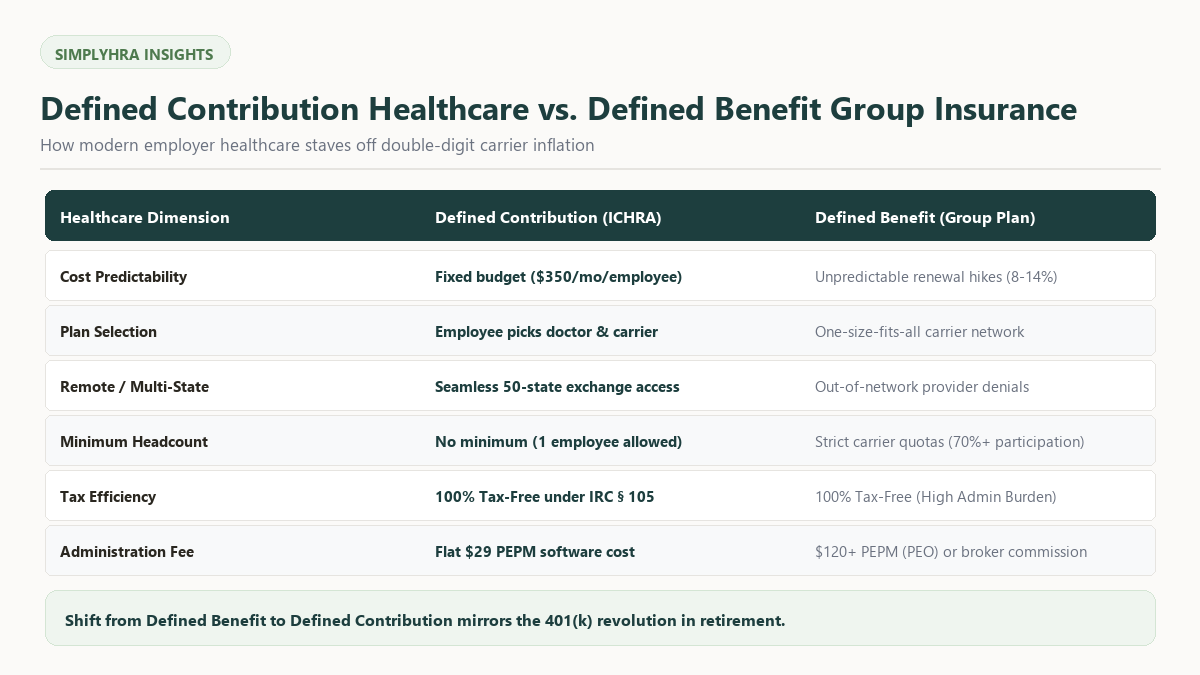
Defined Benefit vs. Defined Contribution: Strategic Comparison
The operational and financial differences between these two compensation architectures reshape company balance sheets:
| Dimension | Defined Benefit (Traditional Group) | Defined Contribution (SimplyHRA ICHRA) |
|---|---|---|
| Financial Liability | Open-Ended: Employer must absorb unpredictable annual renewal spikes (8%–20%+). | 100% Capped: Employer sets fixed monthly allowance (e.g. $500/mo). Budget is 100% predictable. |
| Employee Plan Choice | Limited to 1–2 employer-selected plans from a single carrier network. | Full individual market choice: Bronze, Silver, Gold, or Platinum across all area carriers. |
| Risk Pool Exposure | Tied to group claims. A few high-cost medical events spike next year's premiums. | Claims are absorbed by the vast individual exchange market. Zero employer renewal shock. |
| Coverage Portability | Terminates upon employment separation (expensive COBRA continuation). | Employees own their individual policies and maintain continuity even if they leave. |
Federal Regulatory Foundations
Defined contribution healthcare is codified under federal law through two primary statutory vehicles:
- Individual Coverage HRA (ICHRA): Created under 26 CFR § 54.9802-4, available to employers of any size with no annual contribution caps and flexible employee class segmentation.
- Qualified Small Employer HRA (QSEHRA): Established under IRC § 9831(d) for employers with fewer than 50 full-time employees, subject to statutory annual contribution caps.
Through SimplyHRA’s automated defined contribution platform, reimbursements are deposited directly into employee accounts with automated substantiation, giving employers institutional-grade compliance with zero administrative drag.
Transition Your Business to Defined Contribution Healthcare
Cap your annual healthcare inflation at 0% while providing employees with 100% individual plan choice across all major carriers in their state.
Schedule a SimplyHRA Consultation →Related glossaries
Defined Contribution Healthcare
Minimum Participation Rate Requirement