Accountable Plan

Accountable Plan: Definition, IRS Rules & Tax Compliance
In corporate payroll and employee benefits, an Accountable Plan is a formalized reimbursement method that allows companies to reimburse workers for legitimate business expenses without treating those payments as taxable gross wages.
The 3-Part Accountable Plan Mandate
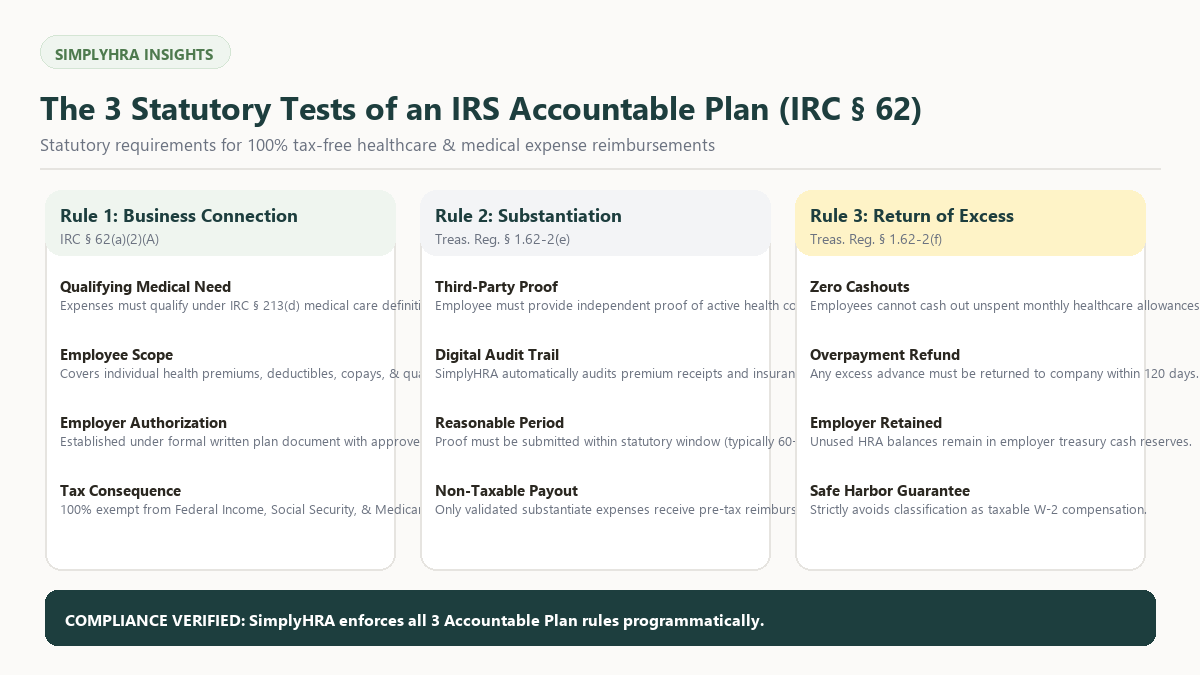
The Three Mandatory IRS Criteria
To retain tax-exempt status under Treasury Regulation § 1.62-2, every reimbursement program must strictly enforce three operational controls:
- 1. Business Connection: The expense must have a direct business nexus incurred in connection with performing services for the company. Personal living expenses or standard home-to-work commuting miles are strictly disqualified under IRC § 162.
- 2. Adequate Substantiation: Employees must verify expenses by providing documentary evidence (itemized invoices, dates, amounts, and business purpose) within a reasonable timeframe, defined under IRS safe harbor as within 60 days of being incurred.
- 3. Return of Excess Amounts: Any advance or excess allowance provided to an employee that exceeds actual substantiated expenses must be returned to the employer within a reasonable timeframe, defined as within 120 days.
Tax Penalty for Non-Accountable Plans
If an employer pays expense stipends without requiring receipts or fails any of the three rules, the IRS classifies the entire program as a Non-Accountable Plan:
- All payments must be reported on Form W-2 as taxable employee wages (Box 1, 3, and 5).
- Employers must withhold federal income tax, state income tax, and employee FICA (7.65%).
- Employers must pay matching employer FICA (7.65%) and federal unemployment taxes (FUTA), needlessly inflating payroll costs.
Accountable Plans vs. Health Reimbursement Arrangements (HRAs)
While general business expenses (mileage, travel, remote cell phone stipends) fall under IRC § 62 Accountable Plans, employee healthcare reimbursements must comply with IRC § 105(b) and ACA market reform rules. Sponsoring an Individual Coverage HRA (ICHRA) via SimplyHRA ensures health premium reimbursements remain 100% tax-free to employees and fully tax-deductible to the employer.
Deploy 100% Tax-Free Health Reimbursements
Learn how SimplyHRA leverages IRS Section 105 and ACA rules to deliver fully tax-deductible healthcare allowances without non-accountable plan payroll taxes.
Explore SimplyHRA Defined Contribution →Related glossaries
Defined Contribution Healthcare
Minimum Participation Rate Requirement