Why Independent Health Insurance Brokers Recommend ICHRA to Small Businesses

Why Independent Health Insurance Brokers Recommend ICHRA to Small Businesses
The role of the employee benefits advisor is undergoing its most radical transformation since the passage of the Affordable Care Act in 2010. For years, brokers managing small and mid-market employers (companies with 5 to 150 employees) had limited tools: shop between three local carriers, increase employee copays and deductibles, or shift to a restrictive narrow-network HMO.
Today, the nation’s most successful benefits consultants are abandoning this defensive cycle. Instead of justifying 14% rate increases, they are proactively introducing clients to Individual Coverage Health Reimbursement Arrangements (ICHRA). Here is why the defined contribution model has become the preferred growth engine for modern benefits advisory firms.
Why the Best Benefits Advisors Are Pitching ICHRA First
The 4 Catalysts Driving Brokers Toward Defined Contribution Healthcare
1. Conquering the Multi-State Remote Worker Dilemma
Before 2020, most small businesses operated from a single central facility. Today, even 15-person companies routinely employ workers across four to eight different states. Traditional group health insurance policies are legally tied to the employer’s headquarters state. If a firm based in Austin, Texas hires software engineers in Chicago and sales representatives in Atlanta, those out-of-state employees are frequently relegated to emergency-only or costly out-of-network benefits.
With an ICHRA, the broker solves 50-state coverage instantly. The employer provides a tax-free monthly allowance, and remote workers select top-tier local plans from carriers operating directly in their home zip codes (e.g. BCBS Illinois, Kaiser California, Horizon BCBS New Jersey), with 100% in-network physician access.
2. Eliminating the 70% Minimum Participation Barrier
Commercial carriers generally enforce a 70% to 75% minimum participation rate on small group policies. In a 20-person company, if 7 employees choose to stay on a spouse’s plan or military TRICARE, the carrier will disqualify the employer from coverage. Brokers frequently lose small business clients entirely due to participation failures.
Under federal ICHRA regulations (26 CFR § 54.9802-4), there is zero minimum participation requirement. If only 3 out of 20 employees utilize the ICHRA allowance, the plan remains 100% compliant and active. The employer pays solely for employees who actually enroll, preventing wasted administrative overhead.
3. Delivering Absolute Financial Budget Caps for CFOs
Under traditional group health plans, employers enter each budget cycle with an open-ended financial liability. A single catastrophic medical claim (e.g. premature birth, oncology treatment, coronary surgery) can drive next year’s group renewal up by 25% to 40%.
An ICHRA transitions the company from a volatile “defined benefit” liability to a controlled “defined contribution” asset. The employer defines the exact monthly reimbursement limit (e.g. $500/month for single employees, $1,100/month for family tiers). High individual claims are absorbed by the vast individual market risk pool, completely insulating the employer from renewal shocks.
4. Custom Employee Classification Strategies
Federal law grants employers extraordinary latitude to segment ICHRA allowances across 11 statutory employee classes:
- Full-Time vs. Part-Time Workers
- Salaried vs. Hourly / Non-Exempt Staff
- Geographic Rating Areas (States or Metropolitan Regions)
- Seasonal Employees and Temp Staff
This allows brokers to construct tailored corporate benefit strategies—for example, offering traditional group coverage to executive headquarters staff while providing an ICHRA allowance to field personnel or remote contractors.
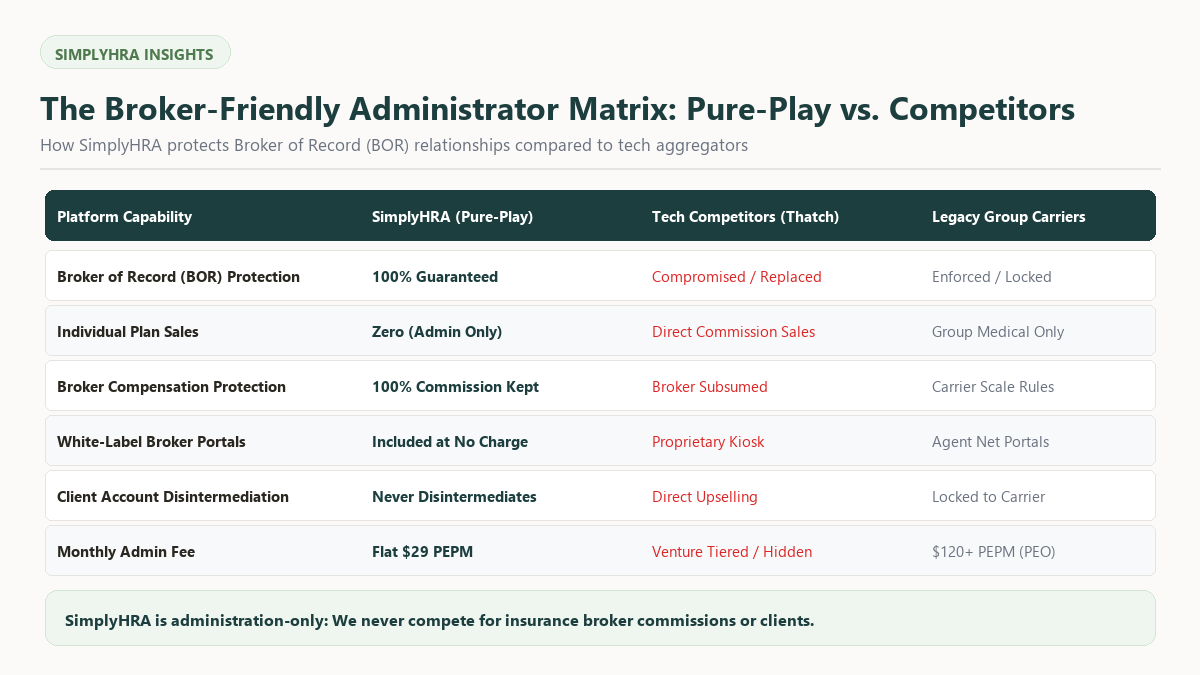
The SimplyHRA Advantage for Health Insurance Brokers
Many legacy HRA administration vendors view insurance brokers as competitors, attempting to disintermediate advisors and capture client renewals directly. SimplyHRA was engineered with a strict Broker-First Protection Architecture:
| Protection Pillar | SimplyHRA Institutional Commitment |
|---|---|
| 100% BOR Defense | SimplyHRA never solicits, captures, or reassigns your Broker of Record status. Your client remains 100% your client. |
| Flat Transparent Pricing | We charge a transparent $29 PEPM fee for full administrative compliance, legal documentation, and automated reimbursement verification, leaving your consulting margins untouched. |
| Turnkey Exchange Tech | Our digital enrollment portal guides employees through state and federal exchange shopping, subsidy reconciliation, and automated receipt substantiation without broker administrative overhead. |
Partner with SimplyHRA as an Independent Advisor
Are you a health insurance broker or employee benefits consultant? Join the SimplyHRA Broker Partner Network for complete BOR protection, turnkey enrollment tools, and flat $29 PEPM client pricing.
Join the SimplyHRA Broker Network →Case Study: Rescuing a 28-Employee Distributed Marketing Agency
A midwestern benefits broker represented a growing digital marketing agency with 28 employees spread across 7 states. At annual renewal, the incumbent carrier presented a 19.4% premium increase ($318,000 to $379,692), while 4 remote workers in California and Colorado complained their providers were out of network.
The broker recommended transitioning from the legacy group plan to SimplyHRA Defined Contribution:
- Budget Established: $450/month for single employees; $1,050/month for employees with dependents.
- Total Annual Benefit Spend: $214,200 (a $165,492 annual savings compared to the proposed group renewal).
- Employee Satisfaction: 100% of remote staff enrolled in local top-tier carriers accepted by their personal physicians.
- Advisor Outcome: The broker retained the client on a multi-year advisory retainer, earned praise from the CFO, and eliminated all fourth-quarter renewal friction.
Related blogs

Health Insurance Broker Fees & Commissions: A Small Business Transparency Guide
When to Leave a PEO: A Small Business Exit Guide & Cost Analysis