When to Leave a PEO: A Small Business Exit Guide & Cost Analysis
When to Leave a PEO: The Small Business Inflection Point
For early-stage startups and lean professional practices, entering a Professional Employer Organization (PEO) is an intuitive milestone. In exchange for a single bundled invoice, the PEO becomes your “co-employer,” handling state tax withholding, workers’ compensation, multi-state payroll, and providing immediate access to large-group medical coverage.
However, what accelerates an early startup eventually binds a maturing enterprise. As your team grows, the structural economics of co-employment flip from an asset to an escalating liability. Understanding exactly when and how to exit a PEO is one of the highest-leverage financial decisions a COO, CFO, or founder can make.
When Does a PEO Become an Unnecessary Expense?
The 4 Warning Signs Your Business Has Outgrown Its PEO
Finance leaders evaluate a PEO exit when they observe four systemic operational frictions:
1. Administrative Fee Creep ($139–$220+ PEPM)
Unlike software-as-a-service (SaaS) tools that scale efficiently with volume, PEOs charge per-employee-per-month (PEPM) fees ranging from $139 to over $220, or an opaque 2% to 4% surcharge on gross payroll. At 25 employees, you are spending $45,000 to $66,000 annually purely for payroll processing and benefits access—services modern payroll platforms provide for less than a fifth of that cost.
2. The Renewal Shock Paradox
Startups often join PEOs believing that pooling risk with thousands of other small employers will protect them from annual health insurance renewal spikes. In practice, the opposite occurs. Because PEO master policies pool unvetted cross-client claims, healthy SMBs regularly receive 12% to 22% annual health premium increases to subsidize losses incurred by other client companies in the master trust.
3. Multi-State Remote Worker Friction
Today’s distributed workforces expose carrier limitations. A PEO typically negotiates master health plans with one or two national carriers (e.g. Aetna or UnitedHealthcare). Remote employees living outside major metropolitan hubs or in specific states often discover their local primary care physicians and regional hospital systems are classified as “out of network,” triggering employee dissatisfaction and heavy out-of-pocket expenses.
4. Loss of Fiduciary & Corporate Autonomy
Under a co-employment agreement (Client Service Agreement), the PEO controls your Employer Identification Number (EIN) for payroll tax reporting. You cannot customize benefits packages, institute flexible health reimbursement tiers, or integrate specialized equity and performance tools without explicit PEO approval.
Financial Comparison: PEO Bundled Billing vs. Standalone Payroll + ICHRA
The table below models actual annual operational expenditures for a 20-employee technology firm operating under a leading PEO versus an uncoupled architecture featuring modern payroll and SimplyHRA Defined Contribution:
| Cost Component | PEO Model (e.g. Justworks / Insperity) | SimplyHRA (ICHRA) + Standalone HRIS |
|---|---|---|
| Administrative / Software Fees | $165 PEPM × 20 = $39,600 / year | $29 (SimplyHRA) + $10 (Gusto) × 20 = $9,360 / year |
| Health Insurance Outlay | $690/mo avg premium × 20 = $165,600 / year (uncontrollable) | $525/mo defined allowance × 20 = $126,000 / year (100% budget capped) |
| Workers' Comp & Compliance | Bundled with opaque carrier markups (~$4,200/yr) | Direct market brokered rate (~$2,400/yr) |
| Total Annual Outlay | $209,400 / year | $137,760 / year |
| Net Annual Savings | +$71,640 Annual Cash Flow Returned to Core Operations | |
The 90-Day PEO Exit Playbook: Navigating SUTA and Coverage Transitions
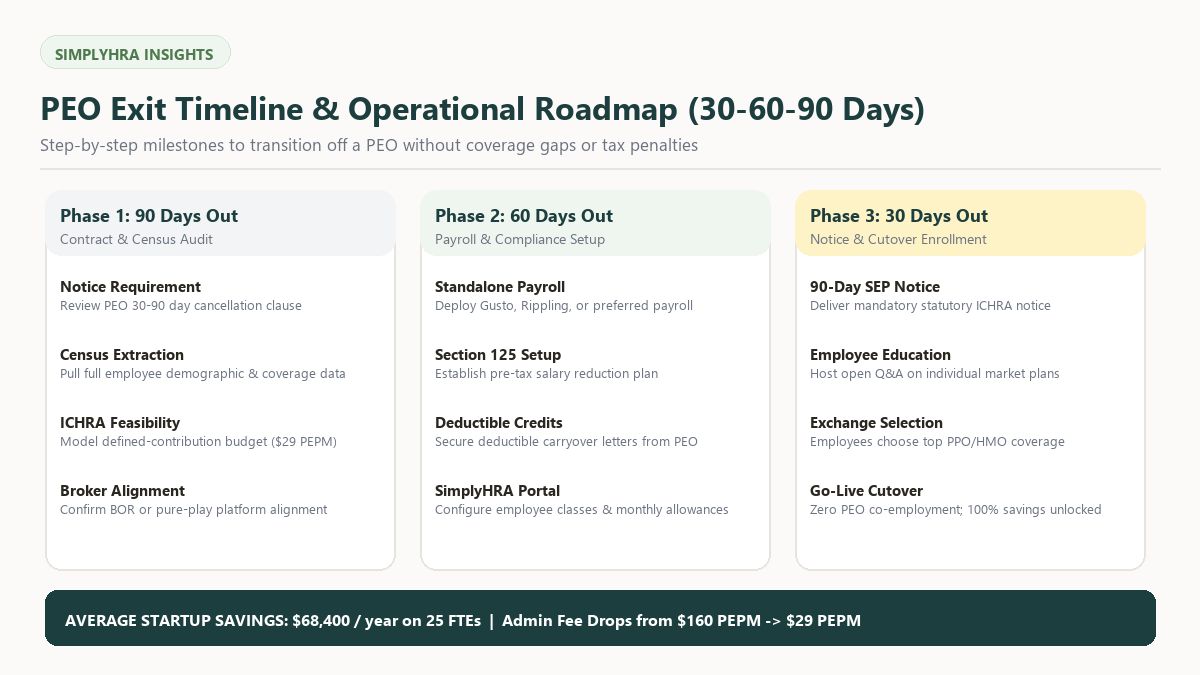
Exiting a PEO requires precise coordination to prevent tax double-payment and coverage gaps. Follow this statutory checklist:
Phase 1: Calendar Year Alignment (Days 90–60)
The SUTA Wage Base Trap: In most states, State Unemployment Tax Act (SUTA) taxes are paid on employee wages up to a state wage cap (e.g. $7,000 to $14,000). While in a PEO, SUTA taxes are paid under the PEO’s state unemployment account number. If you leave mid-year (e.g. July 1st), your new standalone payroll entity must start wage calculations from $0, forcing you to pay SUTA taxes twice on the same employees. Whenever possible, align your official effective exit date with January 1st to reset wage caps cleanly.
Phase 2: Establish Direct Payroll and Tax IDs (Days 60–30)
Obtain state employer withholding numbers and state unemployment insurance accounts in every jurisdiction where you employ staff. Migrate employee demographic records, direct deposit details, and historical W-2 records into your new HRIS platform.
Phase 3: Launch ICHRA and Trigger the 60-Day SEP (Days 30–1)
Terminating the PEO’s master group health policy qualifies every employee for a guaranteed 60-day Special Enrollment Period (SEP) under 45 CFR § 155.420. By pairing your exit with SimplyHRA, employees receive fixed monthly tax-free allowances to select high-quality individual health plans on state or federal exchanges, maintaining continuous coverage without network disruption.
Calculate Your Exact Savings Leaving a PEO
Compare your current PEO invoice against SimplyHRA's flat $29/PEPM defined contribution platform paired with modern standalone payroll. Uncouple risk without disrupting employee healthcare.
Schedule a PEO Exit Consultation →Frequently Asked Questions: Leaving a PEO
Will exiting a PEO disrupt our employees' existing doctors and treatments?
No. In fact, an ICHRA vastly improves provider continuity. Under a PEO, employees are limited to the PEO's chosen carrier network. Under an ICHRA, employees can select from every carrier available in their geographic area (Kaiser, Blue Cross, Aetna, Cigna, regional co-ops), ensuring their personal doctors and hospitals remain in-network.
How long does it take to leave a PEO?
A standard PEO uncoupling requires 60 to 90 days. Most PEO Client Service Agreements require 30 to 60 days advance written notice. Initiating the process in October for a January 1st launch provides ample time to set up state tax IDs and run an organized employee open enrollment.
Can we use our existing insurance broker when leaving a PEO?
Yes! Unlike PEOs that lock out independent benefits advisors, SimplyHRA partners directly with independent health insurance brokers under full Broker of Record (BOR) protection, allowing your trusted advisor to guide your transition and receive transparent advisory compensation.
Related blogs

Why Independent Health Insurance Brokers Recommend ICHRA to Small Businesses

Health Insurance Broker Fees & Commissions: A Small Business Transparency Guide