Health Insurance Broker Fees & Commissions: A Small Business Transparency Guide

Health Insurance Broker Fees & Commissions: The Small Business Transparency Guide
Every year, small business owners sit across from their benefits broker to review annual health insurance renewals. Too often, the conversation follows a predictable script: health plan premiums are climbing by 9% to 15%, the broker explains that market conditions leave few alternatives, and the employer reluctantly signs the renewal or increases employee deductibles.
What few employers understand is how broker compensation structures fundamentally influence the plan options presented to them. Knowing the mechanics of broker fees, legal disclosure mandates, and modern defined contribution alternatives allows business owners to align their advisor’s incentives directly with company fiscal health.
How Health Insurance Brokers Actually Get Paid
The Three Primary Ways Health Insurance Brokers Earn Revenue
Independent insurance brokers and corporate benefits advisors generate revenue through three distinct mechanisms:
1. Percentage-of-Premium Commissions
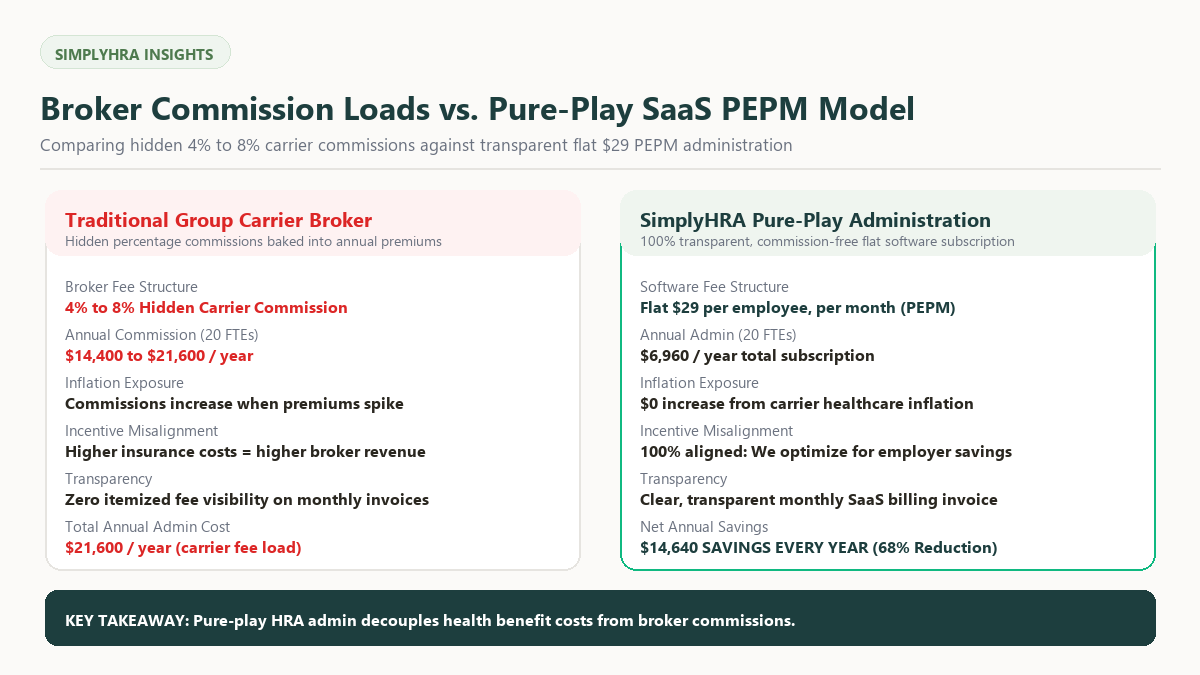
In traditional small-group and large-group markets, insurance carriers (e.g. UnitedHealthcare, Anthem, Blue Cross Blue Shield) pay brokers a commission calculated as a fixed percentage of total monthly premiums—typically between 3% and 6%. For a 30-employee company with an annual group premium of $250,000, a 5% commission yields $12,500 annually. When the carrier raises rates by 12% at renewal, the broker’s commission automatically increases by 12% without delivering additional advisory services.
2. Fixed Per-Employee-Per-Month (PEPM) Commissions
Some carriers pay a flat dollar amount per enrolled employee per month, typically ranging from $15 to $35 PEPM. While this decouples broker revenue from premium inflation, it still ties advisor compensation strictly to headcount rather than the quality, affordability, or clinical effectiveness of the coverage provided.
3. Direct Advisory Consulting Fees
Progressive benefits advisors operate on a transparent fee-for-service advisory agreement. Under this model, the employer pays the broker a defined monthly or quarterly consulting fee for plan design, employee advocacy, and compliance oversight, while the broker waives carrier commissions or credits them back to the client. This transforms the broker from a transactional insurance vendor into a true fiduciary partner.
The Consolidated Appropriations Act (CAA): The Legal Mandate for Disclosure
Under Section 202 of the federal Consolidated Appropriations Act (CAA) of 2021, Congress enacted landmark compensation disclosure requirements for group health plan service providers (codified under ERISA § 408(b)(2)):
| CAA Mandate | Legal Requirement & Fiduciary Standard |
|---|---|
| The $1,000 Threshold | Any broker or consultant expecting to receive $1,000 or more in direct or indirect compensation for healthcare brokerage services must provide formal written disclosure to the employer prior to contract execution or renewal. |
| Indirect Compensation Disclosures | Brokers must disclose indirect payments from third parties, including carrier production bonuses, volume incentives, override payments, trip incentives, and pharmacy benefit manager (PBM) rebates. |
| Employer Fiduciary Liability | If a plan sponsor fails to obtain required CAA compensation disclosures from their broker, the contract is legally deemed a “prohibited transaction” under ERISA, exposing company executives to personal fiduciary liability. |
Why Innovative Brokers Are Shifting Clients to ICHRA
Forward-thinking health insurance brokers are aggressively moving their small-to-midsize business clients from traditional group plans to Defined Contribution Individual Coverage HRAs (ICHRA). Here is why the economics work for both employer and broker:
- Unlocking Uncontrollable Renewals: Instead of delivering double-digit rate hikes every November, brokers offer clients fixed budgeting where the employer dictates the annual allowance increase (e.g. 3% or $0).
- Zero Minimum Participation Worries: In small group plans, carriers require at least 70% to 75% employee participation. If employees waive coverage for a spouse’s plan or military benefits, the employer loses coverage. ICHRA requires 0% minimum participation.
- Preserving Broker Compensation with Turnkey Technology: SimplyHRA operates on a partner-first model. We charge a simple $29 PEPM administrative fee, protect the broker’s Broker of Record (BOR), and enable the advisor to charge their standard advisory consulting fee while eliminating the administrative burden of claims dispute resolution and marketplace enrollments.
Bring SimplyHRA to Your Insurance Broker
Do you love your benefits broker? SimplyHRA partners directly with independent health insurance brokers under full Broker of Record (BOR) protection. Introduce your broker to modern defined contribution healthcare.
Introduce Your Broker to SimplyHRA →Questions to Ask Your Benefits Broker at Your Next Renewal
To ensure your company receives optimal value and total transparency, ask your health insurance broker these three questions:
- “Can you provide our complete CAA Section 202 compensation disclosure detailing all direct commissions and indirect carrier bonuses associated with our policy?”
- “Have you evaluated a defined contribution ICHRA model for our team to compare against our traditional renewal rate?”
- “Are we able to transition our account to a fee-for-service consulting model to ensure recommendations are completely carrier-agnostic?”
Related blogs

Why Independent Health Insurance Brokers Recommend ICHRA to Small Businesses

When to Leave a PEO: A Small Business Exit Guide & Cost Analysis