ICHRA for Nonprofits
ICHRA for Nonprofits: What You Need to Know
TL;DR
Individual Coverage Health Reimbursement Arrangement (ICHRA) gives nonprofits a way to offer competitive, flexible, and cost-effective health benefits without the overhead of a group plan.
CHOICE (Custom Health Option and Individual Care Expense) Arrangement is the current name for what was previously referred to as an ICHRA (Individual Coverage Health Reimbursement Arrangement). This page uses both terms.
Key Takeaways
- No employee cap: Unlike other HRAs like Qualified Small Employer Health Reimbursement Arrangement (QSEHRA), which tops out under 50 employees, ICHRA is available to businesses of any size - from five-person grassroots teams to national organizations with hundreds of staff.
- Payroll tax win, not income tax: While nonprofits don't care about income tax write-offs since a 501(c)(3) organization doesn't owe income tax to begin with, ICHRA reimbursements are exempt from the Federal Insurance Contributions Act (FICA) payroll taxes.
- One plan, different rules per group: Nonprofits can tailor their ICHRA plan by offering different benefits per employee class (e.g., full-time staff, remote employees, and seasonal hires).
Nonprofits live and die by budget lines.
Every dollar is carefully allocated, which makes competitive health benefits a tough sell. After all, traditional group plans show up with unpredictable premium hikes attached.
That's where ICHRA comes in.
Under ICHRA, organizations hold the power to set fixed monthly reimbursement allowances while employees are free to choose their own coverage.
No rigid headcount minimums. No renewal surprises.
One thing worth clearing up early: adopting ICHRA for nonprofits isn't a tax deduction play. A 501(c)(3) doesn't owe federal income tax to begin with, so the actual savings show up on the payroll side.
ICHRA in Simple Terms
An ICHRA is an employer-funded benefit where the organization sets a fixed monthly allowance, and employees use it to buy their own individual health insurance plan.
Instead of picking one group policy for everyone, each employee shops the individual market for coverage that actually fits their situation, then gets reimbursed tax-free up to the allowance amount.
Why Does ICHRA Fit Nonprofits?
Nonprofits deal with a few constraints that make ICHRA a better structural fit than a standard group plan.
No Employee Count Requirements
QSEHRA is the only HRA type with a strict employee-count maximum of 49 employees, whereas ICHRA has no size ceiling. The only wrinkle: organizations need to meet a minimum size requirement if the ICHRA is offered alongside a traditional group plan, scaling up from at least 10 employees for organizations under 100 total staff (10% of total employees from a pool of 100-200 and a minimum of 20 for companies with more than 200 employees).
Budget Predictability Matters More Here Than In Most Industries
Grant funding and donor restrictions often mean a benefits line item can't just absorb a surprise premium increase. With ICHRA, you make sure allowances stay fixed — the organization sets it, and it doesn't move unless they decide to change it.
Nonprofit Staffing Rarely Looks Uniform
Full-time program staff, part-time coordinators, seasonal event workers, and remote-only employees often coexist on the same small team. ICHRA's employee classes let an organization set different allowance amounts for each group, rather than forcing blanket coverage or excluding certain roles from benefits entirely.
What's the Actual Tax Benefit for a Tax-Exempt Organization?
This is worth clearing up, since most ICHRA content written for nonprofits leans on language that doesn't quite apply. Reimbursements made through ICHRA are exempt from payroll tax (FICA) for both the organization and the employee, and reimbursed amounts don't count as taxable income for employees either.
That payroll-tax exemption applies to nonprofits as well, but the confusion comes in the "tax-deductible" framing.
For a for-profit company, ICHRA contributions reduce taxable income. But for a 501(c)(3) that doesn't pay federal income tax in the first place, there's no taxable income to reduce, and a deduction claim doesn't translate into actual savings for a tax-exempt organization.
A few more things worth knowing:
- The alternative is worse. Nonprofits may skip ICHRA and just hand employees cash for insurance instead. That money, however, becomes regular taxable wages, and the nonprofit owes its 7.65% FICA share on it (as of 2026).
- Unrelated business income changes the math. For nonprofits that owe Unrelated Business Income Tax (UBIT), ICHRA contributions tied to that work can function as a genuine deduction against that taxable income. Be sure to run this by your tax advisor if it applies to your organization.
- Running short on the allowance? A Section 125 cafeteria plan lets an employee cover the gap between their premium and the ICHRA allowance pre-tax. However, it only works if they bought the plan off-exchange (marketplace-purchased plans don't qualify).
What Compliance Rules Still Apply?
ICHRA cuts a lot of the overhead of a group plan, but it's still a formal benefit with its own paperwork requirements.
- Consistency within each class: Every employee within the same class needs to get the same terms — though the rules do allow specific variations, like scaling allowances by age or family size. It's consistent treatment within the framework, not a "100% identical in every way" requirement.
- Written plan document and 90-day notice: ICHRA generally counts as an ERISA welfare benefit plan, which requires a plan document and Summary Plan Description (SPD). Employees also need to receive a 90-day notice explaining their allowance and how accepting or declining it affects eligibility for Premium Tax Credits (PTC).
- Ongoing coverage verification: Employees need qualifying individual coverage for the specific month a reimbursement is received. A coverage lapse last month makes that month's reimbursement ineligible, even if coverage resumes the next.
- Affordability for Applicable Large Employers (ALEs): This isn't a nonprofit-specific rule — it applies to any employer that qualifies as an ALE (50+ full-time equivalent employees). ALEs need ICHRA reimbursement allowances to meet the ACA's affordability threshold, which is the maximum contribution amount for employees based on their annual household income (9.96% in 2026).
Setting Up ICHRA for Your Nonprofit with SimplyHRA
Choosing a health benefit shouldn't cost a nonprofit more time or money than it saves.
Between the compliance paperwork, the class-size rules, and the coverage verification, ICHRA has real upside for mission-driven organizations.
That's where SimplyHRA fits.
The flat $29 per employee per month (PEPM) rate means no surprises showing up on next year's grant report.
There's also no setup fee or broker commission. Plus, the intuitive, self-service interface and built-in AI assistant allow for quick rollout.
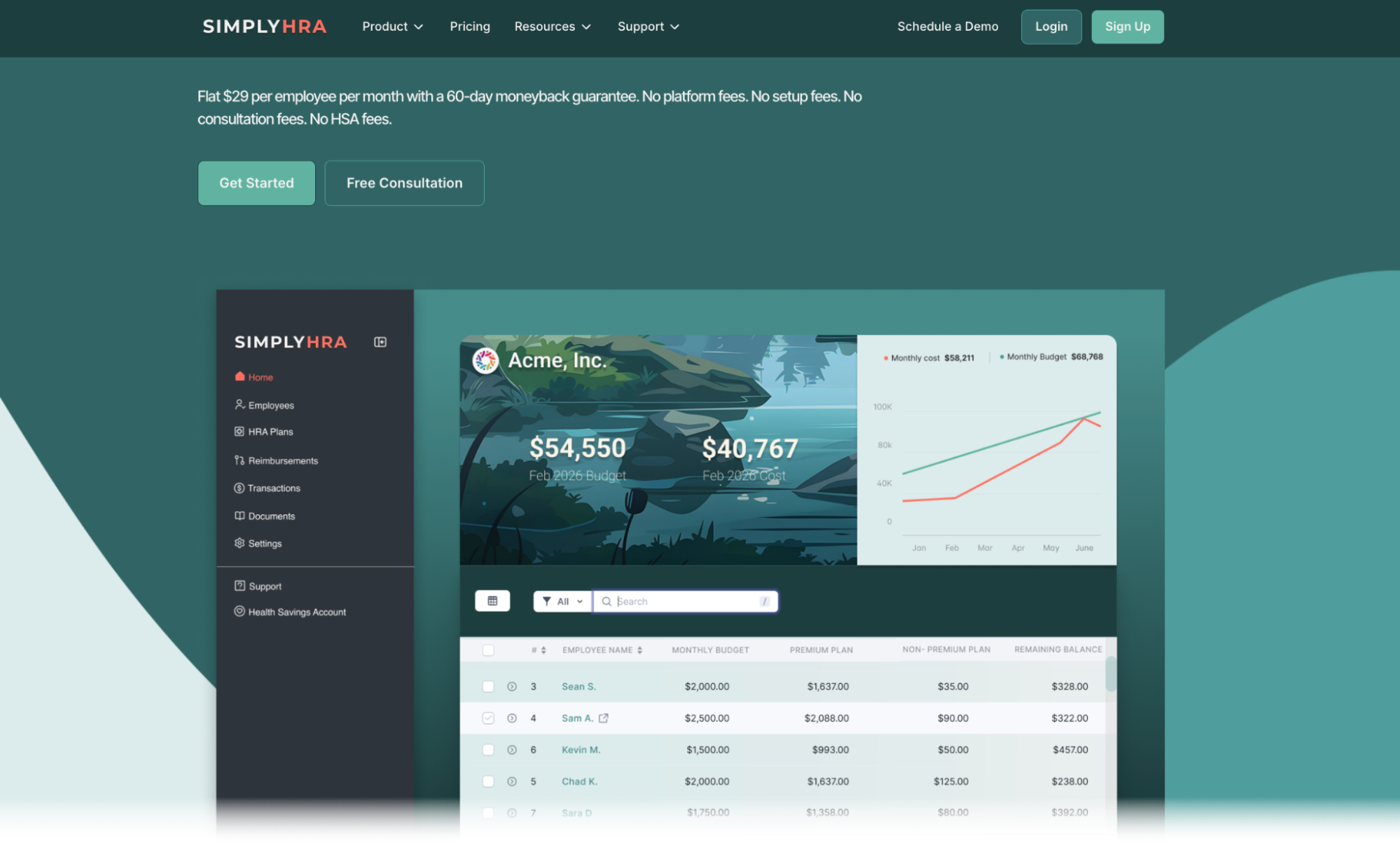
Book a personalized demo here to see how easy it is to implement ICHRA for your team.
Related blogs
Navigating ICHRA Compliance in 2026: Guide + Checklist
HMO vs PPO vs EPO for Employers