HMO vs PPO vs EPO for Employers
HMO vs PPO vs EPO: What Employers Need to Know
TL;DR
Under ICHRA, employers don't pick the network anymore — but plan-type availability still shapes what employees get and how affordability math works out.
CHOICE (Custom Health Option and Individual Care Expense) Arrangement is the current name for what was previously referred to as an ICHRA (Individual Coverage Health Reimbursement Arrangement). This page uses both terms.
Key Takeaways
- PPO is scarce on the individual market: Most available plans are HMO or EPO, a real shift for teams coming off a group PPO.
- Affordability math runs through plan type: ALE testing benchmarks against the lowest-cost Silver plan, usually an HMO.
- The employer's job shifts from picking to preparing: Set a realistic allowance, then give employees the support to choose well.
Under a group health plan, the network decision was simple: the employer chooses, employees use it. Nobody else on the team had to think about whether to choose an HMO, PPO, or EPO — because it wasn't their choice to make.
This dynamic changes with Individual Coverage Health Reimbursement Arrangement (ICHRA), which puts employees in charge of plan selection. In turn, an employer's role shifts from "picking a network" to something closer to "setting and managing a budget."
That shift catches a lot of businesses off guard, especially ones coming off a group PPO. The individual market doesn't like the group market, and knowing that gap exists before switching, not after, makes the difference between a smooth rollout and a wave of employee complaints.
How Does Plan-Type Availability Affect Your ICHRA Strategy?
PPO is the most common plan type in the group market, but it's genuinely scarce in the individual market. Nationwide, HMO and EPO plans make up the large majority of what's actually available to someone shopping on their own.
That's not a small difference. If your team is coming off a group PPO, they're used to seeing any doctor they want — in-network or out, with or without a referral.
Move to ICHRA in a state where PPO barely exists on-exchange, and suddenly that same team is choosing between HMO and EPO — both of which restrict out-of-network care.
Availability also isn't consistent across states, which matters if your team is spread out.
Some states still offer a reasonable PPO selection on the marketplace. Others, like Texas, offer none at all on HealthCare.gov, pushing anyone who wants one off-exchange and out of subsidy eligibility entirely.
The practical takeaway here is, before rolling out ICHRA, it's worth checking what's actually available in the ZIP codes your employees live in, not just assuming the individual market mirrors what your group plan looked like. A team concentrated in one state faces a very different reality than one spread across five.
How Does Plan Type Affect Your Affordability Calculations?
This is where plan type stops being just an employee-experience question and turns into a compliance concern.
If your organization qualifies as an Applicable Large Employer (ALE), ICHRA affordability gets tested against the lowest-cost, self-only Silver plan available in each employee's area. That benchmark plan, more often than not, is an HMO since this plan type dominates the individual market on price as well as availability.
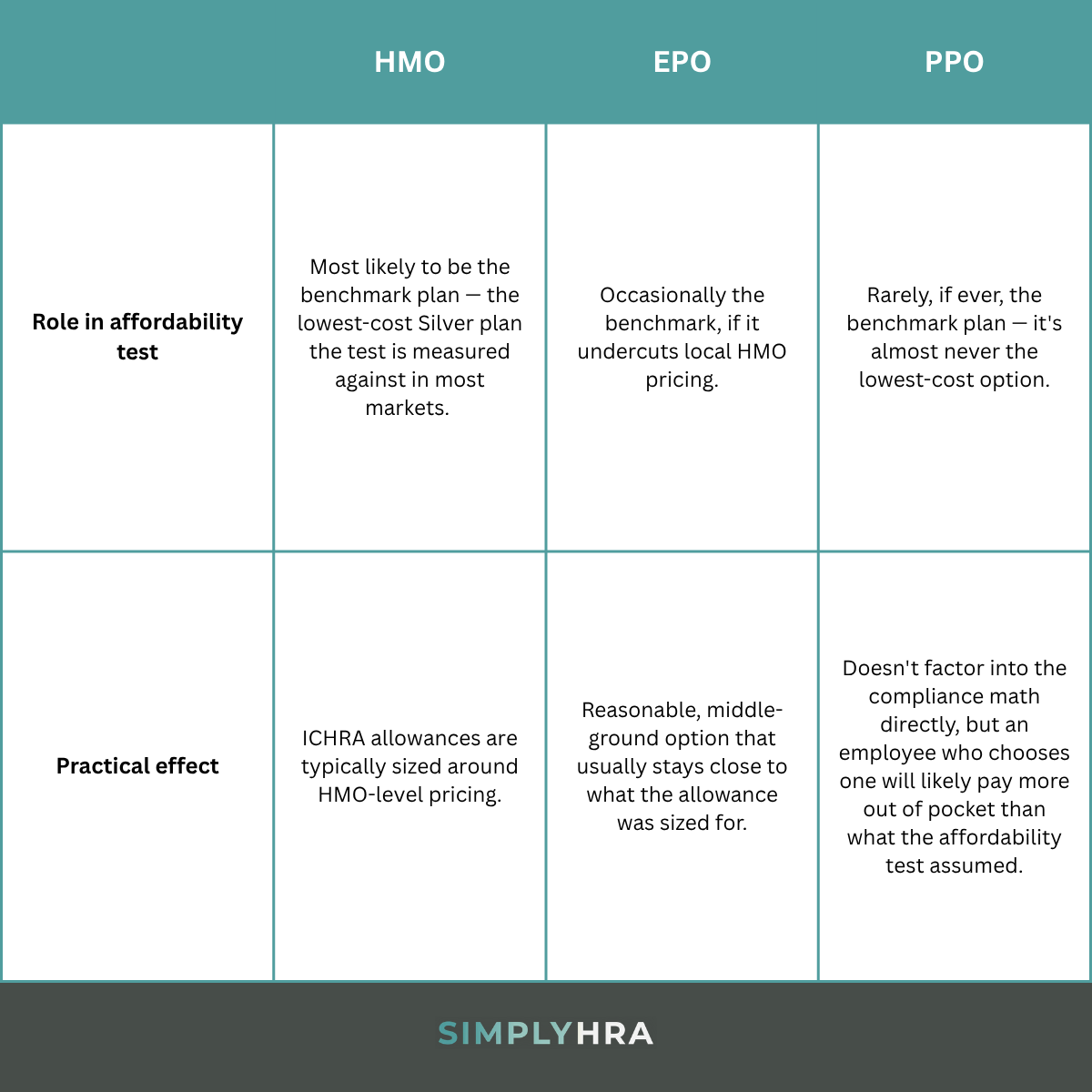
Remember, your allowance has to keep an employee's contribution to that specific benchmark plan under the ACA's affordability threshold (9.96% of household income for 2026). If HMO pricing in a given area runs unusually low, the bar for "affordable" gets lower too, which can work in your favor.
If HMO options are thin in that market and pricing runs higher, the math gets tighter.
The practical implication is that affordability isn't one number across your whole company. It changes based on the cost of benchmark plans, which varies by location.
We covered the full mechanics of this calculation, including the safe harbors, in our ALE-focused guide here.
What's Your Actual Role, If You're Not Choosing the Network?
Under a group plan, the employer's job was selection.
Under ICHRA, the job transforms to preparation.
That sounds like less control, and it is, in a sense. But the real employer lever isn't gone; it just moved.
Instead of picking a single network for everyone, the job becomes setting a realistic allowance based on what's actually available locally, then making sure employees have what they need to make a good choice.
That second part is where most of the friction shows up in practice. An employee who's never shopped for their own insurance doesn't automatically know the difference between a referral requirement and an out-of-network exclusion, let alone what that means for their specific situation.
Left alone with a login and an allowance, plenty of employees may get overwhelmed and simply settle for the first plan that fits their budget.
This is where modern benefits management platforms like SimplyHRA come in.
With the AI assistant available to answer questions 24/7, employees are never really left to handle decisions alone. If they require more tailored guidance, they can also book a consultation with SimplyHRA's team of licensed benefits specialists, especially if they prefer real conversations about what actually works in their area.
On the employer side, the dashboard shows what employees are actually choosing, so there's visibility into whether the allowance is landing the way it was intended, without anyone on your team needing to become an insurance broker.
In summary, ICHRA evolves an employer's role from plan selection to:
- Setting a realistic allowance based on what individual-market plans actually cost in your employees' locations, not a guess carried over from group-plan budgeting.
- Confirming affordability where it applies, which involves checking the allowance against the LCSP benchmark (if the company is subject to the ACA employer mandate).
- Flagging the PPO gap early by letting employees know if their state's marketplace has limited or no individual PPO options.
- Providing support, not selection, and access to tools (or specialists) to help employees navigate self-managed healthcare.
- Checking in on what's working through multiple reports and visual dashboards, revealing enrollment patterns, allowance utilization, and other useful datasets.
Final Words
Make no mistake, traditional group plans also made employee healthcare simple: one network, one decision, made once by someone in HR. Every employee then has to accept that choice, whether or not it's a good fit for them.
ICHRA trades that simplicity for something better, but it does ask more of the employer upfront. You need to know what's actually available in your team's market, understand how plan type feeds into your affordability calculations, make sure employees aren't left guessing, and more.
SimplyHRA will help carry that weight through a visual dashboard that simplifies monitoring and a host of employee support tools that align with the self-service design.
Book a free consultation here and see what ICHRA offers before you commit to anything.
Related blogs
Navigating ICHRA Compliance in 2026: Guide + Checklist
ICHRA Guide for Businesses Offering Insurance First Time