ICHRA for ALEs
Guide to ICHRA for Applicable Large Employers (ALEs) with 50+ FTEs
TL;DR
Hit 50 Full-Time Equivalent (FTE) employees and the rules change fast — the ACA's employer mandate kicks in, and offering health coverage isn't optional anymore. Individual Coverage Health Reimbursement Arrangement (ICHRA) can satisfy the mandate, but there's a catch: the allowance has to pass an affordability test and a 95% offer requirement.
CHOICE (Custom Health Option and Individual Care Expense) Arrangement is the current name for what was previously referred to as an ICHRA (Individual Coverage Health Reimbursement Arrangement). This page uses both terms.
Key takeaways
- Affordability meets minimum value standard: Clear the affordability threshold and an ICHRA plan automatically meets minimum value, too — giving you one less test to worry about in terms of compliance.
- 95% offer rule for ALEs: As an ALE, you must offer ICHRA coverage to at least 95% of your full-time employees.
- Location safe harbor: Multi-location employers can use a location-based safe harbor to simplify affordability calculations (using the employee's primary worksite instead of home address).
50 employees doesn't feel like a lot, until it is.
Once you cross that threshold, the Affordable Care Act (ACA) stops treating health coverage as optional. You're now officially an ALE, and the rules that applied to smaller teams no longer apply to you.
This transition catches a lot of growing startups and businesses off guard.
One year, health benefits are a nice perk. Suddenly, they're a compliance requirement with real dollar penalties if you get anything wrong.
This guide helps ensure you successfully navigate ICHRA compliance as a full-fledged ALE.
But first, a quick clarification.
What Actually Makes You an ALE?
50 full-time employees isn't the whole picture when it comes to determining who qualifies as an ALE.
Here's the part people often miss: Part-timers count, too — but not like your FTE employees.
The IRS converts their hours into full-time-equivalent value, then tacks that onto your actual full-time headcount. A team of 35 full-timers plus a handful of part-time staff can land you in ALE territory if their collective hours add up.
It's also not the actual headcount you take on just any workday. The IRS actually looks at your average across the previous calendar year, so a busy summer or a slow January won't swing your status by itself.
One more thing worth knowing if your organization sits inside a larger structure: Related entities under common ownership get counted together as a controlled group. The headcount that matters isn't just the one entity offering the ICHRA — it's everyone connected to it.
Does an ICHRA Satisfy the Employer Mandate?
Yes, but there are a couple of things to consider.
The employer mandate has two separate penalty triggers, and it's worth knowing which one you're avoiding.
The first hits if you don't offer coverage to at least 95% of your full-time employees. Fail to comply, and even one employee landing a subsidized marketplace plan can set off the steeper penalty.
The second applies even if you did offer coverage, but it wasn't affordable or didn't meet the minimum value for specific employees who ended up using premium tax credits (PTCs) anyway.
Here's where ICHRA simplifies things.
An affordable ICHRA is automatically treated as meeting minimum value, too. That means you're not running two separate evaluations — you're just doing one affordability check. Meet that requirement, and both penalty triggers are covered in one calculation.
That's a real departure from traditional group plans, where minimum value gets assessed on its own, separate from affordability, adding another hurdle to overcome.
Note: Click here for the full IRS guide on employer shared responsibility provisions, including official penalty amounts and affordability calculations.
How Do You Calculate Affordability Across a Larger, Multi-Location Workforce?
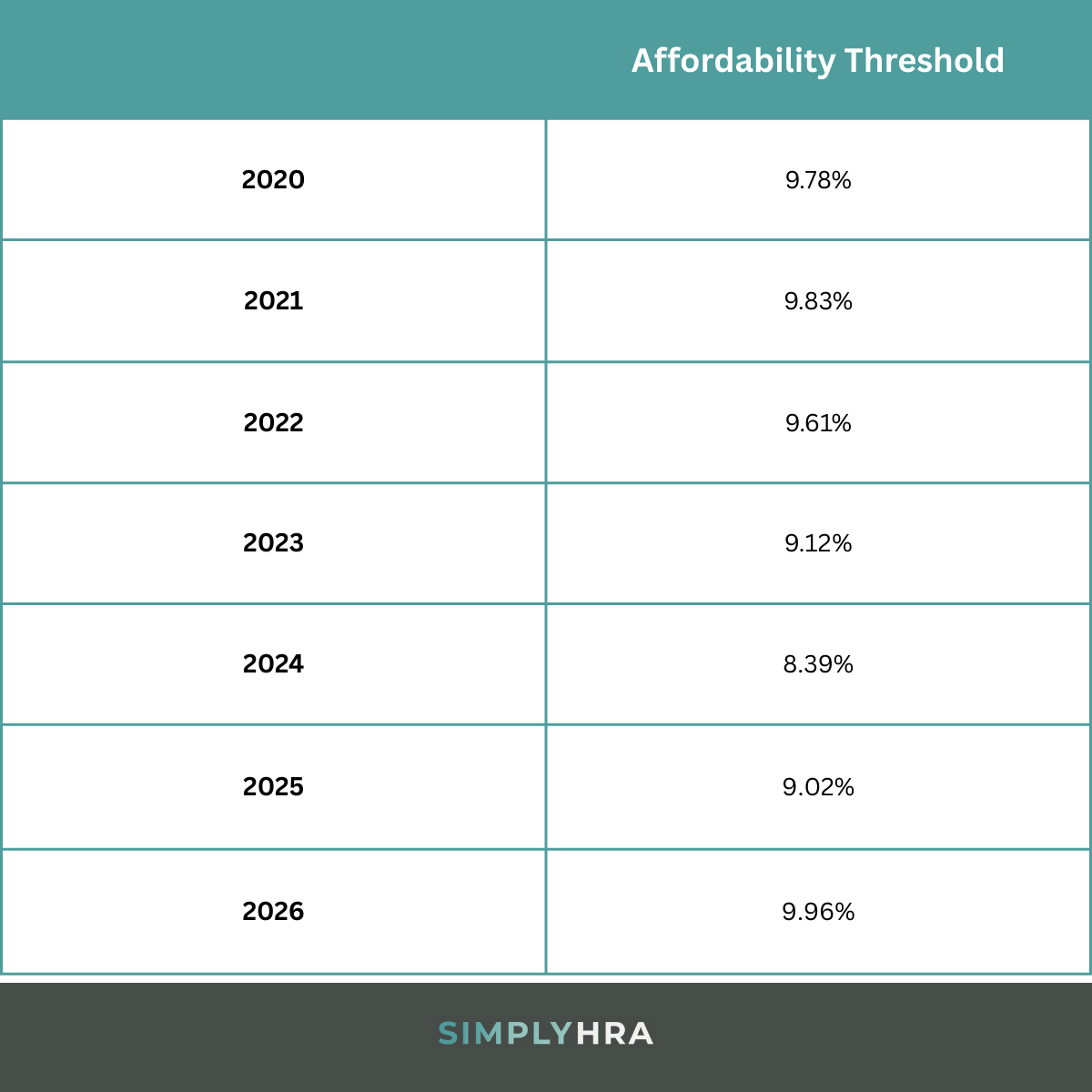
As per the affordability rule, employee contributions should not exceed the IRS-set threshold of 9.96%. This figure is adjusted on a yearly basis.
Here's a problem:
Affordability is technically based on household income, and you don't have access to that information for every employee.
Nobody's handing over their spouse's paycheck stubs during open enrollment.
That's why the IRS built in safe harbors for calculating affordability:
- W-2 Safe Harbor: Uses the employee's W-2 wages from that year instead of household income.
- Rate of Pay Safe Harbor: Uses the employee's hourly rate or monthly salary, which is useful if you want to lock in affordability before the year starts.
- Federal Poverty Line (FPL) Safe Harbor: Uses the FPL to calculate affordability, which is consistent across the 48 contiguous states (except in Alaska and Hawaii).
For employers spread across multiple locations, there's also the location safe harbor.
Instead of calculating affordability against each employee's home address, you can base it on the lowest-cost silver plan (LCSP) available where their primary worksite sits. This offers a convenient shortcut to ALEs with teams that span several rating areas.
What About Reporting?
Becoming an ALE doesn't just mean offering coverage — it also means proving you did, every year.
The core requirement doesn't change with ICHRA. As an ALE, you're still required to file Forms 1094-C and 1095-C annually, reporting on coverage offers to full-time employees.
What does change is the level of detail.
ICHRA offers use their own set of codes on the form, separate from the codes for group plan offers.
In addition, there's an added field for the ZIP code tied to each employee's rating area — that's what determines the LCSP used in the affordability calculation.
This is where the tracking burden tends to sneak up on growing employers. Multiply that level of detail across a workforce split by employee classes and worksite locations, and a spreadsheet stops being a workable system fast.
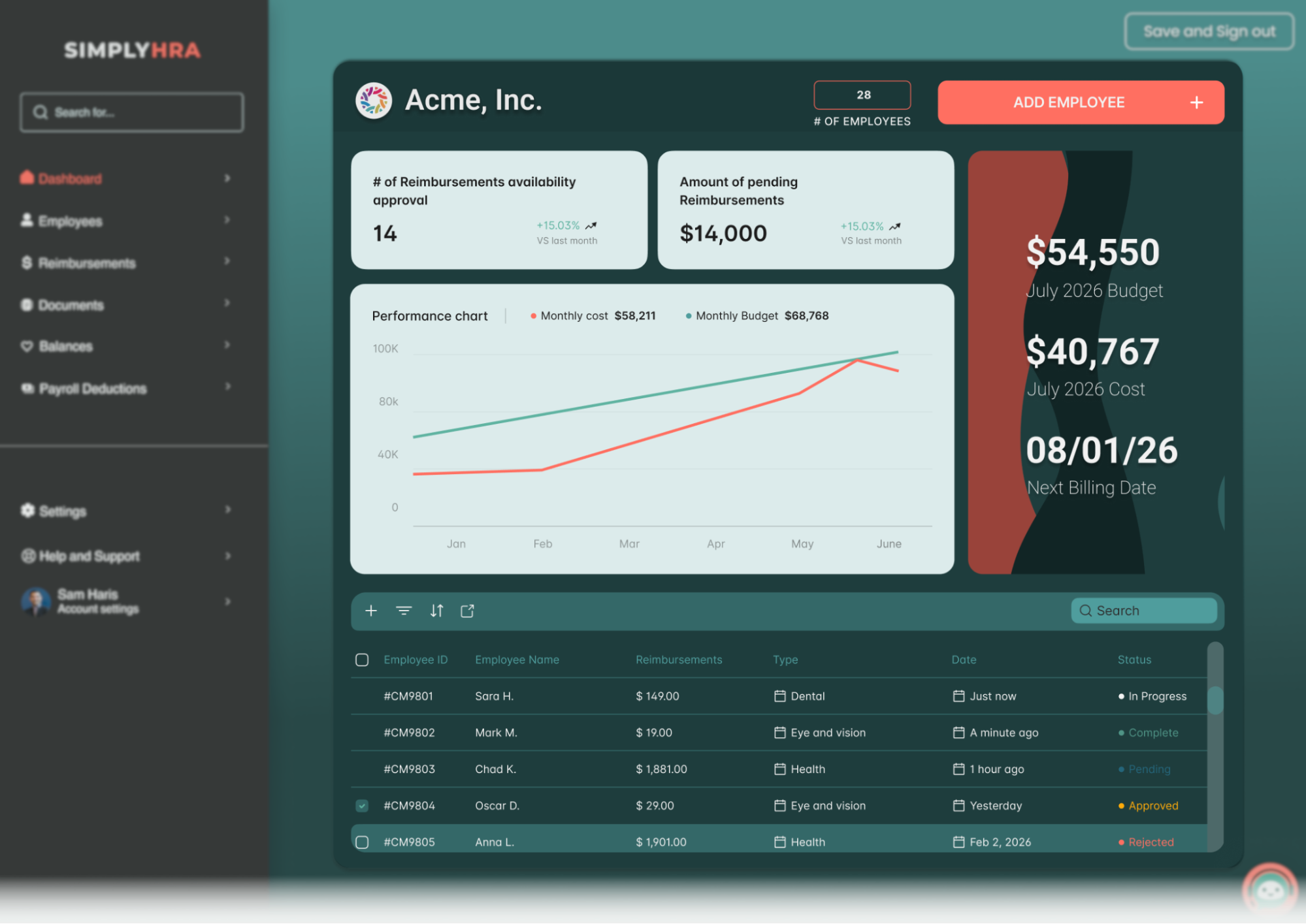
SimplyHRA simplifies compliance with audit-ready reports and visual data dashboards that track key metrics in real time.
Final Words
Crossing into ALE territory isn't something a lot of growing companies plan for — it just happens.
ICHRA gives you a real, convenient path through it:
- One affordability calculation to cover both penalty triggers
- Flexible reimbursement allowances per employee class
- Safe harbors for calculating affordability
- Location safe harbor for remote teams
SimplyHRA is built exactly for this stage of growth.
Using our intuitive, self-service visual interface and built-in AI assistant, it's easy to get your ICHRA plan up and running in a few days. Book a personalized demo here to see what an ALE-ready ICHRA setup looks like.
Related blogs
Navigating ICHRA Compliance in 2026: Guide + Checklist
HMO vs PPO vs EPO for Employers