How to Set Up Reimbursements Tied to Payroll Cycles (2026)
TLDR
Reimbursements tied to payroll cycles are approved employee reimbursements paid on a scheduled payroll run rather than through a separate ad hoc payment. Setting them up correctly requires a plan document, a dedicated non-taxable pay code, a claim-submission cutoff before each pay run, substantiated expense approvals, and post-payroll reconciliation. The term is most common in ICHRA administration, where employers reimburse individual health insurance premiums on a predictable schedule. Getting even one of these steps wrong can delay employee payments, create tax problems, or break your audit trail.
CHOICE (Custom Health Option and Individual Care Expense) Arrangement is the current name for what was previously referred to as an ICHRA (Individual Coverage Health Reimbursement Arrangement). This page uses both terms.
Schedule a SimplyHRA demo to see how payroll-triggered ICHRA reimbursements work without manual spreadsheets.
What “Reimbursements Tied to Payroll Cycles” Actually Means
A reimbursement tied to payroll cycles is an approved employee reimbursement that gets paid on the employer’s regular payroll schedule. The employee submits proof of an eligible expense, an administrator reviews and approves it, and the approved amount appears on the next payroll run as a line item, not as wages.
This matters because the reimbursement is not compensation. HRA reimbursements are employer-funded, and amounts up to the maximum for the coverage period are generally not included in income when the arrangement qualifies under IRS rules. If payroll treats a qualifying reimbursement like taxable wages, both the employer and employee pay unnecessary taxes.
The term shows up most in ICHRA (Individual Coverage HRA) administration. With an ICHRA, each employee picks their own individual health insurance plan, pays the premium, and gets reimbursed by the employer up to a set monthly allowance. That reimbursement needs to land somewhere, and payroll is the most common delivery mechanism.
Three related terms cause confusion. It helps to separate them upfront:
Payroll reimbursement means the employer pays the employee back through payroll. This is the approved claim amount flowing to the employee.
Payroll deduction means money comes out of the employee’s paycheck, often for the portion of a premium that exceeds the employer’s allowance. ICHRA providers sometimes need to manage both reimbursements and deductions when employee premiums exceed allowance limits, as Finch explains in its overview of ICHRA payroll integrations.
ACH or debit card reimbursement means the payment happens outside payroll entirely. According to Salusion, more than 90% of its clients choose automated ACH transactions instead of processing HRA reimbursements through payroll. Payroll is not the only payment rail.
Understanding these distinctions is the first step toward a clean setup. For a broader look at how different reimbursement types work, see this guide on employee reimbursement types.
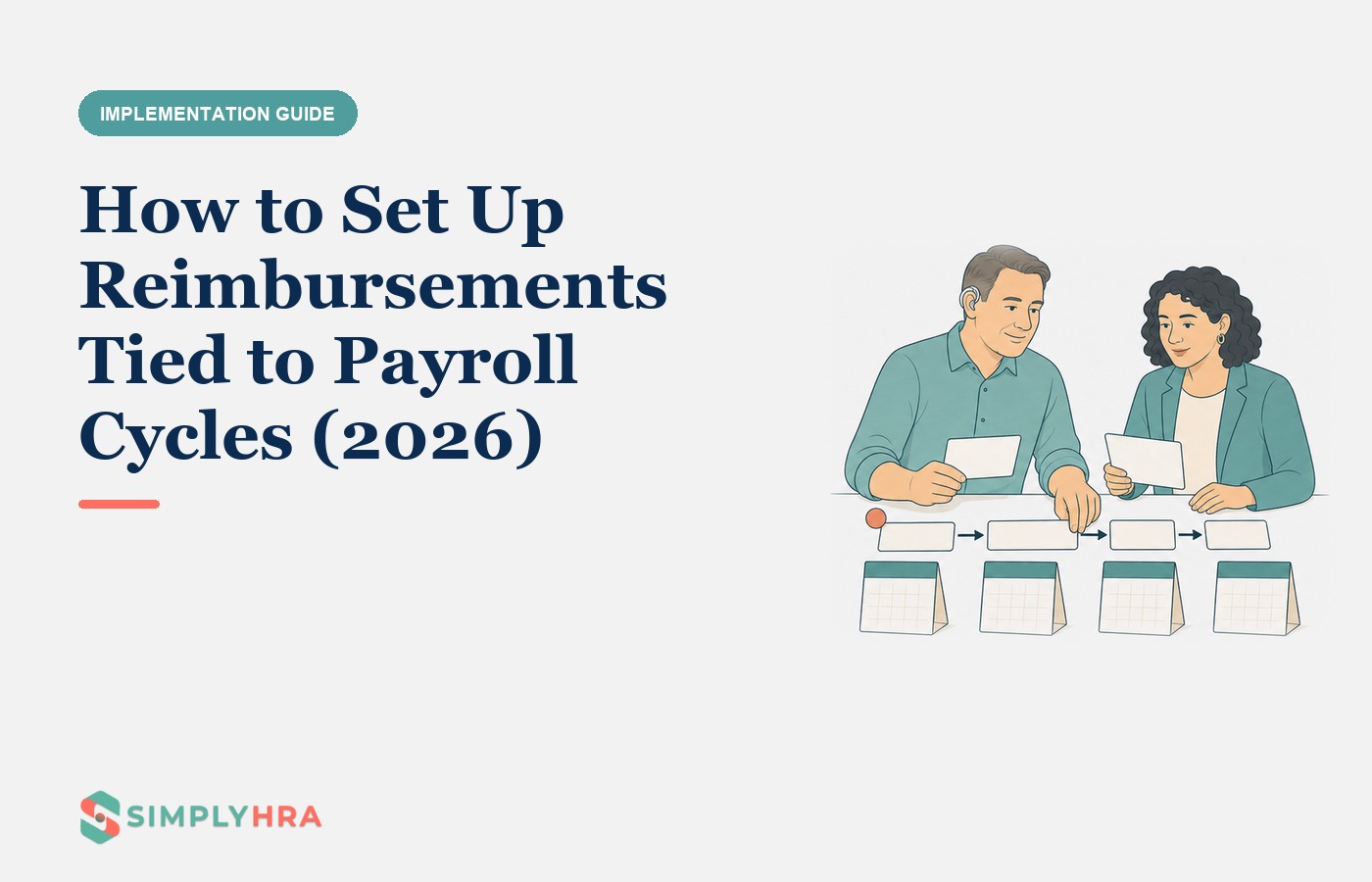
How the Workflow Works: From Claim Approval to Paycheck
Setting up reimbursements tied to payroll cycles is not just a payroll task. It is a chain of events that starts with the employee and ends with accounting. Here is the sequence:
Step 1: Employee pays a premium or incurs an eligible expense. For an ICHRA, this usually means paying a monthly health insurance premium on an individual plan purchased through the marketplace, directly from a carrier, or through a state exchange.
Step 2: Employee submits proof. The employee uploads a premium invoice, payment receipt, or attestation of coverage to the ICHRA administrator or platform.
Step 3: Administrator verifies eligibility and coverage. Under ICHRA rules, the HRA cannot reimburse expenses unless the participant has qualifying individual health insurance coverage for the month the expense was incurred. This substantiation step must happen before every reimbursement.
Step 4: Administrator calculates the approved amount. The reimbursement is capped at the employee’s monthly allowance, minus any amounts already reimbursed for that period.
Step 5: Approved amount appears on a reimbursement statement. This is the document that tells payroll exactly what to pay, to whom, and under which code.
Step 6: Payroll receives the amount before cutoff. If the amount arrives after the payroll cutoff, it moves to the next cycle.
Step 7: Payroll pays the reimbursement on the scheduled pay date. The amount shows up on the employee’s direct deposit or paycheck, labeled clearly.
Step 8: HR and finance reconcile. The reimbursement report, payroll register, and general ledger need to agree. For a detailed walkthrough of the approval-to-payment process, see this step-by-step reimbursement guide.
Payroll is not complete when employees are paid. For reimbursements, payroll is complete when the reimbursement report, payroll register, accounting entry, and employee balances all match.
How to Set Up Reimbursements in Your Payroll System
Here is the setup checklist, step by step.
Confirm your plan document first
Payroll setup should never come before plan setup. If the payroll team adds a recurring reimbursement before eligibility rules, coverage proof requirements, and plan terms are settled, the employer risks paying the wrong amount or paying someone who is not eligible.
The plan document should define who is eligible, what expenses qualify, monthly allowance limits per employee class, whether unused amounts carry over, claim submission deadlines, reimbursement frequency, and what happens after termination.
Create a dedicated reimbursement pay item
The payroll team should create a dedicated earning code such as “ICHRA Reimbursement” or “HRA Reimbursement.” QuickBooks Community threads show that payroll admins can create or rename a reimbursement pay type and enter recurring or variable amounts when running payroll.
Mark eligible reimbursements as non-taxable when plan and IRS rules are satisfied. Create separate handling for any taxable reimbursements. If you are unsure about tax treatment, confirm with your benefits administrator, payroll provider, or CPA before processing.
Map the pay item to your general ledger
The reimbursement pay item should post to the correct GL account so your accounting team can track ICHRA costs separate from wages and other benefits expenses.
Decide how amounts enter payroll
This is where most setups succeed or fail. There are three maturity levels:
Manual entry means downloading a reimbursement report and typing amounts into payroll. This works for very small teams but is error-prone. A small business owner on Reddit shared that they chose an ICHRA provider partly because of a Gusto partnership, then discovered they still had to manually set up tax-free reimbursements in Gusto and employees still had to upload cost evidence themselves.
CSV import means the ICHRA platform creates a payroll-ready file with employee IDs, amounts, and pay codes. Less typing, better audit trail, but still requires admin action.
Bidirectional integration means the platform reads employee data from payroll and writes approved reimbursements back automatically. Finch reports that HR admins spend an average of nine hours per week manually updating benefits-related data between systems, which integration eliminates.
The distinction matters. If you are evaluating ICHRA administrators, ask whether approved reimbursements sync directly into payroll or whether you are downloading a report and retyping amounts. Take Command’s employer guidance explicitly states that its reimbursement data does not automatically sync to payroll. “Payroll partner” and “payroll integration” are not always the same thing.
For best practices around payroll-triggered workflows, timing and automation level make the biggest difference.
Run a test payroll
Before rolling out to all employees, run a test payroll with one employee. Confirm the reimbursement appears as a separate line item, is coded as non-taxable (when qualifying), and shows a clear label on the pay stub. This guide on test payroll cycles with ICHRA reimbursements covers the details.
Communicate timing to employees
Employees need to know: what to submit, where to submit it, when to submit it, and when to expect payment. The reimbursement workflow may be technical, but the rollout problem is human. Practitioners on Reddit report that open enrollment can become stressful when employees do not understand the ICHRA model, plan shopping, or reimbursement rules.
Choosing the Right Reimbursement Cadence
How to set up reimbursements tied to payroll cycles depends partly on how often you run payroll. Monthly premiums do not always map cleanly to biweekly or weekly pay periods.
Monthly payroll is the simplest match. Put approved reimbursements on the monthly pay run after claim approval. The risk is a long wait if a claim misses the cutoff.
Semi-monthly payroll gives you a choice. You can pay reimbursements on one designated payroll per month or generate two reimbursement files. Splitting monthly premiums across two checks can confuse employees unless clearly documented.
Biweekly payroll creates a mismatch: 26 pay periods versus 12 monthly premiums. You need a defined formula. The cleanest option for most employers is to designate one biweekly payroll run per month for premium reimbursements.
Weekly payroll has the most touchpoints. Unless claim volume justifies weekly processing, designate one weekly run per month for premium reimbursements.
For small employers running premium-only ICHRAs, one designated reimbursement payroll per month is usually the cleanest setup. For larger employers with more variable expenses, a platform-generated reimbursement file before each pay run is safer.
See SimplyHRA pricing to understand how payroll-integrated ICHRA administration works at $29 per employee per month.
Payroll Cutoff Rules
A reimbursement tied to payroll cycles does not mean immediate payment. It means the approved claim is paid on the next eligible payroll cycle after review, cutoff, and processing.
The cutoff rule should answer four questions:
- What is the last day an employee can submit a claim for the next pay run?
- What is the last day the administrator must approve claims?
- What is the last day payroll can receive a reimbursement file?
- What happens if a claim is approved after cutoff?
The answer to question four is straightforward: the reimbursement moves to the following cycle. The full claim-to-payment process commonly takes two to six weeks depending on review speed, report cutoff, payroll cycle, and payment delivery.
“Approved” and “paid” are different statuses. Payroll-tied reimbursement adds a timing step between approval and cash received. Employees should know this before they submit their first claim.
ICHRA Compliance Requirements Before Reimbursement
Payroll should never be the first system to see a reimbursement amount. It should receive only approved, substantiated, capped amounts. Here is what must happen before any ICHRA reimbursement hits payroll.
Coverage verification
The employee must have qualifying individual health insurance coverage or Medicare for the month. The federal ICHRA regulation requires ongoing substantiation before each reimbursement, using either a third-party document or a participant attestation that includes coverage start date and provider name. For more detail on what plans qualify, see this ICHRA eligibility guide.
Required notice
The ICHRA regulation requires a written notice at least 90 calendar days before the beginning of each plan year. This notice must explain the arrangement, the opt-out right, and the interaction with premium tax credits.
Opt-out rights and premium tax credits
Employees must generally be allowed to opt out of the ICHRA once per plan year. This matters because accepting an affordable ICHRA can affect eligibility for premium tax credits on marketplace plans.
No double dipping
IRS Publication 502 makes clear that if medical expenses are reimbursed by an HRA, the employee cannot include those same expenses in their medical expense deductions. Premiums paid with pre-tax salary reductions also cannot be deducted because the dollars were never included in gross income. Payroll teams need expense classification before payment, especially when an expense has already received pre-tax treatment through a spouse’s employer plan.
Payroll Reimbursement vs. Payroll Deduction
Do not mix up money going to the employee and money coming out of the paycheck. Some ICHRA workflows require both.
Reimbursement means the employer pays the employee back for a covered premium or medical expense, up to the monthly allowance.
Deduction means the employee pays a portion of their premium, or a non-reimbursable amount, through a payroll deduction. This happens when the employee’s premium exceeds the employer’s ICHRA allowance.
For example, if the employer allows $400 per month but the employee’s premium is $430, the employer reimburses $400 and the employee covers the remaining $30. That $30 might be handled through a payroll deduction if the plan and payroll workflow support it.
When a reimbursement only covers part of an expense, partial reimbursement logic becomes important. The platform needs to calculate the approved amount correctly, and the remaining balance needs clear handling.
Comparing Payment Methods
Not every employer routes reimbursements through payroll. Here is how the options compare.
| Payment method | Best for | Pros | Cons |
|---|---|---|---|
| Payroll reimbursement | Employers that want reimbursements paid with regular direct deposit | Familiar pay process, centralized records, easier employee visibility | Can delay payment until next payroll; manual entry risk if not integrated |
| ACH reimbursement | Employers that want reimbursements outside payroll | Can be faster; avoids pay-run dependency | Requires separate ledger and bank workflow |
| Pre-funded debit card | Employers that want to reduce employee out-of-pocket burden | Employees avoid fronting the whole premium | Requires prefunding and strong transaction controls |
| Payroll deduction for excess premium | Employees choosing plans above the allowance | Keeps employee balance collection in payroll | Must be configured carefully for tax treatment |
| Manual check | Very small employers or one-off exceptions | Simple payment | Weak audit trail and reconciliation risk |
A practitioner on LinkedIn noted that in a pure reimbursement model, employees pay for coverage first and then get paid back, which can create cash-flow friction when premiums are large. Payroll-cycle reimbursement is predictable for the employer, but it may still leave employees fronting premiums unless the employer uses debit cards, premium payment support, or other cash-flow tools.
SimplyHRA supports payroll reimbursement, payroll deduction for non-reimbursable purchases, and optional pre-funded debit cards, covering three of these methods in one platform. Explore SimplyHRA for employers to see how these workflows connect.
ICHRA vs. QSEHRA: Payroll Reporting Differences
One critical detail when setting up reimbursements tied to payroll cycles: ICHRA and QSEHRA have different W-2 reporting rules.
QSEHRA amounts must be reported on Form W-2 Box 12 using Code FF. ICHRA benefits do not need W-2 Box 12 reporting under the same code. Confusing the two creates compliance problems.
For applicable large employers (ALEs), ICHRA offers are reported through Forms 1094-C and 1095-C, including specific ICHRA-related codes and the ZIP code used for determining the lowest-cost silver plan for affordability calculations. This is a separate workflow from payroll reimbursement setup, but the payroll team should know the distinction.
For more on ACA reporting forms, this 1094-C vs. 1095-C guide breaks down what each form covers.
What Can Go Wrong
Setting up reimbursements tied to payroll cycles has several failure points. Here are the most common.
Wrong pay code. If the reimbursement is coded as taxable wages instead of a non-taxable reimbursement, the employee gets taxed unnecessarily and the error requires correction.
Manual data entry errors. Typing the wrong amount for even one employee creates a cascade: wrong paycheck, wrong allowance balance, wrong GL posting.
Claim approved after cutoff. If the employee does not understand cutoff timing, they expect payment on the next payroll and get frustrated when it slips a cycle.
Recurring reimbursement continues after coverage loss. If an employee loses individual coverage but the recurring payroll item is not stopped, the employer pays an ineligible reimbursement. Finch’s analysis identifies stale eligibility data, lagging termination events, and premium leakage as downstream problems when back-end data flow remains manual.
Employee believes ICHRA is a cash stipend. A health stipend is often taxable compensation. An ICHRA is a formal HRA with plan rules and substantiation requirements. If it is just extra money in payroll with no plan document, eligibility rule, or substantiation, it is not an ICHRA reimbursement.
Vendor claims “integration” but delivers manual reports. One Finch LinkedIn post framed this as the “last-mile payroll problem.” The ICHRA front-end shopping experience has improved, but someone still has to ensure the right contribution lands in payroll, coded accurately and on time. Ask your administrator whether the system writes reimbursements into payroll automatically, or merely gives you a report to type into payroll.
Why Payroll-Cycle Reimbursements Matter Now
ICHRA adoption is growing fast. According to the HRA Council’s 2026 data, more than 20,000 U.S. businesses now offer an ICHRA or QSEHRA to at least 500,000 employees. Flyte HCM’s summary of that report shows employers offering ICHRA grew from more than 6,600 in 2025 to more than 12,700 in 2026, with a 178% increase among employers with 1,000+ employees.
That same data showed a median employer allowance of $459 per covered life versus a median premium of $567, with employees contributing a median of about $105 out of pocket. These numbers mean payroll needs to handle both a reimbursement and, often, a deduction in the same cycle.
As ICHRA scales from microbusinesses to larger employers, manual reimbursement reports become less sustainable. Payroll-cycle reimbursement is becoming a platform-selection issue, not just an HR process issue. A Reddit employer who moved from group coverage to ICHRA after a large renewal increase said employees liked choosing between major insurers, but the operational work of administering it mattered just as much as the plan design.
Questions to Ask Before Choosing an ICHRA Reimbursement Setup
If you are evaluating how to set up reimbursements tied to payroll cycles through a vendor, ask these questions before signing:
- Do approved reimbursements sync directly into payroll, or do we download a report and enter amounts manually?
- Which payroll systems are supported?
- Is the integration one-way or bidirectional?
- Can the system handle both reimbursements and deductions?
- Can it handle biweekly and semi-monthly payroll cadences?
- Can it split taxable and non-taxable reimbursement amounts?
- How does it handle late approvals after payroll cutoff?
- How are terminated employees removed from future reimbursement files?
- What substantiation evidence is stored?
- What reconciliation reports are available after payroll closes?
- Can employees see when an approved reimbursement will be paid?
- Does the system support cards or prefunding to reduce employee out-of-pocket burden?
For a broader vendor evaluation framework, this administrator selection checklist covers what to look for beyond just payroll integration.
Payroll-Cycle Reimbursement Setup Checklist
Use this checklist when setting up reimbursements tied to payroll cycles for ICHRA:
- Confirm the HRA/ICHRA plan document and eligible expense rules
- Define employee classes and monthly allowances
- Set the reimbursement cadence (monthly, semi-monthly, biweekly, or weekly)
- Set claim-submission and approval cutoffs
- Create a dedicated HRA/ICHRA reimbursement pay item
- Confirm tax treatment with your benefits admin, payroll provider, or CPA
- Decide whether amounts flow by integration, CSV import, or manual entry
- Map the pay item to the right GL account
- Run a test payroll with one employee
- Confirm the pay stub label is clear
- Reconcile the reimbursement report to the payroll register
- Communicate timing rules to employees before the first pay run
How SimplyHRA Handles Payroll-Cycle Reimbursements
SimplyHRA is built around payroll-centric ICHRA administration. It supports employer-to-employee reimbursement payments triggered by payroll, automatic expense classification, partial reimbursements, and automatic deduction of non-reimbursable purchases from payroll.
It integrates with Gusto, Rippling, Plane, ADP, and other HRIS and payroll systems. For employers who want to reduce employee cash-flow friction, SimplyHRA offers optional pre-funded debit cards so employees do not have to front premiums and wait for the next payroll cycle.
The platform includes audit-ready reporting, 24/7 AI-powered support, eligibility verification, and in-house broker assistance for employees choosing marketplace plans.
If your team is still downloading reimbursement reports and retyping amounts into payroll, schedule a demo to see how SimplyHRA streamlines the workflow.
FAQ
Is an ICHRA reimbursement taxable?
When the ICHRA meets IRS requirements and the expense is substantiated and eligible, the reimbursement is generally not included in the employee’s income. However, certain reimbursements can be taxable. The payroll code should reflect the administrator’s approved classification, not the employee’s description. Confirm tax treatment with your benefits admin or CPA.
Can I reimburse employees through payroll?
Yes. Payroll is one of the most common ways employers pay ICHRA reimbursements. The key is creating a dedicated non-taxable reimbursement pay item, only paying substantiated and approved amounts, and reconciling after each pay run.
What payroll code should I use for ICHRA reimbursements?
Create a dedicated pay item labeled something like “ICHRA Reimbursement” or “HRA Reimbursement.” Mark it as non-taxable for eligible, substantiated reimbursements. Most payroll systems (Gusto, ADP, QuickBooks, Rippling, Paychex) allow custom earning codes or reimbursement pay types.
What happens if a claim is approved after the payroll cutoff?
The reimbursement moves to the next scheduled payroll cycle. The full process from claim submission to payment commonly takes two to six weeks depending on review speed, cutoff timing, and payroll schedule. Employees should understand this before their first submission.
Do ICHRA reimbursements need to be reported on W-2s?
No. ICHRA benefits do not use W-2 Box 12 Code FF. That code is for QSEHRA. ICHRA reporting for applicable large employers happens through Forms 1094-C and 1095-C, which is a separate workflow from payroll reimbursement setup.
Is payroll reimbursement better than ACH or debit cards?
It depends on the employer’s priorities. Payroll reimbursement centralizes records and uses a familiar process. ACH can be faster and avoids pay-run dependency. Pre-funded debit cards reduce the employee’s out-of-pocket burden. Many employers use a combination.
How do I reconcile reimbursements after payroll?
After each pay run, compare the approved reimbursement report total to the payroll reimbursement item total. Check employee-level amounts, any deductions for premiums above the allowance, voids or corrections, GL postings, and year-to-date reimbursement totals. If the numbers do not match, investigate before the next cycle.
What documentation is required before an ICHRA reimbursement?
The ICHRA regulation requires proof that the employee has qualifying individual health insurance coverage for the month. This can be a third-party document (from an issuer or exchange) or a participant attestation with coverage start date and provider name. Substantiation must happen before each reimbursement, not just at enrollment.
Related blogs
Prefunding ICHRA Accounts Best Practices: 2026 Guide
Defined Contribution Allowance: ICHRA Rules for 2026