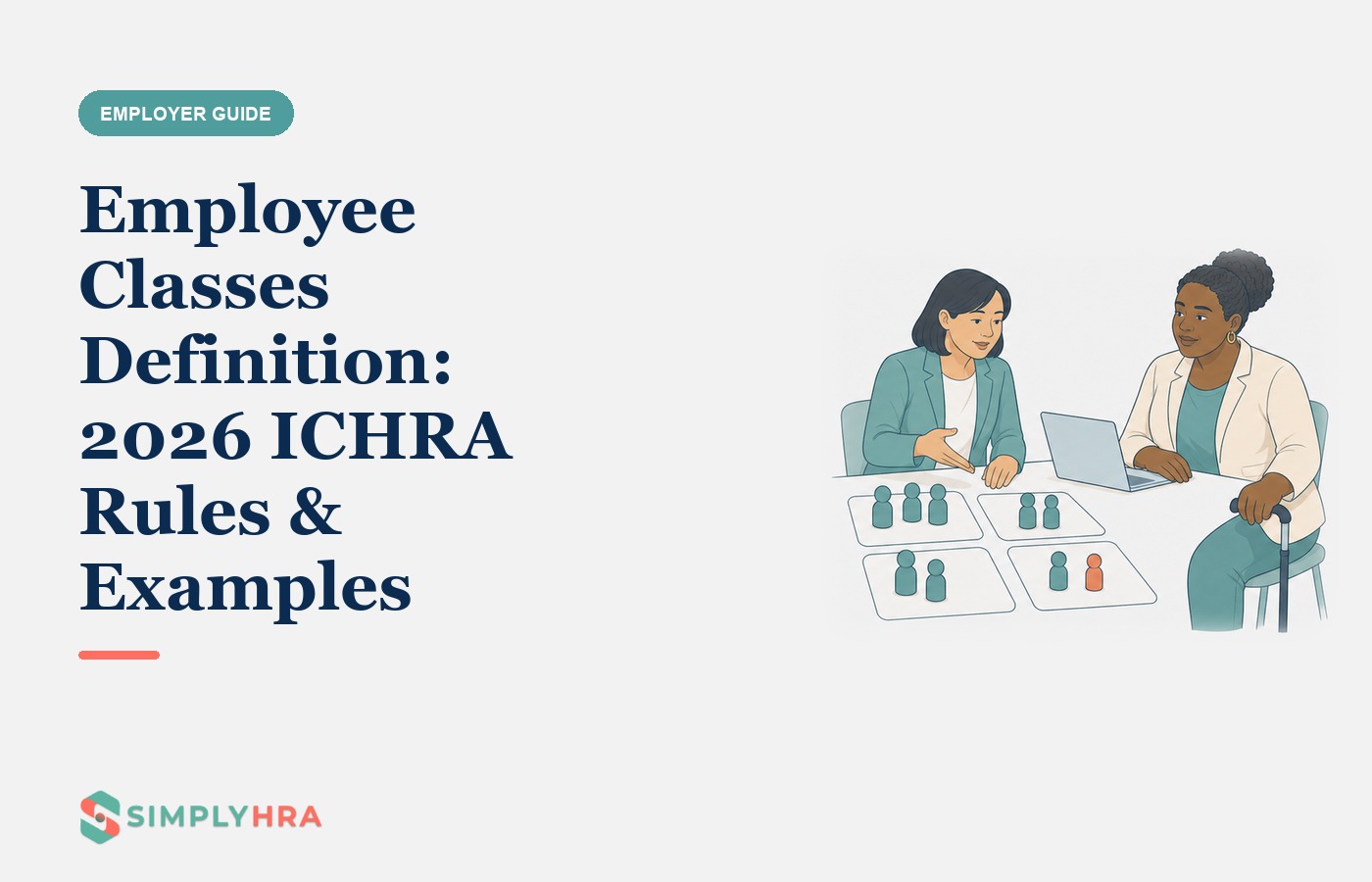
Employee Classes Definition: 2026 ICHRA Rules & Examples
TLDR
Employee classes are defined groups of workers that employers use to structure ICHRA benefit eligibility and reimbursement amounts. Federal rules specify 11 permitted classes based on job criteria like full-time or part-time status, salaried or hourly pay, work location, and seasonal status. Employers cannot invent their own categories. Getting employee class definitions right determines who qualifies for an ICHRA, how much each group receives, whether a traditional group plan can coexist alongside the ICHRA, and whether minimum class size rules kick in.
CHOICE (Custom Health Option and Individual Care Expense) Arrangement is the current name for what was previously referred to as an ICHRA (Individual Coverage Health Reimbursement Arrangement). This page uses both terms.
What Are Employee Classes?
Employee classes are groups of employees used to determine benefit eligibility and contribution levels. The term shows up across HR in different contexts (EEO categories, exempt vs. nonexempt status, payroll classifications), but when most people search for the employee classes definition today, they are looking for the ICHRA-specific meaning. That is because Google’s search results for this term are dominated by ICHRA content, and for good reason: employee classes are the structural backbone of how Individual Coverage HRAs work.
In an ICHRA, employee classes must be based on permitted job-related criteria. Employers can offer an ICHRA to all eligible employees or only to certain types/classes, but HealthCare.gov makes it clear that “the individual coverage HRA rules specify the classes, you can’t make up your own.”
An ICHRA is an employer-funded arrangement that reimburses employees tax-free for individual health insurance premiums and qualified medical expenses up to a set annual amount. Employees must carry their own individual health insurance (such as a Marketplace plan or Medicare) to use the funds. The employee class definition an employer selects determines the entire benefit design.
See how SimplyHRA handles employee class setup.
Why Employee Classes Matter
Employee classes are not a minor compliance checkbox. They answer four fundamental questions about an employer’s ICHRA:
Who is eligible? An employer might offer the ICHRA only to full-time employees, or extend it to both full-time and part-time workers with different allowances.
How much does each group receive? Salaried employees might get one reimbursement amount while hourly employees get another.
Can the employer keep a group plan for some workers? Yes, but not for the same class receiving the ICHRA. An employer can offer a traditional group health plan to one class and an ICHRA to a different class, but cannot let employees within the same class choose between the two.
Do minimum class size rules apply? Only sometimes, and only when a group plan and ICHRA coexist across different classes.
Practitioners on LinkedIn have noted that defining employee classes is one of the first strategic decisions an employer should make. Benefits consultant Lisa Collins argued that brokers approach ICHRA backward when they immediately ask for a quote. She recommended first assessing workforce profile, employee classes, and contribution strategy before pricing anything out. That sequence matters because the employee class definition drives every downstream decision.
The 11 Permitted ICHRA Employee Classes
The IRS final rules list 11 permissible employee classes. Before each plan year, the employer must determine which classes it will use and define them. Once set, class definitions cannot be changed until the next plan year.
| Employee class | What it means |
|---|---|
| Full-time employees | Employees treated as full-time under the employer’s chosen definition. For ACA purposes, full-time generally means at least 30 hours per week or 130 hours per month. |
| Part-time employees | Employees who do not meet the full-time definition. |
| Salaried employees | Employees paid on a salary basis. |
| Non-salaried employees | Employees not paid on a salary basis, typically hourly workers. The IRS uses “non-salaried” rather than “hourly.” |
| Employees in the same rating area | Employees whose primary worksite is in the same ACA insurance rating area. Useful for remote and multi-state teams. |
| Seasonal employees | Employees treated as seasonal under the employer’s chosen definition, applied consistently. |
| CBA-covered employees | Employees included in a unit covered by a collective bargaining agreement. Separate CBAs can be separate classes. |
| Waiting-period employees | Employees who have not yet satisfied a permitted waiting period for coverage. |
| Non-resident aliens with no U.S.-based income | A narrow class. Do not simplify this to “international employees” without the income qualification. |
| Certain temporary staffing employees | Employees hired by a staffing entity for temporary placement at an unrelated company. This does not cover every temporary worker. |
| Combination of two or more permitted classes | For example, full-time employees in California, or part-time hourly employees. Combinations can trigger minimum class size rules. |
For a deeper walkthrough of how to build these classes from your workforce data, see this guide on designing eligibility criteria for benefit classes.
What Employee Classes Are Not
One of the most common misunderstandings is that employers can create whatever groupings make sense internally. They cannot. The employee classes definition for ICHRA purposes is narrow and specific.
Employee classes are not the same as:
- Department names (“Engineering,” “Sales,” “Operations”)
- Job titles or management levels (“Managers,” “Directors,” “VPs”)
- Performance tiers or seniority bands
- Exempt vs. nonexempt status under wage-and-hour law
- EEO job categories
- Health-risk groups or claims-cost segments
If an employer’s HR system uses “managers” as a category, that label alone is not a permitted ICHRA class. If all managers happen to be salaried and all non-managers happen to be hourly, the employer could potentially use the salaried/non-salaried distinction. But the class must map to one of the 11 permitted categories, not to an informal internal label.
The IRS designed these rules to prevent employers from segmenting employees by health risk or using classes as a way to push expensive claimants off the group plan. If the class is not tied to a permitted job-based category, it is not a valid ICHRA employee class.
What Employers Can Vary by Class
Different allowances for different classes
Employers can offer different ICHRA reimbursement amounts to different employee classes. A restaurant group might offer full-time employees $500 per month and part-time employees $250 per month. That is straightforward as long as each group fits a permitted class.
For detailed guidance on structuring those amounts, read about varying benefits by employee class.
Same terms within a class
Employees inside the same class generally must receive the ICHRA on the same terms. An employer cannot offer different allowances to two full-time employees in the same class because one has higher medical claims or longer tenure.
Age-based variation (with limits)
The rules allow employers to increase ICHRA allowances by age, which makes sense because older employees often face higher individual-market premiums. But there is a cap: the amount for the oldest participant cannot exceed three times the amount for the youngest participant in that class. The 3:1 ratio mirrors the ACA’s general age-rating concept.
Dependent-count variation
Allowances can also vary based on the number of dependents covered by the HRA. A full-time employee-only allowance might be $450 per month while a full-time employee-plus-family allowance is $900 per month, as long as the structure is applied consistently within the class.
What is not allowed within a class
Tenure-based differences do not fly. The IRS commentary states that providing larger or smaller ICHRA amounts to employees in a class based on years of service violates the same-terms requirement. Do not use employee classes as a backdoor to reward tenure, target specific individuals, or isolate expensive claims.
Minimum Class Size Rules
Minimum class size is the compliance topic that generates the most confusion. Most competing articles make it sound like every ICHRA class needs a minimum number of employees. That is not accurate. The rule is narrower than it appears.
When minimum class size applies
Minimum class size rules apply only when an employer offers a traditional group health plan to one or more classes and an ICHRA to one or more other classes. If the employer offers only an ICHRA (no group plan at all), minimum class size does not apply.
The thresholds
When the rule does apply, the required minimum depends on employer size:
| Employer size | Minimum ICHRA class size |
|---|---|
| Fewer than 100 employees | 10 employees |
| 100 to 200 employees | 10% of total employees (rounded down) |
| More than 200 employees | 20 employees |
Employer size is based on the number of employees the employer reasonably expects to employ on the first day of the plan year. The count looks at employees offered the ICHRA as of the first day of the plan year, not the number who actually enroll.
Which classes trigger it
The minimum class size rule applies to these “applicable classes” when offered an ICHRA alongside a group plan for another class: full-time, part-time, salaried, non-salaried, same-rating-area (unless the geographic area is a whole state), and combination classes that include one of those categories.
It generally does not apply to seasonal employees, CBA employees, waiting-period employees, non-resident aliens with no U.S.-based income, certain temporary staffing employees, or state-level geographic classes.
Quick decision framework
- Are you offering a traditional group health plan to any class? If no, minimum class size does not apply.
- Are you offering an ICHRA to a different class? If no, it does not apply.
- Is the ICHRA class one of the applicable categories listed above? If no, it likely does not apply.
- Does an exception apply (state-level geography, qualifying new-hire subclass)? If yes, it may not apply.
- If none of those exceptions fit, use the 10 / 10% / 20 threshold.
Not sure whether your class design triggers minimum class size rules? Talk through your plan design before finalizing plan documents.
Using a Group Plan and ICHRA Together
Employers can maintain a traditional group health plan for one employee class and offer an ICHRA to another. This flexibility is one of the reasons ICHRA adoption is growing. HRA Council data shows that more than 20,000 U.S. businesses offered ICHRA or QSEHRA as a health benefit in 2026, covering at least 500,000 employees, with Applicable Large Employers representing the fastest-growing segment.
But the rules on mixing benefits are strict. An employer cannot offer both a group plan and an ICHRA to the same class, and cannot give employees within a class a choice between the two. The employer chooses the benefit type by class.
There is a special rule for new hires. An employer offering a group plan to a class can prospectively offer an ICHRA to new employees hired on or after a specific future date, while continuing the group plan for existing employees. The new-hire subclass must receive the ICHRA on the same terms.
One common mistake: assuming employees can pick whichever option they prefer. That is not how the employee classes definition works in practice. The employer assigns the benefit type to the class.
For a broader comparison of these two models, read about group insurance vs. individual insurance.
How Employee Classes Affect ACA Affordability
Employee classes do not exist in a vacuum. For Applicable Large Employers (those with 50 or more full-time employees and equivalents), the class structure directly affects ACA compliance strategy.
For 2026 plans, an ICHRA is considered affordable if the employee’s monthly cost for the lowest-cost Silver plan in their area, after applying the HRA reimbursement, is less than 9.96% of one-twelfth of the employee’s yearly household income.
Employee classes let employers target affordability where it matters most. An ALE might set a higher allowance for full-time employees (where employer mandate exposure exists) and a lower allowance for part-time employees (where no shared responsibility payment risk applies).
The premium tax credit interaction is another area where employee class definitions create real consequences. If an ICHRA offer is affordable, the employee and covered household members generally cannot receive the Marketplace premium tax credit, even if the employee does not use the HRA. If the ICHRA is unaffordable, the employee can decline it and claim the PTC if otherwise eligible, but cannot use both.
Practitioners on Reddit report that this PTC interaction creates genuine confusion. One r/tax user described spending hours untangling Form 1095-C, affordability calculations, and advance premium tax credits after discovering an ICHRA offer through employee self-service, believing they owed more than $1,000 in repayment. For more on how these rules interact, see this explanation of ICHRA and ACA tax credits.
For ALEs needing to understand affordability safe harbors, this ACA affordability and FPL safe harbor guide covers the details.
What Employee Classes Mean for Employees
Most content about employee classes is written for employers and brokers. But the employee experience matters just as much.
An employee’s class assignment determines three things: whether they receive an ICHRA, a group plan, or no employer health benefit at all; how much their allowance is (if they get an ICHRA); and what decisions they need to make about individual coverage.
That last point is where things get complicated. Employees receiving an ICHRA must enroll in qualifying individual health insurance (such as a Marketplace plan or Medicare) to use the funds. Short-term plans and limited-benefit coverage like standalone dental or vision do not count.
Practitioners on Reddit describe the employee side as “choice plus confusion.” One r/HealthInsurance user whose employer planned an October 2026 ICHRA transition said the company promised nearly 50 plan options, tax-free monthly allowances, and individual consultations, but the employee still asked whether the arrangement was actually better than regular insurance. Another user at a roughly 500-employee company reported on Reddit that premiums went down after moving to ICHRA, but the complexity of choosing plans became “far worse,” and the best available ACA plan felt weaker than the previous group plan.
The takeaway is that a compliant employee class structure alone is not enough. Employers also need to invest in employee education, network comparisons, prescription checks, and enrollment support. Classes make ICHRA flexible, but employee communication and administration determine whether it actually works.
For employers thinking about how to support part-time and seasonal staff through this process, coordination across classes requires extra planning.
Employee Class Documentation Checklist
The IRS requires class definitions to be determined before the plan year and locked in for that year. That makes upfront documentation essential. Here is what employers should have in order before building classes:
- Common-law employer identified (especially relevant for staffing arrangements and controlled groups)
- Full-time definition selected and documented in the plan document
- Hours or FTE status for every employee
- Salaried vs. non-salaried designation pulled from payroll records
- Primary worksite or state for each employee (critical for geographic classes)
- Seasonal status defined consistently
- CBA status and which bargaining agreement applies
- Waiting-period rules and eligibility dates
- Hire dates for possible new-hire subclass treatment
- Dependent and household data for allowance modeling
- Employee ZIP codes for affordability testing and rating-area mapping
Every one of these data points should map to a field in the employer’s payroll or HRIS system. If the data is messy, the class assignments will be messy, and that creates compliance risk.
SimplyHRA helps employers create ICHRA plans, define employee classes, set allowances, manage reimbursements, and maintain audit-ready reporting in one platform. Review SimplyHRA pricing to see how the platform fits your budget.
Allowed vs. Not Allowed: Employee Class Examples
This is where the employee classes definition becomes practical. Below are common scenarios employers face.
| Design idea | Status | Why |
|---|---|---|
| Full-time employees get ICHRA; part-time employees get nothing | Generally allowed | Both are permitted classes. Affordability and employer mandate rules still apply for full-time employees at ALEs. |
| Full-time employees get group plan; part-time employees get ICHRA | Allowed if class rules are met | Minimum class size may apply to the part-time ICHRA class. |
| Hourly workers get ICHRA; salaried workers get group plan | Allowed if class rules are met | Salaried and non-salaried are applicable classes subject to minimum class size when both benefit types coexist. |
| Remote employees in a whole state get ICHRA; HQ employees get group plan | Often easier than sub-state carveouts | State-level geographic classes avoid the rating-area minimum class size trigger. |
| Employees with high claims get moved to ICHRA | Not allowed | Classes must be based on permitted job criteria, not health status or claims history. |
| “Managers” receive more than “non-managers” | Not a valid ICHRA class by itself | Unless “managers” maps exactly to salaried and “non-managers” maps to non-salaried, this label is not a permitted class. |
| Older employees receive higher allowances | Allowed within limits | Oldest participants cannot receive more than 3x the youngest in the same class. |
| Employees with families receive higher allowances | Allowed if consistent | Allowances can vary by number of covered dependents within the class. |
| Longer-tenured employees receive more within the same class | Not allowed | Years-of-service differences within a class violate the same-terms requirement. |
One Reddit thread in r/HealthInsurance illustrated why “allowed vs. not allowed” matters in practice. A benefits administrator at a 66-employee company facing a 40% group insurance renewal after catastrophic claims asked about moving to ICHRA. The impulse was understandable, but the class design still needs to be based on permitted categories, not on which employees drove the claims spike.
A benefits industry veteran on LinkedIn, Carey Gruenbaum, framed the broader challenge well: ICHRA sits between traditional group benefits and the individual insurance market. The hard part is not memorizing the 11 classes. It is connecting group-benefits administration to individual-market enrollment while keeping employees confident in the transition.
The Market Context
Employer-sponsored coverage keeps getting more expensive. KFF’s 2025 survey found that average annual premiums for employer-sponsored family coverage reached $26,993, with workers contributing $6,850 on average. The average deductible for single coverage was $1,886.
Against that backdrop, ICHRA adoption is accelerating. KFF found that among small firms not currently offering health benefits, 2% were “very likely” and 16% were “somewhat likely” to offer an ICHRA in the next two years. Employee classes are not a niche compliance footnote. They are one of the main mechanisms employers use to move from one-size-fits-all group plans to defined-contribution health benefits.
Not every practitioner thinks ICHRA is a universal solution. CRC Benefits wrote on LinkedIn that ICHRA can help groups with high turnover, variable hours, and multi-location workforces, but classes and affordability need close review. And a commenter on Centene’s LinkedIn post pointed out that ICHRAs do not directly reduce healthcare prices. ICHRA creates budget predictability and plan choice for employees. It does not automatically make healthcare cheaper or guarantee broader networks.
Explore ICHRA administration for employers to see how SimplyHRA supports class setup, reimbursements, and compliance.
FAQs
What is the employee classes definition for ICHRA?
Employee classes are defined groups of employees based on permitted job-related criteria, such as full-time or part-time status, salaried or hourly pay, work location, seasonal status, CBA coverage, waiting-period status, or a combination of permitted categories. In an ICHRA, these classes determine who is eligible for the benefit and how much each group can be reimbursed.
Can an employer create any employee class it wants?
No. For ICHRA purposes, HealthCare.gov states that the rules specify the available classes and employers cannot make up their own. The class must fit one of the 11 permitted categories defined in the IRS final rules.
Can different employee classes receive different ICHRA amounts?
Yes. Employers can set different reimbursement amounts for different permitted classes. Within a class, amounts can vary only by age (subject to a 3:1 cap) and by number of covered dependents. Otherwise, employees in the same class must be offered the ICHRA on the same terms.
Do minimum class size rules always apply?
No. Minimum class size rules apply only when an employer offers a traditional group health plan to at least one class and an ICHRA to another class, and the ICHRA class is one of the applicable categories. If the employer offers only an ICHRA with no group plan, minimum class size does not apply.
Can an employer offer a group plan to one class and an ICHRA to another?
Yes, but the employer cannot offer both to the same class or give employees within a class a choice between the two. Minimum class size rules may apply depending on the class types involved.
Can employee classes change during the plan year?
No. The IRS requires employers to determine classes and their definitions before the plan year. Once established, they cannot be changed until the next plan year.
Can an employee use an ICHRA and a Marketplace premium tax credit at the same time?
Not for the same months of coverage. If the ICHRA offer is affordable, the employee generally cannot receive the premium tax credit. If the ICHRA is unaffordable, the employee can decline it and claim the PTC if otherwise eligible.
How should an employer start defining employee classes?
Start with objective workforce data: hours worked, pay basis, primary work location, seasonal status, CBA status, and hire dates. Map those data points to the 11 permitted classes before setting allowance amounts. If the starting question is “who is expensive?” or “who should we move off the group plan?”, the design is backward and may create compliance risk.
Related blogs
Prefunding ICHRA Accounts Best Practices: 2026 Guide
Defined Contribution Allowance: ICHRA Rules for 2026