Tailor Plan Design for Different Employee Classes (2026)
TL;DR
Tailoring plan design for different employee classes means using legally approved workforce categories to offer varying health benefit eligibility or reimbursement allowances. Under ICHRA rules, employers can set different monthly allowances for groups like full-time, part-time, salaried, hourly, seasonal, or location-based employees, but everyone in the same class must generally receive the same terms. The structure is compliance-driven, not arbitrary, and getting the details wrong can trigger penalties, employee confusion, and tax-credit problems.
CHOICE (Custom Health Option and Individual Care Expense) Arrangement is the current name for what was previously referred to as an ICHRA (Individual Coverage Health Reimbursement Arrangement). This page uses both terms.
Employers with mixed workforces, think full-time headquarters staff alongside part-time retail workers or remote contractors across three states, quickly discover that a single group health plan doesn’t fit everyone equally. Some employees are overpaying for coverage they barely use. Others are priced out entirely.
This is the problem that tailoring plan design for different employee classes is meant to solve. And in practice, it almost always means one thing: structuring an Individual Coverage HRA (ICHRA) so that different groups of workers receive different reimbursement allowances based on objective, rule-based categories.
The concept sounds simple. The execution requires understanding federal regulations, same-terms requirements, minimum class-size thresholds, ACA affordability math, and the real-world impact on employees choosing their own coverage.
Schedule a SimplyHRA demo to see how employee classes and allowances work inside the platform.
What “Tailor Plan Design for Different Employee Classes” Actually Means
In plain language, tailoring plan design by employee class means the employer does not offer one identical benefit to every worker. Instead, the employer groups employees into approved categories and assigns each category its own eligibility rules or reimbursement amount.
In an ICHRA, this works differently than a traditional group plan. The employer does not pick one insurance carrier or one plan. Instead, the employer sets a monthly allowance per class, and employees use that allowance to buy their own qualifying individual health insurance or Medicare coverage. The employer reimburses employees for premiums (and sometimes other medical expenses) up to the class allowance.
Why is this gaining traction? Group health insurance premiums have become a serious budget problem. KFF’s 2025 survey found average annual premiums of $9,325 for single coverage and $26,993 for family coverage, with family premiums rising 6% from the prior year. Among smaller firms that don’t offer benefits, 41% say the cost is simply too high. ICHRA class design gives employers a way to offer health benefits with predictable costs while adjusting for workforce differences.
But the flexibility comes with firm guardrails. Employee classes are not something employers can invent freely. Federal ICHRA regulations specify which classes are permitted, require same terms within each class, and impose minimum class-size rules in certain situations.
The Approved ICHRA Employee Classes
Employers cannot create classes based on job title, performance rating, tenure, or personal characteristics. The regulations list specific categories, and employers must choose from this list or use approved combinations.
| Employee class | What it means | Common use |
|---|---|---|
| Full-time employees | Workers meeting the employer’s full-time threshold | Core staff with higher allowances |
| Part-time employees | Workers below the full-time threshold | Scaled benefits for part-time teams |
| Salaried employees | Workers paid on a salary basis | Separate office or management staff |
| Non-salaried (hourly) employees | Workers not paid on salary | Field, retail, hospitality, or shift workers |
| Seasonal employees | Workers hired for defined seasonal periods | Limited or separate benefit levels |
| Same rating area | Workers grouped by insurance rating area | Adjust for local premium differences |
| Collectively bargained employees | Workers covered by a union agreement | Align with CBA terms |
| Waiting-period employees | Workers who haven’t completed the waiting period | Handle new-hire eligibility timing |
| Nonresident aliens with no U.S.-based income | Specific foreign-worker category | Separate or exclude where applicable |
| Temporary staffing firm employees | Workers placed by a staffing agency | Staffing industry plan design |
| Combination classes | Two or more approved classes combined | Example: full-time hourly workers in Texas |
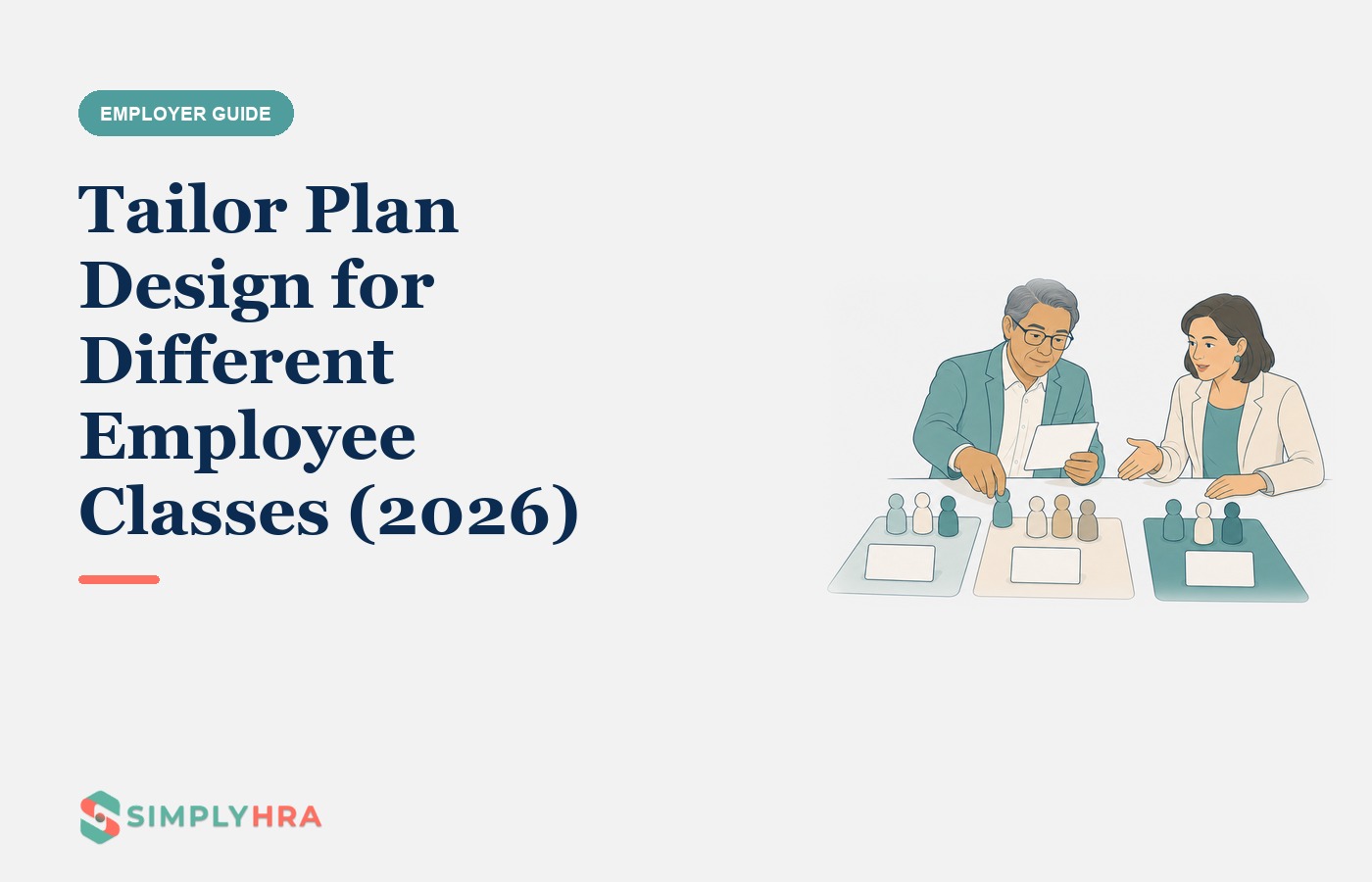
Employers must define their classes before the plan year begins, and those definitions generally cannot change mid-year. For a deeper look at how to set up these groupings, see this guide on designing eligibility criteria for benefit classes.
HealthCare.gov puts it directly: the rules specify the classes, and employers cannot make up their own.
The Same-Terms Rule: Different Classes, Not Different People
This is the rule that prevents class-based design from becoming selective favoritism.
If an employer offers an ICHRA to a class of employees, the HRA must generally be offered on the same terms to all participants within that class. Two full-time employees in the same class cannot receive $800 and $300 respectively just because one has higher claims, better negotiating skills, or a closer relationship with management.
Here’s what’s allowed and what’s not:
Compliant: All full-time employees receive $500 per month. All part-time employees receive $250 per month. The classes are different; the treatment within each class is uniform.
Not compliant under ICHRA rules: One full-time employee gets $800 because they threatened to quit, while another full-time employee gets $400. This is person-by-person variation, not class-based design.
Practitioners on LinkedIn have flagged this distinction as a frequent stumbling point. Benefits compliance professional Kylie Everhart warns that creating classes to target specific individuals or move high-cost claimants off a group plan is one of the most common mistakes employers make. Class design, she emphasizes, should be treated as a regulatory construct, not a creative carve-out.
What Can Vary Inside a Single Class
The same-terms rule has two important exceptions: age and family size.
Age-Based Variation
Employers may increase allowances as employees get older. This makes sense because individual-market premiums are priced by age. A 60-year-old typically pays far more for the same plan than a 25-year-old.
The limit: the allowance for the oldest participant cannot exceed three times the allowance for the youngest participant. This 3:1 cap mirrors the ACA’s age-rating ratio for individual and small-group market premiums.
Family-Size Variation
Employers may also increase the allowance based on the number of dependents covered by the HRA. An employee-only allowance of $400 per month might increase to $600 for employee-plus-spouse and $900 for family coverage, as long as the same increases apply to all similarly situated employees in the class.
Why These Variations Matter
Age and dependent adjustments are best understood as buying-power adjustments, not preferential treatment. A flat $400 allowance buys very different coverage for a 28-year-old single employee in Iowa versus a 55-year-old with three kids in New Jersey. Adjusting for age and family size helps the allowance track real premium costs.
For more on structuring these variations, see varying benefits by employee class.
Mixing Group Coverage and ICHRA Across Classes
Yes, employers can offer a traditional group health plan to one class and an ICHRA to another. A company might keep its group plan for full-time salaried employees while offering an ICHRA to part-time hourly workers.
The critical restriction: the same class cannot be offered a choice between the two. The decision is made by class, not by individual employee. This means a full-time salaried worker cannot say, “I’d rather take the ICHRA instead of the group plan.” The class assignment determines the benefit type.
This creates real design consequences. For a comparison of group vs. individual insurance, employers should evaluate plan networks, cost-sharing levels, and employee demographics before deciding which class gets which benefit type.
Talk through your class design with a SimplyHRA advisor to map your workforce structure to compliant ICHRA classes.
Minimum Class-Size Rules
This is where many employers get confused, and for good reason. Minimum class-size rules are conditional, not universal.
When They Apply
Minimum class-size requirements kick in only when the employer offers a traditional group health plan to at least one class and an ICHRA to at least one other class. They apply to certain class types: full-time, part-time, salaried, non-salaried, and rating-area classes (with exceptions for state-level geographic classes).
When They Don’t Apply
If the employer offers only ICHRA and no traditional group plan to any class, minimum class-size rules generally do not apply. An employer with 50 full-time and 7 part-time employees can give different ICHRA allowances to each class, even though the part-time class has only 7 people.
This is a point that trips up real employers. A small nonprofit on Reddit wanted to cover a single part-time employee through ICHRA while using a PEO for other benefits, but believed it needed at least 10 part-time employees. The confusion stemmed from not knowing whether minimum class-size rules applied to their specific setup.
The Thresholds
When minimums do apply, the required class size depends on employer size:
| Employer size | Minimum class size |
|---|---|
| Fewer than 100 employees | 10 employees |
| 100 to 200 employees | 10% of total employees (rounded down) |
| More than 200 employees | 20 employees |
One detail most guides skip: class size is measured by employees offered the HRA as of the first day of the plan year, not by the number who actually enroll. An employer with 15 part-time employees offered the ICHRA meets the threshold even if only 4 enroll.
A Quick Decision Tree
- Are you offering a group health plan to any class? No? Minimums generally don’t apply. Stop here.
- Yes? Are you also offering ICHRA to a different class?
- Yes? Is that ICHRA class full-time, part-time, salaried, non-salaried, or rating-area-based (below state level)?
- Yes? Check the minimum class-size table above.
ACA Affordability and Premium Tax Credits
For Applicable Large Employers (ALEs, generally those with 50 or more full-time equivalent employees), tailoring plan design for different employee classes does not remove ACA obligations. The ICHRA must be “affordable” under ACA rules, and the calculation works differently than it does for group plans.
For 2026 plan years, an ICHRA is considered affordable if the employee’s monthly cost for the lowest-cost silver plan (LCSP) in their area, after subtracting the ICHRA allowance, is less than 9.96% of household income. CMS publishes LCSP lookup tables to help employers run this calculation by ZIP code.
This matters for class design because allowances that are affordable in one location may be unaffordable in another. A $400 monthly allowance might clear the affordability bar in rural Arkansas but fail in Manhattan. See this guide on ACA affordability and safe harbors for the full breakdown. Employers who qualify as ALEs should also review Applicable Large Employer rules to understand their reporting and penalty exposure.
The Premium Tax Credit Trap
This is one of the highest-stakes employee communication issues in ICHRA class design, and most glossary articles bury it.
An affordable ICHRA offer generally makes the employee (and household members) ineligible for Marketplace premium tax credits, even if the employee doesn’t use the HRA. If the ICHRA is unaffordable, the employee can opt out and claim the premium tax credit, but they must actually decline the ICHRA reimbursements to do so.
A Reddit tax thread captured the fallout when this goes wrong: an employee discovered at tax time that their employer’s ICHRA offer had affected their premium tax credit eligibility, leading to an unexpected amount owed. The employee had not understood the connection between the ICHRA offer and their Marketplace coverage.
Employers who tailor plan design for different employee classes need to communicate this clearly, especially in classes where allowances vary by location or age and may cross the affordability line differently for each worker.
Real-World Examples of Tailored Class Design
Example 1: Full-Time and Part-Time Split
A 40-person restaurant group offers:
- Full-time employees: $500/month ICHRA allowance
- Part-time employees: $200/month ICHRA allowance
This works because full-time and part-time are approved classes, and all employees within each class receive the same terms. No group plan is offered, so minimum class-size rules don’t apply. For more on this structure, see coordinating benefits with part-time staff.
Example 2: Multi-State Remote Team
A 25-person software company has employees in three states:
- Colorado employees: $450/month
- California employees: $700/month
- Texas employees: $350/month
Geographic classes based on state boundaries are allowed and are not subject to the same minimum class-size rules that sub-state rating-area classes may trigger in mixed group-plan/ICHRA designs. The different amounts reflect real premium differences across states.
Example 3: Group Plan Plus ICHRA
A construction company with 80 employees:
- 60 salaried office employees: traditional group health plan
- 20 hourly field workers: ICHRA at $450/month
Salaried and non-salaried are approved classes. Because the employer offers both a group plan and an ICHRA, minimum class-size rules apply to the ICHRA class. With fewer than 100 total employees, the ICHRA class needs at least 10 employees. Twenty qualifies.
Example 4: New-Hire Subclass
An employer offering a group plan to existing full-time employees decides to move future hires to ICHRA. Federal rules allow a prospective new-hire subclass: employees hired on or after a specified future date can be offered ICHRA while employees hired before that date stay on the group plan. The key constraints are that the new-hire subclass must receive the same ICHRA terms internally, and employees cannot choose between the group plan and the ICHRA.
Common Mistakes When Tailoring Plan Design by Employee Class
Creating Unofficial Classes
Groupings like “executives,” “high performers,” “people who used the plan heavily last year,” or effectively “everyone except one person” are not approved ICHRA classes. The temptation is real, especially when an employer wants to reward key hires or manage costs for high-utilization employees, but these structures fail compliance review.
Treating Class Design as a Claims-Management Tool
Moving employees with expensive medical histories into a different benefit structure is exactly the kind of adverse selection the class rules are designed to prevent. CMS guidance and practitioner commentary both reinforce that class boundaries must follow objective criteria, not claims data.
Ignoring Employee Location
Individual-market premiums, plan networks, and available carriers vary dramatically by geography. An employer that sets one flat ICHRA allowance for a distributed team without checking local plan costs is likely underfunding employees in expensive markets and overfunding those in cheap ones.
Showing Subsidized Marketplace Prices in Communications
Practitioners on Reddit have flagged cases where employers presented Marketplace plan costs that assumed premium tax credit subsidies, even though employees with an affordable ICHRA offer generally cannot use those subsidies. This creates a misleading picture of what employees will actually pay.
Skipping the Communication Plan
In a Reddit thread, an employee at a roughly 500-person company said that while premiums went down after moving to ICHRA, choosing coverage became significantly more complex and the available ACA plans felt worse than the prior group plan. Another employee with a serious medical history described fear that Marketplace coverage would cost more or cover less than their previous employer plan.
More plan choice does not automatically equal a better employee experience. Employers should test their class design against real individual-market plan options in each location, not just against the employer budget.
Before Setting Allowances: A Planning Checklist
Good class design answers more than “Is this class legal?” It also answers “Does this allowance actually help employees buy usable coverage?”
Before finalizing a tailored plan design for different employee classes, work through these steps:
- Map where employees live and work. Premium costs, plan availability, and provider networks differ by location.
- Identify your workforce mix. Full-time, part-time, salaried, hourly, seasonal, union, waiting period.
- Research available individual plans. Check carriers, networks, formularies, and deductibles in each relevant market.
- Find the lowest-cost silver plan by location. This drives the ACA affordability calculation for ALEs.
- Model allowances by age and family size. A flat dollar amount creates unequal buying power across demographics.
- Run the affordability test. Especially critical for ALEs to avoid employer mandate penalties.
- Prepare employee communications. Explain class assignments, allowance amounts, premium tax credit effects, how to verify doctors and prescriptions, and what documentation is needed.
LinkedIn practitioner Lisa Collins argues that brokers and employers often approach ICHRA backwards by seeking quotes before assessing workforce demographics, individual market options, and contribution strategy. Michelle Lee Mead similarly recommends stress-testing contributions against real employee scenarios rather than treating the benchmark plan as a checkbox.
Keeping Records for Audit Readiness
Tailoring plan design for different employee classes creates a documentation obligation. If the IRS or DOL asks why Class A gets a different allowance than Class B, the employer needs a clear answer backed by records.
| Record | Why it matters |
|---|---|
| Class definitions and criteria | Shows the class uses approved, objective categories |
| Data source (payroll, HRIS) | Connects class membership to verifiable employment data |
| Allowance formula | Demonstrates same terms within each class and consistent age/dependent variation |
| Class-size calculation | Supports compliance if minimum class-size rules apply |
| Affordability calculation | Supports ALE mandate obligations |
| Notice delivery records | ICHRA rules require written notice, generally 90 days before the plan year |
| Coverage substantiation | ICHRA requires proof of qualifying coverage before reimbursement |
For detailed guidance on documentation requirements, see ICHRA audit and reporting standards.
How SimplyHRA Helps Employers Manage Class-Based ICHRA Design
SimplyHRA helps employers create ICHRA plans and employee classes in a few clicks, set allowances by role, schedule, or location, and manage the reimbursement and compliance workflow from a single platform. Employees get licensed broker assistance to navigate individual plan options, and the platform handles expense classification, partial reimbursements, payroll-triggered payments, coverage verification, and audit-ready reporting. Automatic integrations with payroll and HRIS systems like Gusto, Rippling, ADP, and Plane reduce duplicate data entry.
See SimplyHRA pricing or explore the employer platform to see how class-based ICHRA administration works in practice.
FAQ
Can employers give different ICHRA allowances to different employee classes?
Yes. Employers can set different reimbursement amounts for each approved employee class. Full-time employees might receive $500 per month while part-time employees receive $250. The restriction is that employees within the same class must generally receive the same allowance, with permitted variations for age and number of dependents.
Can employees in the same class receive different allowances?
Generally no, unless the difference is based on age (subject to the 3:1 cap) or the number of dependents covered. An employer cannot give one full-time employee more than another full-time employee based on seniority, job title within the class, claims history, or personal relationships.
Can an employer create a class for “managers” or “executives”?
Not as a standalone class under ICHRA rules. The approved classes are based on schedule (full-time, part-time), pay type (salaried, hourly), location (rating area), collective bargaining status, and a few other specific categories. If all managers happen to be salaried, the employer could use “salaried” as a class, but “manager” by itself is not an approved ICHRA class.
Do minimum class-size rules always apply?
No. Minimum class-size rules apply only when an employer offers a traditional group health plan to one or more classes and an ICHRA to at least one other class. If the employer offers only ICHRA (no group plan at all), the minimums generally do not apply. This is one of the most misunderstood aspects of ICHRA class design.
Can an employer offer group insurance to full-time employees and ICHRA to part-time employees?
Yes. Full-time and part-time are approved classes, and employers can assign different benefit types to each. The employer cannot offer the same class a choice between the group plan and the ICHRA. Minimum class-size rules will apply to the ICHRA class in this mixed-benefit design.
Does an ICHRA affect an employee’s eligibility for premium tax credits?
Yes. An affordable ICHRA offer generally makes employees and household members ineligible for Marketplace premium tax credits, even if they don’t use the ICHRA. If the ICHRA is unaffordable, the employee can opt out of the HRA and claim the credit. Employers should communicate this clearly because many employees don’t discover the impact until tax filing.
What kind of health coverage qualifies for ICHRA reimbursement?
Employees must be enrolled in individual major medical coverage or Medicare (Part A and B, or Part C) for each month they participate in the ICHRA. Short-term plans, dental-only, and vision-only coverage do not qualify. Coverage can be purchased on or off the Marketplace exchange.
This article provides general information about ICHRA employee classes and plan design rules. It is not legal, tax, or benefits advice. Employers should consult qualified benefits, legal, or tax advisors for plan-specific decisions. The 2026 ACA affordability percentage (9.96%) applies to plan years beginning in calendar year 2026 and is subject to annual adjustment.
Related blogs
Prefunding ICHRA Accounts Best Practices: 2026 Guide
Defined Contribution Allowance: ICHRA Rules for 2026