Preventive Care (what’s free under the ACA)
Title
Preventive Care (What’s Free Under the ACA): A Plain-English Guide for Employers and Employees
Meta description
Learn which preventive services the Affordable Care Act generally requires health plans to cover without copays, how no-cost coverage works, and when you may still receive a bill.
Preventive care under the ACA
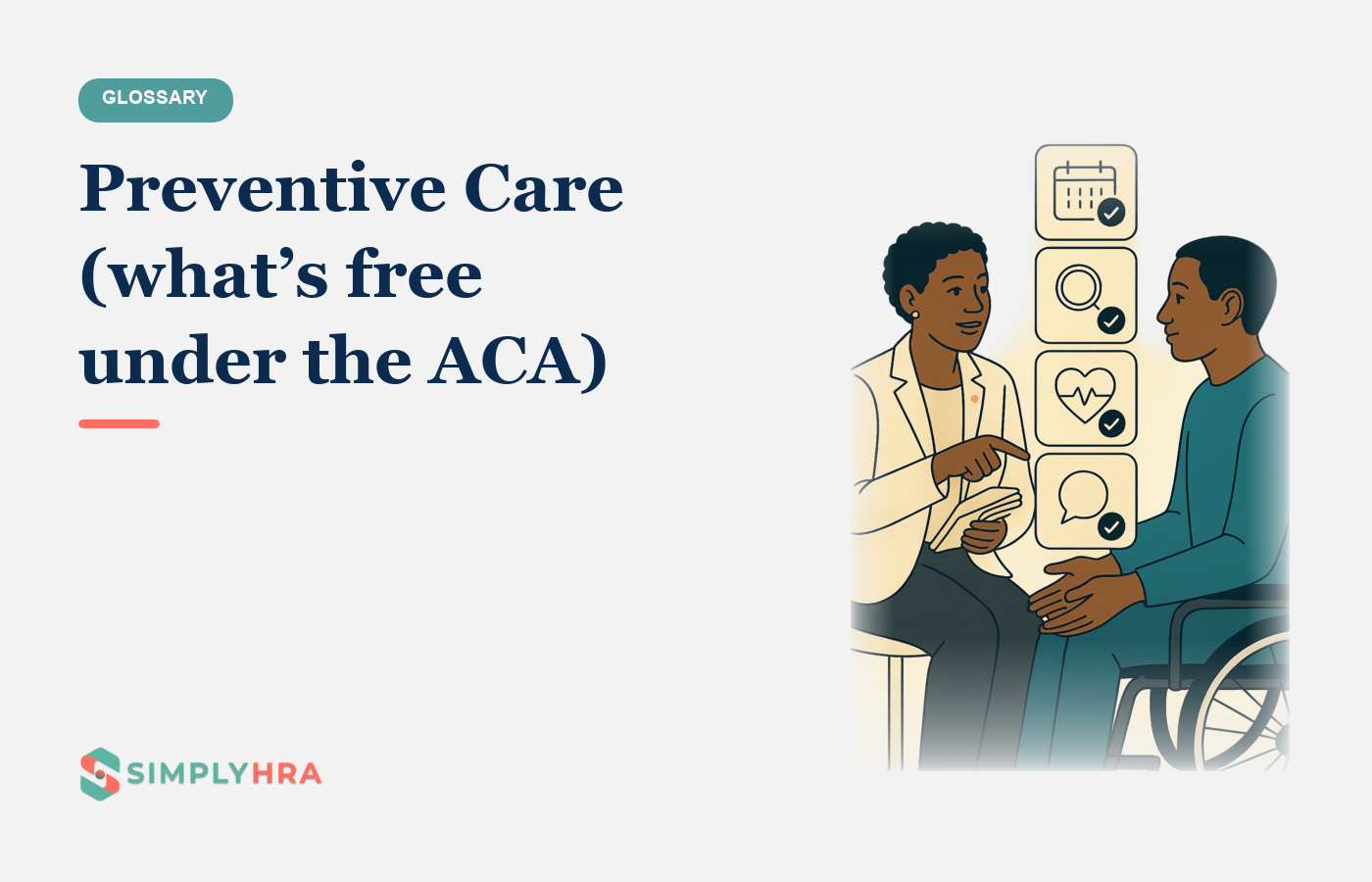
Preventive Care (what’s free under the ACA) means certain checkups, screenings, vaccines, and counseling must be covered without a copay, coinsurance, or deductible when you meet the rules. Put more simply: your qualifying health plan pays the covered preventive-service bill before you get sick, as long as the service and provider qualify.
The Affordable Care Act (ACA) created this protection so cost wouldn’t keep people from routine care that can prevent illness or catch it early. The governing requirement appears in Public Health Service Act section 2713 and its implementing regulation, 45 Code of Federal Regulations section 147.130.
“Free” can be a slightly misleading shorthand. You still pay premiums to keep your insurance, and not every service ordered during a preventive visit is automatically covered at no cost. The rule is about eligible services with no cost-sharing, not free health insurance or an unlimited annual physical.
What preventive care is free under the ACA?
Most non-grandfathered health plans must cover specified recommendations drawn from four sources:
- Services rated “A” or “B” by the United States Preventive Services Task Force, such as certain blood pressure, cancer, and depression screenings.
- Vaccines recommended by the Centers for Disease Control and Prevention’s Advisory Committee on Immunization Practices.
- Preventive care guidelines for women supported by the Health Resources and Services Administration.
- Preventive care guidelines for infants, children, and adolescents supported by the Health Resources and Services Administration.
The exact service can depend on age, sex, pregnancy status, medical history, tobacco use, or another risk factor. Healthcare.gov’s official preventive-care lists separate covered services for adults, women, and children, which is often the easiest starting point for an employee.
For employers, this isn’t a menu you design service by service. If you sponsor a plan subject to the ACA preventive-services requirement, the insurer or plan administrator builds the applicable coverage into the plan. Your job is to choose compliant coverage, distribute plan documents, and avoid promising that every test at a checkup will be free.
How does no-cost preventive care work in practice?
Three details usually determine whether an employee gets a $0 bill: the service must be on the applicable preventive list, the person must satisfy its eligibility criteria, and the care generally must come from an in-network provider.
Say Elena books an in-network screening mammogram at the recommended age and frequency. Her plan generally can’t apply a deductible, copay, or coinsurance to that qualifying screening. If imaging is performed because she found a lump, however, the service may be coded as diagnostic rather than preventive, and normal cost-sharing may apply.
The same issue can arise when a preventive appointment includes unrelated care. A covered vaccine may cost $0, while evaluation of a new knee problem during that visit may produce a separate charge. Federal guidance from the Departments of Labor, Health and Human Services, and the Treasury—Affordable Care Act Implementation FAQs—explains how cost-sharing may depend on billing, the visit’s primary purpose, and whether the preventive service is billed separately.
Before an appointment, employees should ask both the provider and insurer whether the provider is in network, whether the service is covered as preventive for them, and whether facility or laboratory charges are expected. Employers can point people to the Summary of Benefits and Coverage, but they shouldn’t interpret medical coding or guarantee payment.
Who does the ACA preventive-care rule apply to?
The requirement generally applies to non-grandfathered individual and small- or large-group health insurance, including qualified plans bought through the Health Insurance Marketplace. It also applies to many self-funded employer plans.
It doesn’t apply identically everywhere. Grandfathered plans may be exempt, out-of-network care may carry charges when an in-network option exists, and short-term or limited-benefit coverage may not provide ACA protections. Medicare and Medicaid have their own preventive-care rules, even where the covered services overlap.
If you’re uninsured, the ACA’s no-cost-sharing rule doesn’t make a clinic visit automatically free; you must first enroll in coverage that includes the protection. An employee using an Individual Coverage Health Reimbursement Arrangement (ICHRA) or Qualified Small Employer Health Reimbursement Arrangement (QSEHRA) may buy qualifying individual coverage, but should verify the specific plan’s network and benefits before receiving care.
What preventive care costs employers
There’s no separate government fee for offering preventive care under the Affordable Care Act (ACA). With a fully insured group plan, expected preventive claims are built into the premium; with a self-funded plan, the employer generally pays eligible claims plus administration costs. Employees’ use of covered preventive services can therefore affect plan spending, even though the employee sees a $0 bill.
A high-deductible health plan can cover qualifying preventive care before the deductible without keeping an employee from contributing to a Health Savings Account (HSA). Employers should still have their carrier or administrator confirm which services qualify under Internal Revenue Service Notice 2004-23 and later federal guidance; labeling an expense “preventive” doesn’t make it HSA-compatible.
Employer compliance duties, timing, and penalties
For a plan subject to the rule, the plan documents and claims administration must provide required preventive services without cost-sharing under the applicable conditions. Employers should review this at renewal, make sure the Summary of Benefits and Coverage describes preventive benefits accurately, and give employees the required plan materials on time.
The covered-service list changes. In general, a newly adopted recommendation must be incorporated for plan years beginning one year after the recommendation or guideline is issued, although special timing rules can apply. The Departments of Labor, Health and Human Services, and the Treasury explain that timing in Affordable Care Act Implementation Frequently Asked Questions, Part 47.
With fully insured coverage, the carrier does much of the operational work, but that doesn’t mean the employer should ignore errors. A self-funded employer has more direct responsibility and should coordinate with its third-party administrator, pharmacy benefit manager, and benefits counsel.
A noncompliant employer plan can face an Internal Revenue Code section 4980D excise tax of up to $100 per affected person for each day of noncompliance. Form 8928 is used to report certain failures. Correction rules, reasonable-cause relief, and limits can apply, so a suspected recurring copay shouldn’t sit until the next renewal.
What it means for an employee’s coverage and paycheck
A $0 preventive service generally doesn’t increase your paycheck or create taxable income. You continue paying your normal share of the premium through payroll, while the plan waives the deductible, copay, and coinsurance for an eligible service.
You can still choose whether to receive care and which provider to use, but network status and clinical eligibility matter. If a claim is denied or cost-sharing appears incorrectly, ask for the claim’s billing code and explanation of benefits, then use the plan’s internal appeal process. Department of Labor claims-procedure rules give participants in plans governed by the Employee Retirement Income Security Act (ERISA) rights to claim information and review.
If you currently have no insurance, you won’t receive ACA no-cost preventive coverage merely because your employer offers reimbursement. You first need active qualifying coverage. Options may include enrolling in your employer’s plan when eligible, using a special enrollment period after a qualifying event, buying Marketplace coverage during open enrollment, or applying for Medicaid at any time if eligible.
An offer of an Individual Coverage Health Reimbursement Arrangement (ICHRA) can create a special enrollment opportunity for individual insurance. Check the effective date carefully: expenses incurred before coverage starts remain your responsibility.
Worked example: preventive care with an ICHRA allowance
Cedar Lane Design has 12 employees and offers each eligible employee a $500 monthly ICHRA allowance. Maya chooses individual coverage with a $620 monthly premium, so the business reimburses $500 and Maya pays the remaining $120 each month, or $1,440 over 12 months.
Maya then receives a qualifying in-network cervical cancer screening. The plan processes the preventive service at $0 to her; it doesn’t use up the $500 allowance or add money to her paycheck. If the appointment also includes treatment for a separate condition, that portion can be subject to her deductible or copay.
Common preventive-care mistakes
- “My whole annual physical is free.” Only qualifying preventive services and related items covered under the billing rules receive $0 treatment; unrelated evaluation, diagnostic testing, or treatment can be charged.
- “Preventive means free at any doctor.” Plans can generally impose normal cost-sharing out of network when an appropriate in-network provider is available.
- “The employer reimburses every preventive bill.” Insurance should process the claim first. An HRA may reimburse eligible out-of-pocket expenses if the plan is designed to do so, but it shouldn’t pay an amount the insurer was required to cover at $0.
Frequently Asked Questions About Preventive Care (what’s free under the ACA)
Are preventive services still free if I get a premium tax credit?
Yes. A premium tax credit lowers what you pay in premiums for an eligible Marketplace plan; it doesn’t reduce the plan’s preventive-care protections. Bronze, Silver, Gold, and Platinum Marketplace plans must cover applicable preventive services without cost-sharing, and this also applies to Marketplace catastrophic plans. One distinction: you generally can’t use a premium tax credit to buy a catastrophic plan. Eligibility for premium assistance is based on factors such as household income, tax-filing status, and access to other qualifying coverage, not whether you use preventive care.
Is birth control free under the ACA?
Most non-grandfathered plans must cover contraceptive counseling and Food and Drug Administration-approved contraceptive methods for women who can become pregnant without cost-sharing. Plans may use reasonable medical-management rules, such as covering one product without cost-sharing within a contraceptive category. If your clinician says a different product is medically appropriate, the plan must offer an accessible exceptions process. Religious-employer exemptions and accommodations can affect coverage. These requirements come from the Health Resources and Services Administration Women’s Preventive Services Guidelines and federal contraceptive-coverage regulations.
Is a colonoscopy free after a positive stool test?
For adults within the applicable screening recommendation, a follow-up colonoscopy after a positive noninvasive colorectal-cancer screening test must generally be covered without cost-sharing because it completes the screening process. Federal Affordable Care Act Implementation Frequently Asked Questions, Part 51, addressed this point. Items integral to a covered screening colonoscopy, including polyp removal and anesthesia when medically appropriate, also generally can’t trigger cost-sharing. Different rules may apply when a colonoscopy is performed for symptoms, disease monitoring, or treatment rather than screening.
Does free preventive care include HIV prevention medication such as PrEP?
Yes, for people at increased risk of acquiring human immunodeficiency virus (HIV). Qualifying plans must cover recommended preexposure prophylaxis (PrEP) medication without cost-sharing, along with specified services needed to use it safely and effectively. Those supporting services can include HIV testing, hepatitis testing, kidney-function testing, pregnancy testing, sexually transmitted infection screening, adherence counseling, and risk-reduction counseling when clinically applicable. The Departments’ Affordable Care Act Implementation Frequently Asked Questions, Part 47, explains this coverage obligation and permitted medical-management practices.
Will my plan pay for a breast pump under preventive care?
Coverage for breastfeeding support includes lactation counseling and breastfeeding equipment for the duration of breastfeeding under the Health Resources and Services Administration guidelines. That doesn’t always mean you can buy any pump from any store. A plan may apply reasonable rules concerning rental versus purchase, manual versus electric pumps, approved suppliers, and when equipment can be obtained. If the available equipment doesn’t meet your medical needs, ask the plan about its medical-necessity exception process before purchasing one yourself.
Can a health plan limit how often I receive a free preventive service?
Sometimes. When the controlling recommendation states an age range, frequency, method, or risk group, the plan must follow those terms. When it doesn’t specify those details, a plan may use reasonable medical management based on established clinical guidance. That means an extra screening requested sooner than the recommended interval may be subject to cost-sharing unless your circumstances support it. Ask the insurer which recommendation and frequency rule it applied, particularly if your clinician recommends earlier or more frequent screening because of family history or another risk factor.
Can state law require more free preventive care than the ACA?
Yes. A state may require fully insured plans issued in that state to cover additional services, apply broader eligibility rules, or limit cost-sharing beyond the federal minimum. Those insurance mandates generally don’t control self-funded employer plans because the Employee Retirement Income Security Act (ERISA) usually preempts state insurance-benefit mandates for those plans. Your plan document should identify whether coverage is fully insured or self-funded. For a state-specific question, check your state insurance department’s official .gov site or contact the number on your insurance card.
When does free preventive care start after enrollment or a qualifying life event?
The protection starts when your health coverage becomes effective, not when you submit the application. If marriage, birth, adoption, loss of other coverage, or another qualifying life event gives you a special enrollment right, the effective-date rule depends on the event and whether you’re joining an employer plan or Marketplace plan. Birth and adoption coverage may be effective as of the event, while other enrollment changes commonly start later. Confirm the date before scheduling care; claims from an uninsured gap generally won’t become preventive-care claims retroactively. See Department of Labor HIPAA Special Enrollment guidance and 45 Code of Federal Regulations section 155.420.
Do owners, part-time employees, and new hires get the same preventive-care coverage?
If you’re enrolled in the same non-grandfathered plan, the preventive-care terms generally apply regardless of whether you’re an owner, part-timer, or new hire. The real question is whether the plan makes you eligible to enroll. Eligibility can differ by hours, employee class, ownership structure, and plan terms; a sole proprietor with no common-law employees may need individual rather than group coverage. For otherwise eligible employees, a group plan’s waiting period generally can’t exceed 90 days under Public Health Service Act section 2708 and 45 Code of Federal Regulations section 147.116.
Does preventive care stay free with COBRA, Medicare, or Medicaid?
Under Consolidated Omnibus Budget Reconciliation Act (COBRA) continuation coverage, you generally keep the same plan benefits, so its preventive-care rules continue while COBRA is active. You may pay the full premium plus up to a 2% administrative charge, even though qualifying preventive services remain available without cost-sharing. Medicare and Medicaid don’t simply adopt every ACA private-plan rule: each program has its own covered services, eligibility standards, provider rules, and cost-sharing provisions. Check Medicare.gov or your state Medicaid agency before care rather than assuming a service has identical coverage.
Use Preventive Care (what’s free under the ACA) with confidence
Remember three things: “free” means no deductible, copay, or coinsurance for an eligible preventive service—not that every part of a medical visit costs $0. The details still matter, including the service, your eligibility, the provider network, and how the claim is coded. Employers should confirm that their plan is administered correctly, while employees should check coverage before an appointment and question unexpected charges.
SimplyHRA fits small businesses, Human Resources (HR) managers, and employees who want health benefits without enterprise overhead. We built it after living small-business benefits problems ourselves, and we’ve helped other owners and their teams set up and run these benefits through an Individual Coverage Health Reimbursement Arrangement (ICHRA) or Qualified Small Employer Health Reimbursement Arrangement (QSEHRA). This article is educational and isn’t legal or tax advice.
Email info@simplyhra.com or schedule a call for a consultation about employer or employee benefits.
Related glossaries
Preventive Care (what’s free under the ACA)