Network Adequacy
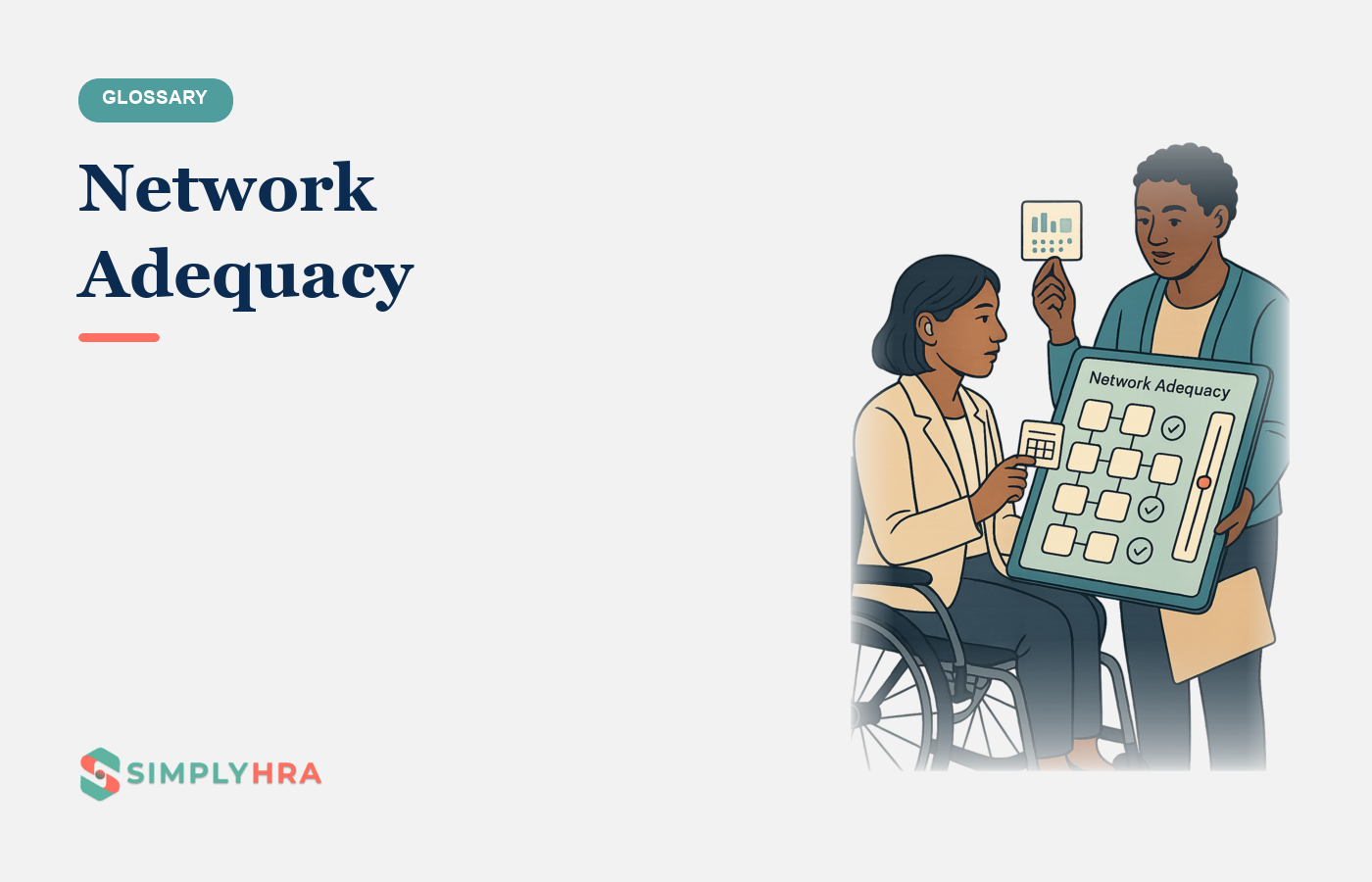
Network Adequacy: What It Means for Employers and Employees
Network Adequacy means a health plan has enough in-network doctors, specialists, hospitals, and other facilities within reasonable distances and wait times to provide the care its members need. Put more simply, a provider network shouldn’t just look large on paper; it should give you practical access to care when and where you need it.
That matters because health plans usually charge less when you use in-network providers. A thin network can leave an employee driving hours for a specialist, waiting months for an appointment, or paying much higher out-of-network bills.
Meta description
Learn what Network Adequacy means, how health plan networks are measured, and what employers and employees should check before choosing coverage.
What is Network Adequacy?
Network adequacy is a standard used by regulators to assess whether a plan’s provider network can reasonably serve its enrolled population. The exact tests depend on the plan type and the state, but they may examine:
- Travel time and distance to providers
- The number and types of available doctors and facilities
- Appointment waiting times
- Access to primary care, behavioral health care, specialists, pharmacies, and hospitals
- Whether providers are accepting new patients
- Access for people with disabilities or limited English proficiency
For Qualified Health Plans sold through a federal Health Insurance Marketplace, the federal framework appears in Centers for Medicare & Medicaid Services regulations at 45 Code of Federal Regulations Section 156.230. Federal Marketplace standards include network breadth and, for applicable plans, appointment wait-time requirements.
Adequacy doesn’t mean every doctor will participate, or that every listed provider is available to you. It also doesn’t mean out-of-network care will be covered. Those details still depend on the plan document, provider directory, and type of network.
How Network Adequacy works in practice
Insurers build networks by contracting with providers. They submit network information to the regulator overseeing the plan, which may be a state insurance department, the Centers for Medicare & Medicaid Services, or both. The regulator compares that information with the standards applying to that market.
A Health Maintenance Organization, or HMO, may generally require care within its network except for emergencies and other protected situations. A Preferred Provider Organization, or PPO, may cover out-of-network care but usually at a higher cost. Either network can satisfy the applicable rules, yet still feel very different to the person using it.
For an employer, the practical job is to look past premiums. Check whether the network includes the hospitals employees use, enough local primary care providers, common specialties, behavioral health professionals, and reasonable options near employees who work remotely.
For an employee, search the insurer’s current directory and then call the provider’s office. Confirm that the doctor accepts the exact plan—not merely the insurance company—and is taking new patients. If ongoing prescriptions, treatment, pregnancy care, or a planned procedure are involved, check the relevant pharmacy, clinicians, and facility separately.
Who do network adequacy rules apply to?
The rules can affect several kinds of coverage, but they aren’t identical across them.
- Individual and Marketplace plans: Federal or state standards may apply. This includes individual coverage purchased with an Individual Coverage Health Reimbursement Arrangement, or ICHRA, and coverage reimbursed through a Qualified Small Employer Health Reimbursement Arrangement, or QSEHRA.
- Fully insured employer plans: State insurance law generally regulates the insurer’s network, so requirements vary by location.
- Medicaid managed care plans: States must establish network adequacy standards under 42 Code of Federal Regulations Section 438.68, alongside federal availability-of-services requirements.
- Medicare Advantage plans: Federal time-and-distance and provider-network rules appear in 42 Code of Federal Regulations Section 422.116.
- Self-funded employer plans: State insurance network rules may not apply in the same way because the employer bears the claims risk. Federal benefit rules and the plan’s contractual terms still matter.
If you’re an employer with workers in several states, one network label doesn’t tell the whole story. If you’re an employee who has no insurance, network access should be one of the first things you compare when considering Marketplace coverage, Medicaid, Medicare, or a work-based option.
What does network adequacy cost an employer?
Network adequacy usually doesn’t create a separate fee on an employer’s invoice. Its cost shows up indirectly through premiums, plan administration, and how easily employees can obtain care. Broader networks may carry higher premiums, while narrow networks can cost less but create more disruption when employees need particular hospitals or specialists.
A fully insured small employer generally isn’t responsible for building or certifying the insurer’s network. Still, the employer should compare service areas, provider access, and directory quality when choosing and renewing coverage. Employers sponsoring plans governed by the Employee Retirement Income Security Act of 1974, or ERISA, also have fiduciary responsibilities when selecting and monitoring plan service providers; the U.S. Department of Labor discusses that responsibility in its publication Understanding Your Fiduciary Responsibilities Under a Group Health Plan.
Deadlines are more direct for insurers. Marketplace issuers go through annual certification and network reviews under 45 Code of Federal Regulations Section 156.230, while state filing calendars govern many fully insured plans. An employer’s practical deadline is earlier: review the network before renewal materials and employee enrollment decisions are due, not after contracts are signed.
Compliance duties and possible penalties
Your duties depend on how the benefit is funded. With a fully insured policy, the carrier normally bears the direct regulatory burden for network adequacy. With a self-funded plan, the employer sponsoring the plan should work with its third-party administrator to understand which federal access, disclosure, directory, and claims rules apply.
Under the No Surprises Act provider-directory provisions in 29 Code of Federal Regulations Section 2590.715-2715A2, plans and issuers must maintain processes for verifying directory information. When a person reasonably relies on incorrect directory information, the plan generally can’t impose more than in-network cost sharing for the affected service.
There isn’t one universal employer fine labeled a “network adequacy penalty.” Enforcement can instead fall under the Employee Retirement Income Security Act, the Internal Revenue Code, the Public Health Service Act, Marketplace rules, or state insurance law. Depending on the violation and responsible party, consequences can include corrective claims payments, federal or state civil penalties, loss of plan certification, or fiduciary claims. Don’t assume the carrier’s contract removes every plan-sponsor responsibility.
What network adequacy means for an employee’s money and choices
A network doesn’t usually change the amount deducted from your paycheck during the plan year, but it can sharply change what you spend when receiving care. An in-network visit may have a fixed copayment; the same visit outside the network may have a larger deductible, higher coinsurance, or no coverage except where federal or state protections apply.
If you currently have no insurance, compare available providers before enrolling. That may mean checking an employer plan, an individual Marketplace plan, Medicaid, or Medicare if you’re eligible. For Marketplace coverage, Healthcare.gov recommends confirming that your doctors, facilities, and prescriptions are covered by the specific plan—not merely by another plan carrying the same insurer’s name.
An Individual Coverage Health Reimbursement Arrangement, or ICHRA, gives you individual-plan choices rather than one employer-selected network. If the offer is considered affordable under federal rules, you generally can’t receive a premium tax credit for Marketplace coverage. If it’s unaffordable, you may decline it and potentially claim a tax credit if otherwise eligible, as provided in the federal ICHRA final rule, 84 Federal Register 28888.
Worked example
Cedar Lane Studio has 10 employees and offers each person a $500 monthly ICHRA allowance. If all employees claim the full amount, the maximum reimbursement cost is 10 × $500 = $5,000 per month.
Cedar Lane chooses SimplyHRA Premium at the stated price of $29 per employee monthly. Administration is 10 × $29 = $290 per month, making the maximum monthly outlay $5,290, or $63,480 annually.
Maya chooses a $620 monthly individual plan whose network includes her physician and nearby hospital. The employer reimburses $500, leaving Maya to pay $120. A cheaper $570 plan would leave her paying only $70, but if her physician is outside that network, the $50 premium savings may not be worth the added medical cost or disruption.
Common network adequacy mistakes
- Treating a large directory as proof of access. Listings can be outdated, duplicated, closed to new patients, or located too far away.
- Assuming “the insurer takes my doctor” is specific enough. A provider may accept one network from that insurer but not the exact plan you’re considering.
- Thinking adequate means every preferred provider must participate. The legal standard focuses on reasonable access across provider types and locations; it doesn’t guarantee access to a particular doctor or hospital.
Frequently Asked Questions About Network Adequacy
Does an out-of-network emergency room have to be covered?
In most emergencies, you can’t be charged higher cost sharing simply because the emergency facility or treating clinician is outside your plan’s network. The No Surprises Act generally requires emergency services to be handled without prior authorization and with in-network cost-sharing protections, although normal deductibles, copayments, and coinsurance can still apply. Ground ambulance bills are generally outside the federal surprise-billing protections, while air ambulance services are covered. The Centers for Medicare & Medicaid Services explains these protections.
What can I do if no in-network specialist is available?
Call the number on your insurance card and request a network-gap exception, sometimes called an out-of-network exception. Ask the plan to treat a qualified outside specialist as in-network because no appropriate participating provider is reasonably available. Provide the specialty you need, nearby providers you contacted, appointment dates offered, and any clinical urgency documented by your doctor. If the request is denied, ask for the denial in writing and follow the plan’s internal appeal instructions; urgent medical situations may qualify for expedited review.
What happens if my doctor leaves the network during treatment?
Federal continuity-of-care rules may temporarily protect certain “continuing care patients” when a provider’s contract ends or plan coverage changes. Examples can include people undergoing treatment for a serious condition, receiving inpatient care, scheduled for nonelective surgery, pregnant and receiving treatment, or terminally ill. If you qualify, you may be able to continue care under the same terms for up to 90 days or until treatment ends, whichever comes first. These protections come from the No Surprises Act continuity-of-care provisions.
Does a better provider network affect my premium tax credit?
Network size or quality doesn’t directly determine your premium tax credit. The credit is generally based on household income, family size, the cost of the benchmark Marketplace plan, and whether you have access to qualifying affordable coverage. Two plans with different networks can therefore produce different net premiums even when your credit amount is the same. You must enroll through the Marketplace to use the credit in advance; the Health Insurance Marketplace explains premium tax credit eligibility.
Do telehealth doctors count toward network adequacy?
Sometimes, but virtual access doesn’t automatically cure a shortage of local, in-person providers. Regulators may consider telehealth availability under rules that vary by market and state, while still requiring physical access for services that can’t be delivered remotely. Before relying on virtual care, check whether the clinician is licensed where you’ll receive care, whether the visit is in-network, and whether follow-up testing or treatment is locally available. Employers should also avoid treating a telehealth benefit as a substitute for examining the plan’s full provider network.
Where do I report an inadequate provider network?
Start with the plan or insurer and keep records of unavailable providers, incorrect listings, excessive travel distances, and appointment delays. For a fully insured plan, you can also contact your state department of insurance. For an employer self-funded plan, contact the U.S. Department of Labor’s Employee Benefits Security Administration through the Department of Labor benefits assistance page. Marketplace members can contact the Marketplace or the insurance regulator identified in their plan documents.
How do network adequacy rules vary by state?
Federal standards are a floor for some coverage, not one nationwide measuring stick for every plan. States may set their own travel-distance, appointment-wait, provider-to-member, essential-community-provider, and directory requirements for regulated insurers. A state may also impose stronger protections when no in-network provider is available. Your employer’s headquarters doesn’t necessarily decide which protections apply; the policy’s issuing state, plan funding, and where you receive care can matter. Check your insurance card or plan documents, then contact the applicable state insurance department for the rule governing your policy.
Can I change plans if I find out the network doesn’t work after enrollment?
Usually, dissatisfaction with a network by itself doesn’t let you switch plans midyear. You normally need the next open enrollment period or a qualifying life event, such as marriage, birth, adoption, or loss of other qualifying coverage. Marketplace special enrollment periods have event-specific deadlines, often 60 days before or after the event, under 45 Code of Federal Regulations Section 155.420. Losing access to one doctor generally isn’t the same as losing coverage. Before changing plans, confirm that the new plan’s effective date won’t leave a gap.
Do owners, part-time employees, and new hires get different provider networks?
Employment status doesn’t change the network attached to a particular insurance policy: two people enrolled in the same plan generally use the same network. What can differ is eligibility for that plan. The governing plan document may exclude part-time workers, impose a permitted waiting period on new hires, or treat owners differently based on the business’s legal and tax structure. Under Public Health Service Act Section 2708, an otherwise eligible employee’s group health plan waiting period generally can’t exceed 90 days. Eligibility doesn’t guarantee that a suitable local provider participates.
Does COBRA keep the same provider network?
Continuation coverage under the Consolidated Omnibus Budget Reconciliation Act, or COBRA, generally keeps you in the same employer plan available to similarly situated active participants, including its current network. If the employer changes carriers or networks for active employees, your COBRA coverage generally changes with theirs. You may have to pay the full premium plus up to a 2% administrative charge. A COBRA election opportunity and a Marketplace special enrollment opportunity can overlap, so compare networks and total costs before choosing; voluntarily dropping COBRA later may not create another special enrollment period.
What if I have Medicare or Medicaid and my doctor isn’t in network?
Medicare Advantage and Medicaid managed care each use their own network rules. If a Medicare Advantage plan makes a significant midyear provider-network change, affected members may receive notice, but the right to change plans depends on the circumstances and available enrollment period. Medicaid networks and remedies vary by state and managed care contract; contact the state Medicaid agency or plan when access is unavailable. Original Medicare works differently: it doesn’t use a closed managed-care network, though you still need a clinician who accepts Medicare. Medicare Advantage standards appear in 42 Code of Federal Regulations Section 422.116, while Medicaid access standards appear in Sections 438.68 and 438.206.
Review Network Adequacy Before You Choose
Remember three things: a provider list isn’t the same as real access, the exact plan network matters more than the insurer’s name, and network rules and remedies can vary by plan type and state. Employers should check access before offering or renewing coverage, while employees should confirm their doctors, hospitals, and medications before enrolling.
SimplyHRA fits small businesses and startups, HR managers, and employees who want individual plan choices instead of a single group network. We built it after living small-business benefits problems ourselves, and we’ve helped other owners and their teams set up and run these benefits without enterprise overhead. Employers can set a tax-free monthly allowance through an Individual Coverage Health Reimbursement Arrangement or Qualified Small Employer Health Reimbursement Arrangement, while employees compare personalized on-exchange and off-exchange plans and can get help from licensed brokers authorized in every state.
This article is for education only, not legal or tax advice. Email info@simplyhra.com or schedule a call for a consultation about employer or employee benefits.
Related glossaries
Network Adequacy
Provider Directory