SimplyHRA vs Venteur
SimplyHRA vs Venteur: What's Different in 2026
TL;DR
If you're looking at the ICHRA space right now, your options have shifted dramatically as Venteur officially migrated to Thatch as of April 1, 2026. While Venteur focused heavily on a personalized ICHRA model powered by health-portfolio AI, SimplyHRA's core design focuses on self-service tools augmented by an AI assistant and 1:1 support.
CHOICE (Custom Health Option and Individual Care Expense) Arrangement is the current name for what was previously referred to as an ICHRA (Individual Coverage Health Reimbursement Arrangement). This page uses both terms.
Key takeaways
- Similar pricing structure: Before moving to Thatch, Venture cost $20 per employee per month, similar to SimplyHRA's $29 per employee per month — one of the remaining platforms that prioritize pricing transparency.
- Administration differences: While Venteur offered a concierge-style, managed ICHRA administration service, SimplyHRA balances the self-service experience with responsive support tools (i.e., in-app AI assistant and 1:1 consultations).
- Reimbursement infrastructure: SimplyHRA offers pre-funded virtual cards to minimize reimbursement delays, whereas Venteur utilized a fintech-driven "Digital Health Wallet" architecture that combined physical/digital cards with internal accounts.
When you decide to ditch traditional group health insurance, you aren't just changing how your business handles benefits—you're changing your entire operational workflow.
Instead of dealing with unpredictable annual premium hikes, you're shifting to a defined contribution model where you give your team a tax-free health stipend and let them choose their own coverage.
But here’s the catch: the success of that shift depends entirely on the platform you choose to manage it.
Two names that frequently come up in this space are SimplyHRA and Venteur.
On paper, they both promise to eliminate administrative headaches and simplify compliance. In practice, however, they approach the "defined contribution" concept from completely different angles.
Market Update: As of April 2026, Venteur has closed its standalone platform operations and transitioned its customers, broker partners, and core technology assets to Thatch. To give you a clear look at the structural choices available in the HRA landscape today, this guide analyzes the distinct platform mechanics, pricing structures, and feature designs that defined the SimplyHRA vs Venteur matchup.
SimplyHRA vs Venteur: Quick Comparison
| Feature | SimplyHRA | Venteur |
|---|---|---|
| Platform Focus | ICHRA | ICHRA and personalized benefits |
| Setup | Guided and streamlined via self-service or agent assistance | Custom benchmarking & affordability modeling |
| Pricing | $29 per employee/month (No base fee) | $20 per employee/month |
| Analytics & Reporting | Exportable, audit-ready reports + interactive dashboards | Advanced compliance data + broker-facing analytics |
| Support | AI-powered assistant + phone + email + 1:1 consultations | AI decision engine + personal health concierge |
| Automation Tools | Automated workflows, optional manual review/approval + payroll/HRIS integrations | Digital Health Wallet + Direct carrier auto-enrollment |
| Perfect For | Startups and SMEs seeking speed and simple automation | Growing teams wanting algorithmic plan suggestions |
Comparing SimplyHRA vs Venteur
Here's a straight look at what each platform offers — what they're good at and where they fall short.
SimplyHRA
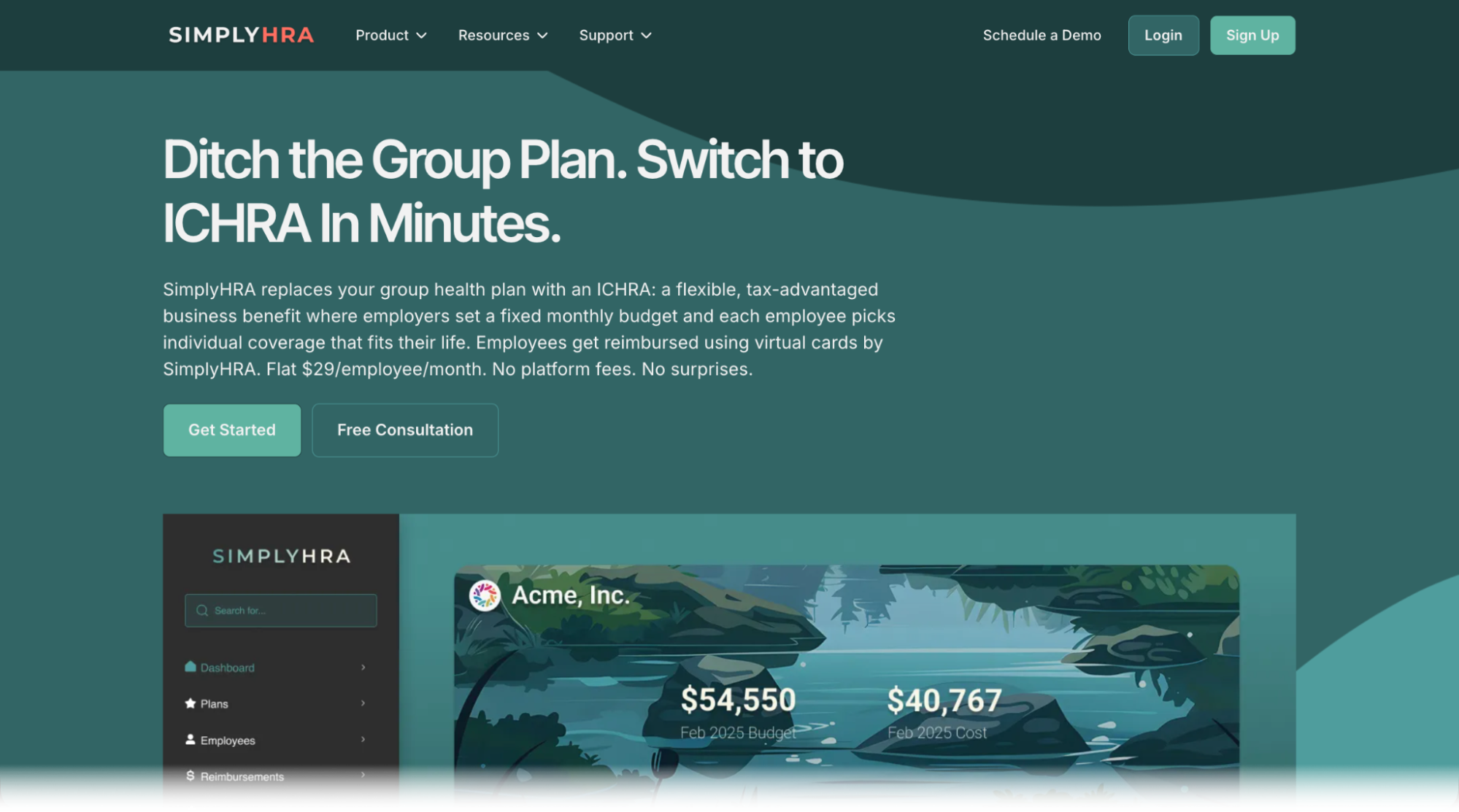
SimplyHRA keeps things simple without fully taking the wheel away from you.
You're still the one primarily running your ICHRA plan; the platform just makes the work significantly less painful.
The platform is also designed to help you complete tasks without requiring a training session or a call with an account manager. You can set reimbursement amounts, onboard employees, view plan reports, and more.
SimplyHRA Pros
- Cross-platform ICHRA management
- Legal and compliance paperwork handled for you automatically
- Personalized employee onboarding support
- Built-in AI chatbot for quick answers and assistance
- Transparent, fixed pricing
- Dynamic data dashboards
SimplyHRA Cons
- Built only for ICHRA
Venteur
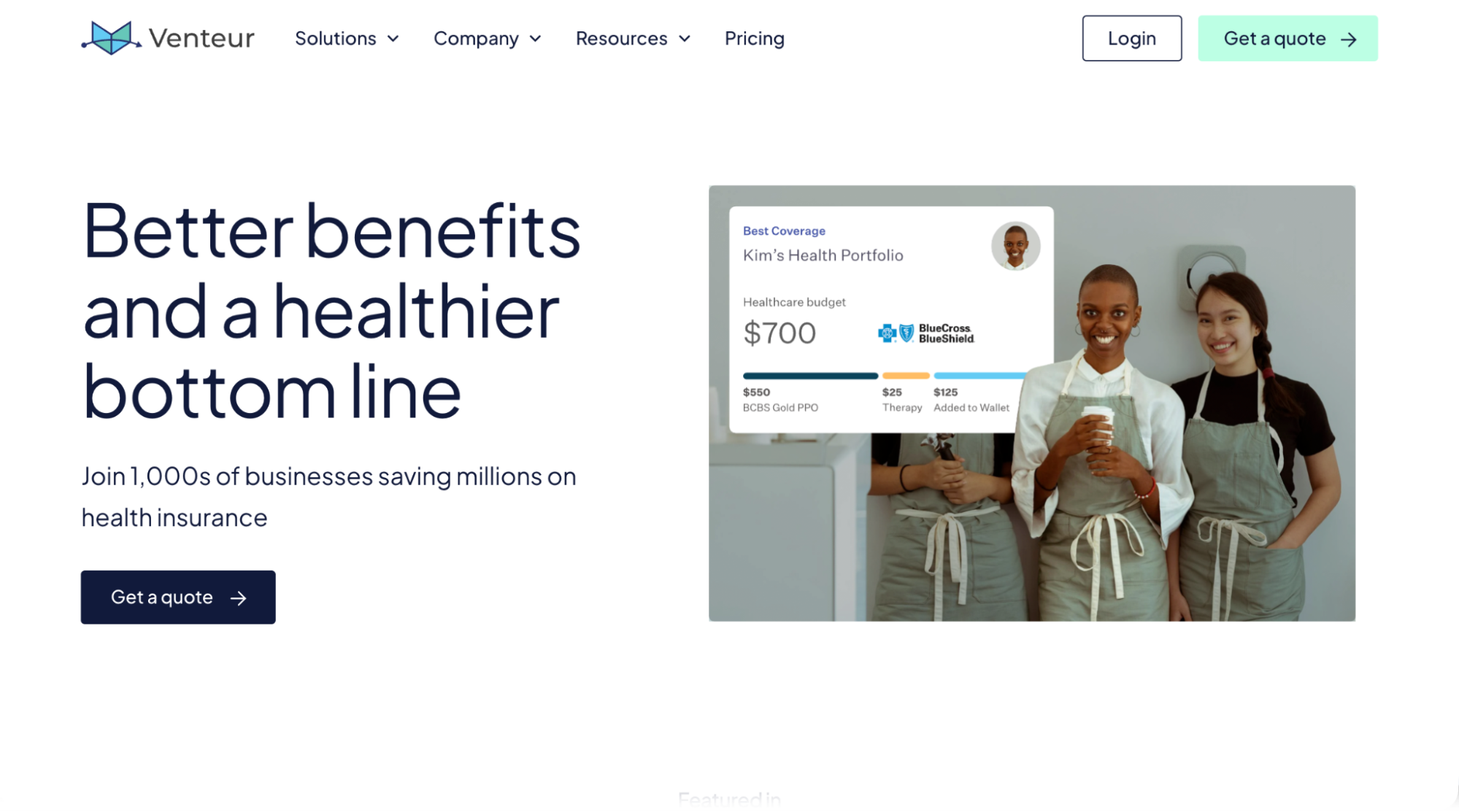
Venteur sits closer to the "concierge" end of the benefits management spectrum.
It's less a self-serve dashboard and more a managed service, with employee and employer portals layered on top of a team of in-house advisors who carry most of the planning and implementation work.
Venteur Pros
- AI-assisted plan recommendations for employees
- Dedicated implementation manager for setup and rollout
- Personal Health Concierge team for employee questions
- Real-time quoting against local market data
- Strong focus on ACA affordability and safe harbor checks
Venteur Cons
- Moved to Thatch as of April 1, 2026
- Limited self-service flexibility
1. ICHRA Setup Process
When you shift from a traditional group health plan to an ICHRA, you are essentially moving from a "defined benefit" to a "defined contribution."
Both platforms handle the basic compliance requirements mandated by the IRS, but their onboarding workflows reflect two completely different software philosophies.
SimplyHRA
SimplyHRA treats plan configuration as a fast, self-contained SaaS task. The employer dashboard features a highly visual, step-by-step wizard designed to eliminate reliance on external benefits consultants.
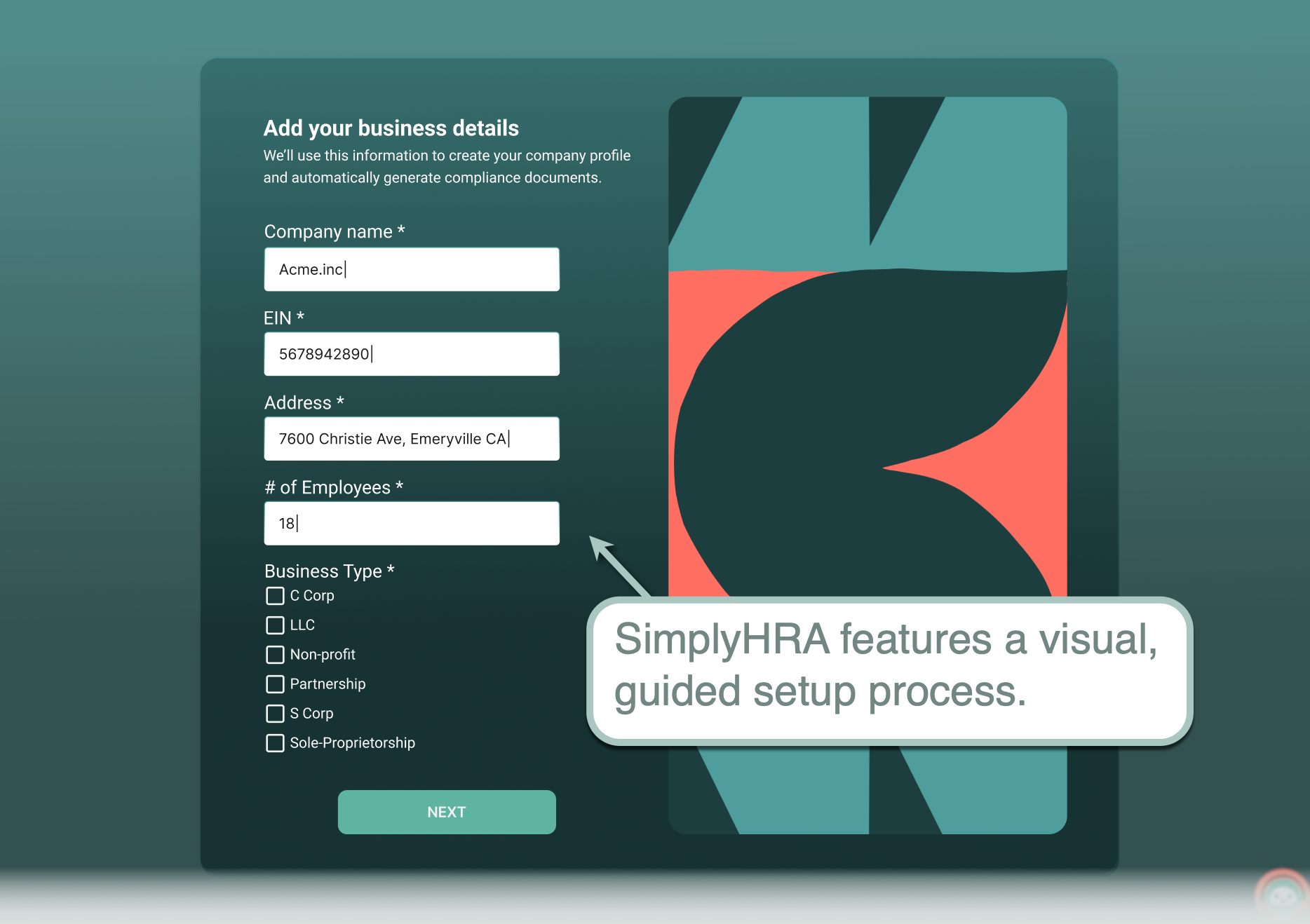
Within the interface, you can establish your employee classes and input your monthly tax-free reimbursement allowance caps. SimplyHRA will handle your compliance-related paperwork, including the Summary Plan Description (SPD) and formal plan documents.
Since SimplyHRA focuses on self-service ICHRA administration, it's ideal for business owners or HR leads who want to log in, establish their budget, and launch a compliant program in under an hour without waiting for a representative to approve the account.
Venteur
Venteur structures its onboarding around an advisory-led, data-heavy approach. Instead of building a self-service setup, the process begins with a structured cost modeling phase.
Employers work with a built-in contribution calculator, pulling data from the local insurance market from across the country in real time.
This allows employers or plan administrators to run hypothetical scenarios and stress-test your budget against actual localized premium rates before launching.
2. Ease of Use & Support
The ultimate success of an ICHRA can be measured by how little time the HR department spends explaining it to the workforce. If employees can't pick plans or hit snags at signup, you're not saving time — you're trading renewal chores for daily help-desk tickets.
SimplyHRA
SimplyHRA pairs a clean, self-service dashboard with responsive, human support and AI assistance. The interface is straightforward on either desktop or phone, allowing routine tasks to be completed without hand-holding.
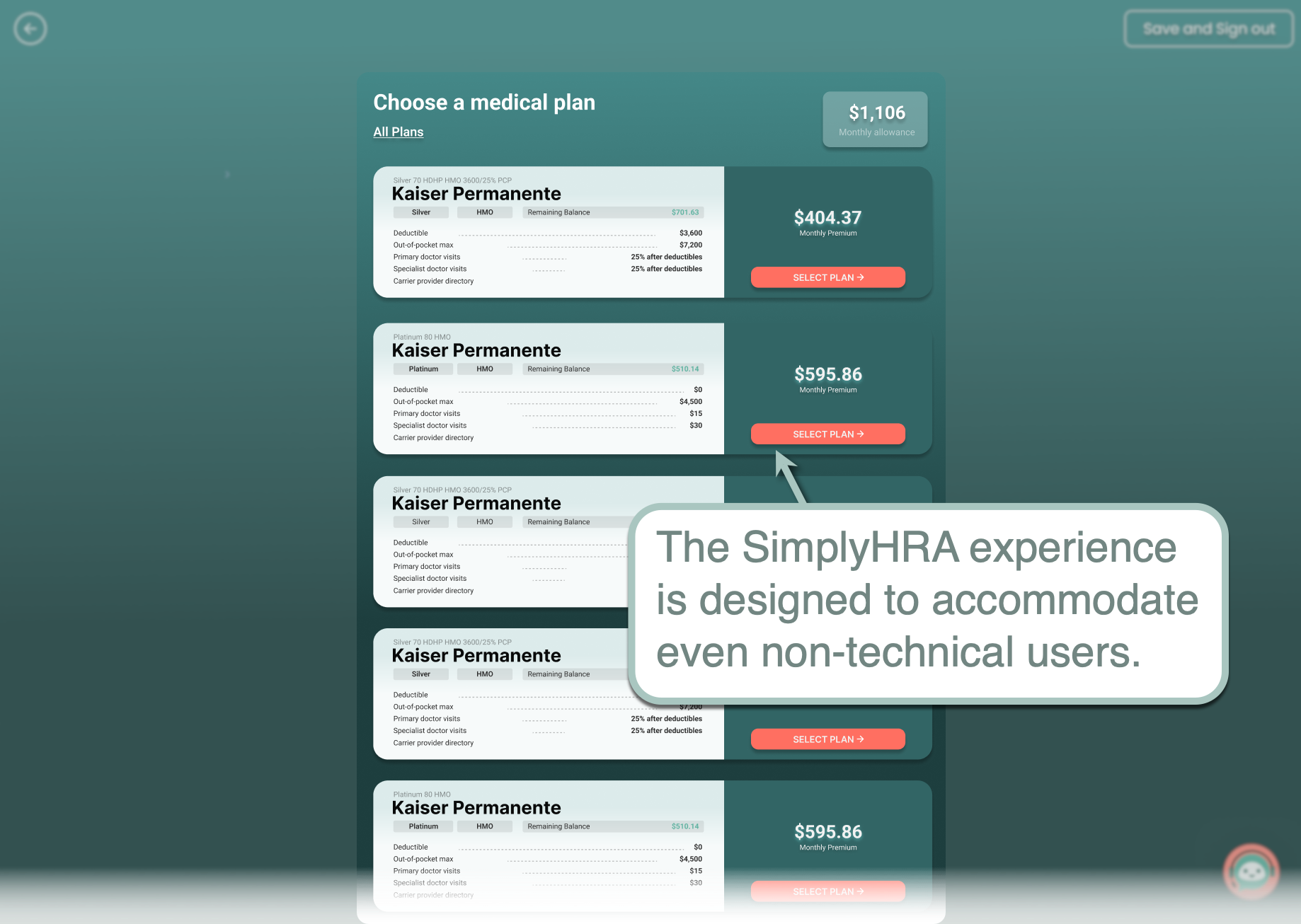
For tasks like checking reimbursement status, confirming what documents are needed, or learning how a feature works, users can get guided help directly from the app. The AI chatbot can also handle straightforward questions on the spot — no need to switch screens or submit a support request.
Venteur
Venteur takes a hands-on approach — real people working alongside the tech, not buried behind it.
Instead of pointing employees at a generic exchange and hoping for the best, enrollment is guided by an AI-assisted recommendation tool. Workers plug in details that shape their choice, including their prescriptions and household income, while the system pulls up a shortlist of regional plans that match their needs.
3. Pricing
Most small businesses didn't pick ICHRA for fun — they picked it because group premiums kept climbing.
As such, pricing (and how predictable it is) matters just as much as the features when investing in an ICHRA plan.
SimplyHRA
SimplyHRA's pricing is about as simple as it gets.
There's no setup fee, no platform subscription, and nothing "extra" tacked on when plan renewal rolls around. It's a fixed, $29 Per Employee Per Month (PEPM) with everything included, like priority support and third-party integrations.
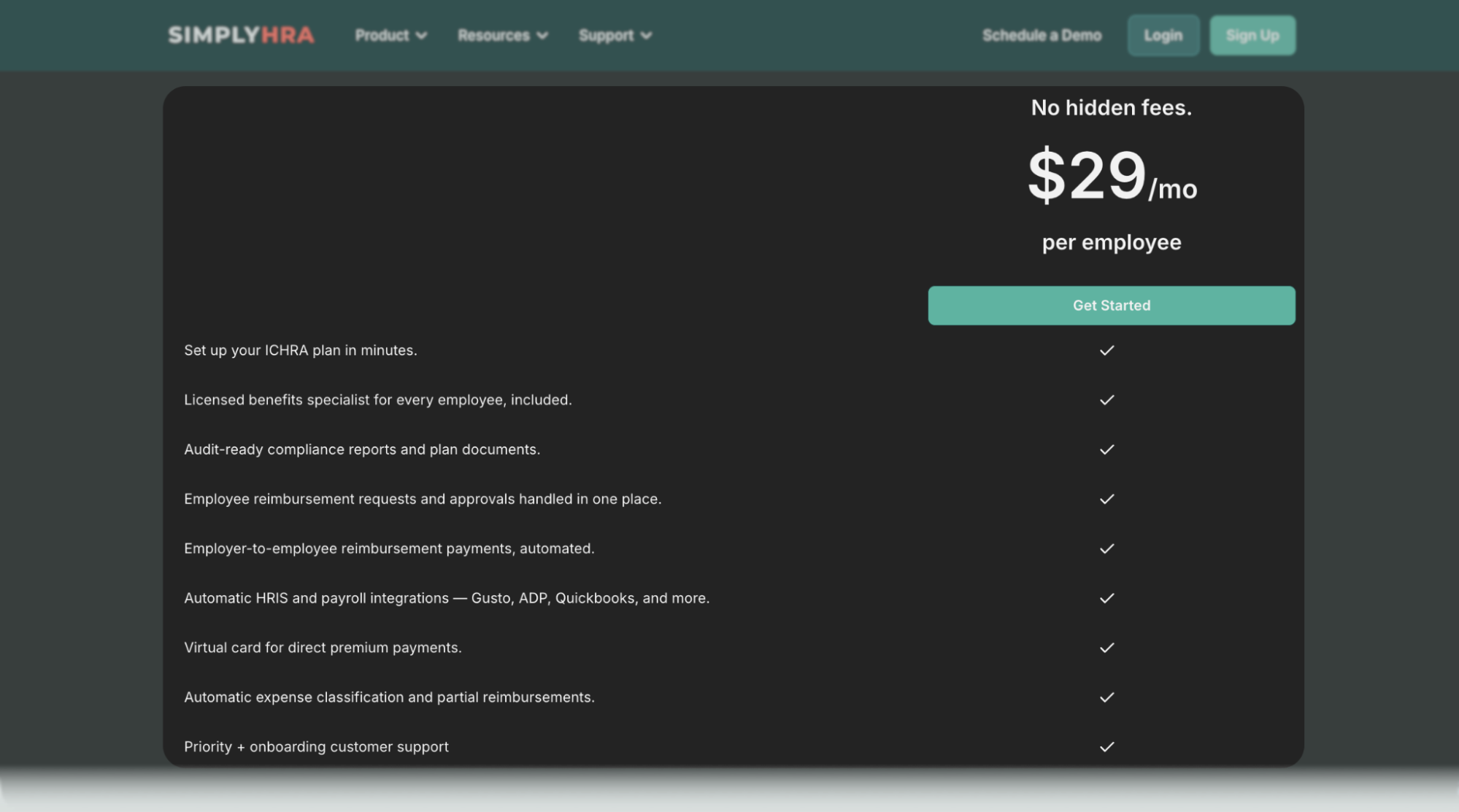
The flat pricing of SimplyHRA makes it ideal for fast-growing startups and small businesses. Since the PEPM rate is fixed, your cost scales in a way you can actually forecast.
Venteur
Venteur also follows a flat pricing model that costs $20 PEPM.
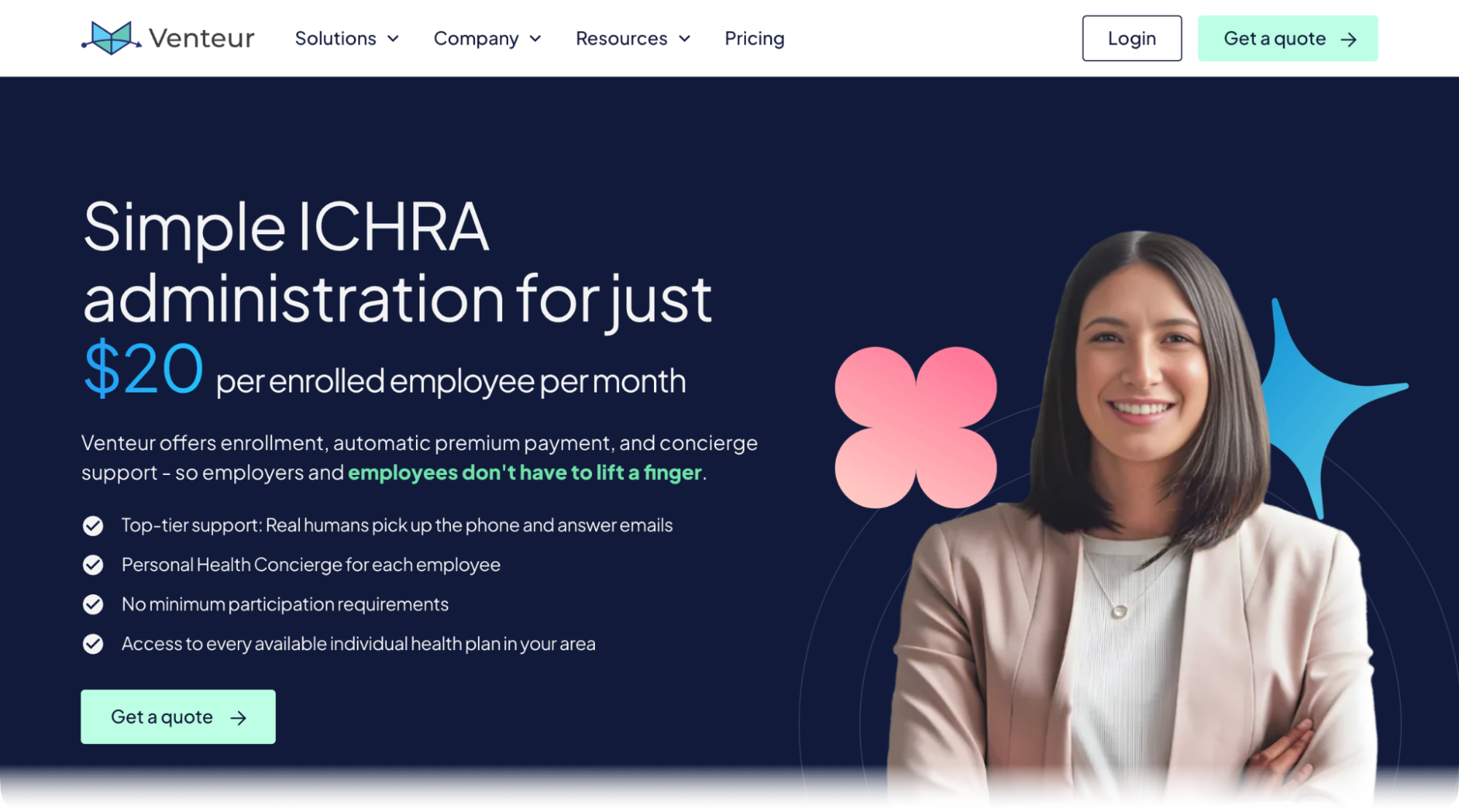
What makes this model distinct from typical enterprise tools is the complete removal of structural barriers like monthly minimum spend limits or foundational baseline platform fees. Employers only pay for the individual workers who actually select and maintain an active healthcare plan through the system.
Just remember that, as of April 1, 2026, Venture moved its entire book of employer accounts into Thatch — and that all Venteur customers will be migrated to Thatch soon if they haven't already.
4. Reimbursement Management
The biggest concern in the defined contribution model is "the float."
This is the cash-flow bottleneck where employees pay expensive premiums and other eligible medical expenses out of pocket, then wait days or weeks for reimbursement.
Modern ICHRA platforms are designed to optimize this timeline while streamlining the experience for both employers and employees.
SimplyHRA
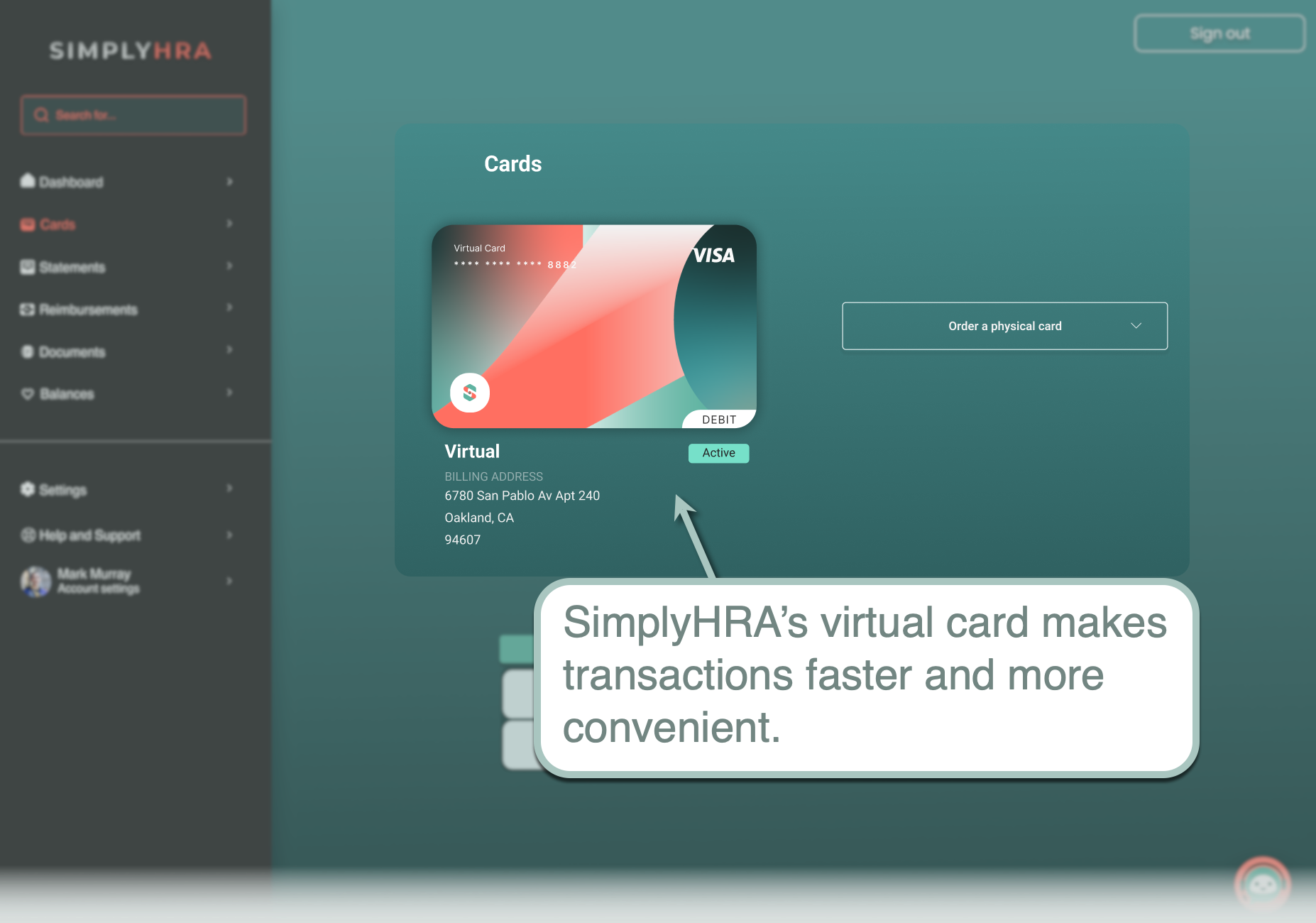
SimplyHRA can bypass the traditional claim-and-repay headache through a virtual card or Automated Clearing House (ACH) integration. Once configured, the card connects directly to the employee's profile — always ready to be used for transactions.
Venteur
Venteur manages premium routing through a fintech infrastructure, centered on their proprietary Digital Health Wallet. When employees enroll, Venteur handles the paperwork and premium payments, pulling the exact dollar amount from the employer's master fund.
For eligible medical expenses, like prescriptions and dental visits, employees only need to upload the receipts and send a reimbursement request via the online portal. Venteur's administrative team reviews the documents and handles approval within a few business days.
5. Compliance, Document Management, & Reporting
When choosing an ICHRA management platform, it must guarantee that your business stays perfectly aligned with the IRS, HIPAA privacy rules, and ERISA standards at all times.
SimplyHRA
SimplyHRA treats day-to-day legal compliance as an automated backend feature.
The platform is 100% in charge of your ICHRA plan's compliance architecture during your initial setup. This includes your formal Plan Document and the federally-mandated Summary Plan Description (SPD).
If regulatory updates alter employee class guidelines mid-year, the SimplyHRA team will also be in charge of updating all compliance paperwork and protocols to reflect the latest changes.
These files will be securely stored and consolidated in the built-in document management tool, which is accessible through the SimplyHRA dashboard.
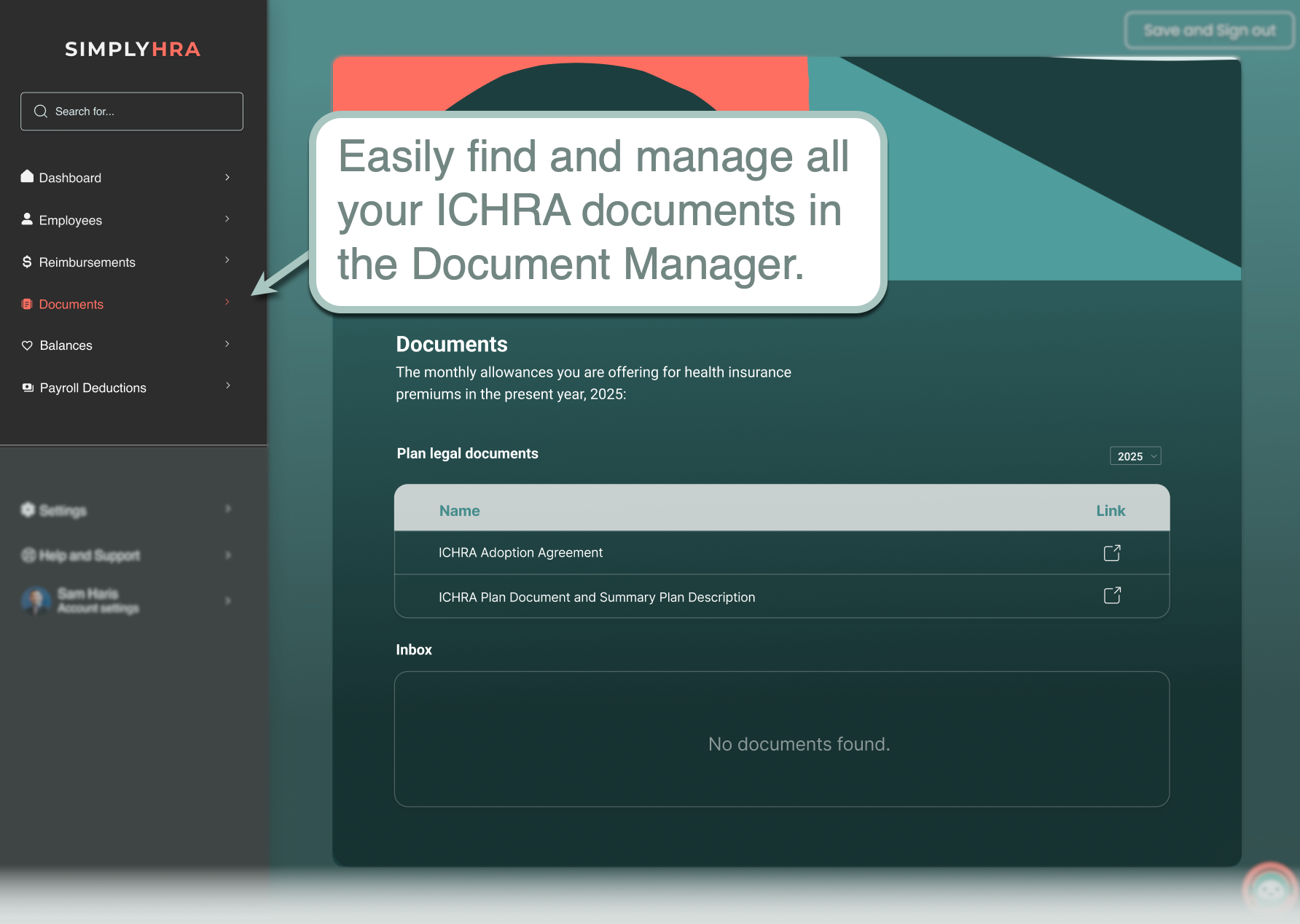
Finally, for routine reporting, SimplyHRA features real-time visual charts that track monthly spending, reimbursement metrics, employee status, and more. No need to force your finance team to build spreadsheets or create reports — all you have to do is export the audit-ready reports generated by the platform.
Venteur
Similarly, Venteur also manages compliance-related paperwork and tasks on behalf of employers. This includes sophisticated compliance requirements for Applicable Large Employers (ALEs), which can easily become a nightmare when done manually.
The software automatically tracks month-by-month employee status codes, localized premium metrics, and custom allowance values.
As for document management, Venteur's focus is to shift the burden away from your internal HR staff. It also ensures sensitive employee information, like medical selections and personal data, is fully encrypted.
Final Words
While one is no longer a standalone platform, SimplyHRA and Venteur represent two contrasting approaches to benefits management: self-service and managed service.
Deciding between these two architectural models depends entirely on your corporate operational style.
If you manage a mid-to-large workforce with highly intricate, multi-state classes, a SaaS-first platform like SimplyHRA can get the job done (especially with 1:1 consultations), but a concierge-style platform can get you there faster.
But if you identify as a startup or growing business, SimplyHRA delivers exactly what you need: A clean, user-friendly, and predictable solution that automates the technical stuff while keeping you in control of everything else that matters.
Schedule a free consultation or request a demo here to see how SimplyHRA can work for your business.
Related blogs
Prefunding ICHRA Accounts Best Practices: 2026 Guide
Defined Contribution Allowance: ICHRA Rules for 2026