HMO vs PPO vs EPO
HMO vs PPO vs EPO: A Guide for Employees
TL;DR
Health Maintenance Organization (HMO), Preferred Provider Organization (PPO), and Exclusive Provider Organization (EPO) plans handle network access, referrals, and cost in different ways. HMO is the top choice for affordability, PPO for wider coverage, and EPO balances no-referral flexibility with price.
CHOICE (Custom Health Option and Individual Care Expense) Arrangement is the current name for what was previously referred to as an ICHRA (Individual Coverage Health Reimbursement Arrangement). This page uses both terms.
Key Takeaways
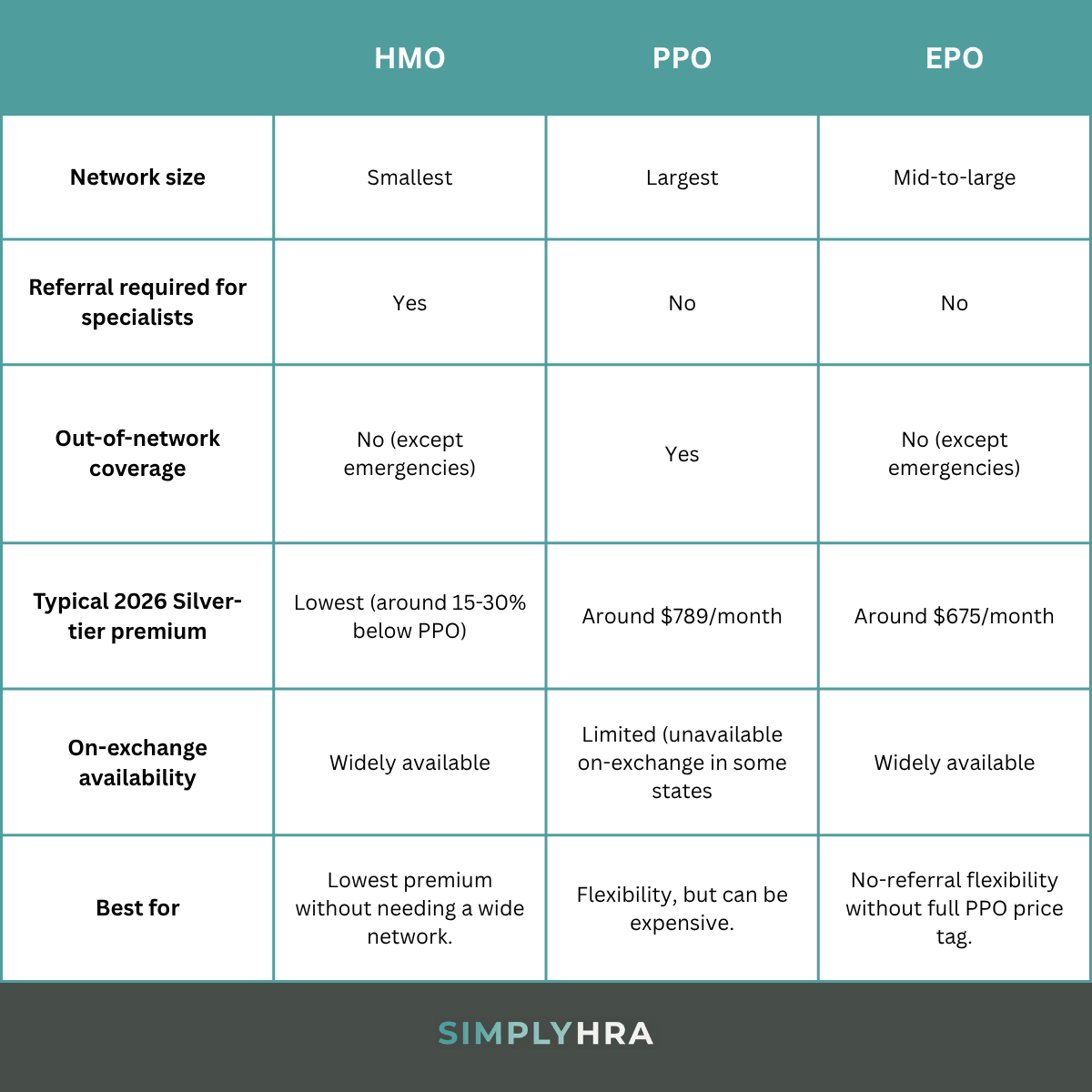
- HMO wins on price, loses on flexibility: Smallest network, referral required for specialists, but consistently the cheapest of the three.
- PPO wins on freedom, costs the most: No referral requirements, out-of-network coverage included, but priced 15-30% above HMO (some states offering it only off-exchange).
- EPO splits the difference: Skips the referral requirement like a PPO, out-of-network coverage like an HMO, and usually sits in the middle in terms of price.
Under a group plan, employees didn't have to think about the differences between HMO, PPO, and EPO.
Once the employer decides, every employee got the same network, same rules, and same tradeoffs — whether or not the choice fit their specific situation.
Individual Coverage Health Reimbursement Arrangement (ICHRA) changes that, empowering employees to customize their health benefits while employers set a fixed monthly reimbursement allowance. In turn, the HMO-PPO-EPO decision now happens at the individual level, not the company level.
This guide will cover the features, differences, and considerations around HMOs, PPOs, and EPOs.
Let's start with a quick comparison.
HMO vs PPO vs EPO: Quick Comparison
1. Health Maintenance Organization
Best for: Employees who want the lowest premium and don't mind a smaller network.
An HMO works around a single Primary Care Provider (PCP). That doctor manages everything, including checkups, specialist referrals, and prescriptions, while stepping outside the plan's network usually means paying full price out of pocket, emergencies aside.
The main reason employees put up with this setup is the price. Genuinely, consistently cheaper than the alternatives, which explains why HMOs fill up so much of the ACA marketplace.
A healthy 28-year-old who rarely sees a doctor probably won't even notice the referral requirement. However, someone dealing with diabetes, or who's already got a specialist they trust outside the network, should seriously consider something else.
2. Preferred Provider Organization
Best for: Employees who want flexibility and don't mind paying — or shopping off-exchange — to get it.
A PPO skips the "gatekeeper" entirely.
No PCP signing off before a specialist visit, permission slips, or out-of-network restrictions to worry about. The plan picks up part of the tab regardless.
That freedom costs real money. PPO premiums run 15-30% above an HMO at the same metal tier, landing at around $789 a month for individuals between 31 and 45 years of age on a 2026 Silver plan.
There's also a catch specific to PPOs in states like Texas, in which HealthCare.gov doesn't list a single individual PPO. Anyone who wants one has to go off-exchange, straight to a carrier, and give up any shot at a subsidy in the process.
3. Exclusive Provider Organization
Best for: Employees who want no-referral flexibility without the full PPO price tag.
EPOs borrow a piece from HMOs and PPOs.
Like a PPO, there's no primary care gatekeeper. Employees can go straight to a specialist without a referral.
And just like HMOs, you don't have to pay the same expensive price as a PPO. However, stepping outside the network also means paying full price, except in a genuine emergency.
EPOs land typically around $676 per month for individuals between 31 and 45 years old, which is noticeably below PPO pricing. Availability tends to be solid, too, with EPOs showing up on marketplaces nationwide far more consistently than PPOs, making them a realistic middle-ground option for the average employee (depending on location).
Which Type is Right for Your Employees?
There's no universal answer.
It depends on what an employee actually values, and what their state's marketplace even offers.
Choose HMO if lowest cost matters most, and seeing a PCP first for referrals isn't a dealbreaker.
Choose PPO if out-of-network access and provider flexibility matter enough to justify the higher premium — keeping in mind it might mean shopping off-exchange depending on the state.
Choose EPO if no-referral flexibility matters, but out-of-network coverage doesn't. It's often seen as the middle ground between the other two, both on cost and how widely it's actually available.
Final Words
Employees choosing their own coverage sounds simple on paper.
Pick a plan, submit a receipt, done.
In practice, most employees never had to compare network types, let alone figure out whether they're available in their marketplace or decide which one fits their specific healthcare needs.
Hopefully, the guide above helped close that gap. Someone who ends up on an EPO without realizing it doesn't cover out-of-network care, or who overpays for a PPO they didn't actually need, isn't getting the full value of the benefit you're offering them as the employer.
SimplyHRA is an ICHRA platform designed to ease benefits management for both employers and employees. Apart from free 1:1 consultations and our library of learning resources, employees can also rely on our built-in AI assistant for answers to all their benefits-related questions.
Book a quick, free consultation here and see what modern, employee-led plan selection looks like.
Related blogs
Maximizing ICHRA Benefits: 12 Strategies That Work in 2026
Navigating ICHRA Compliance in 2026: Guide + Checklist