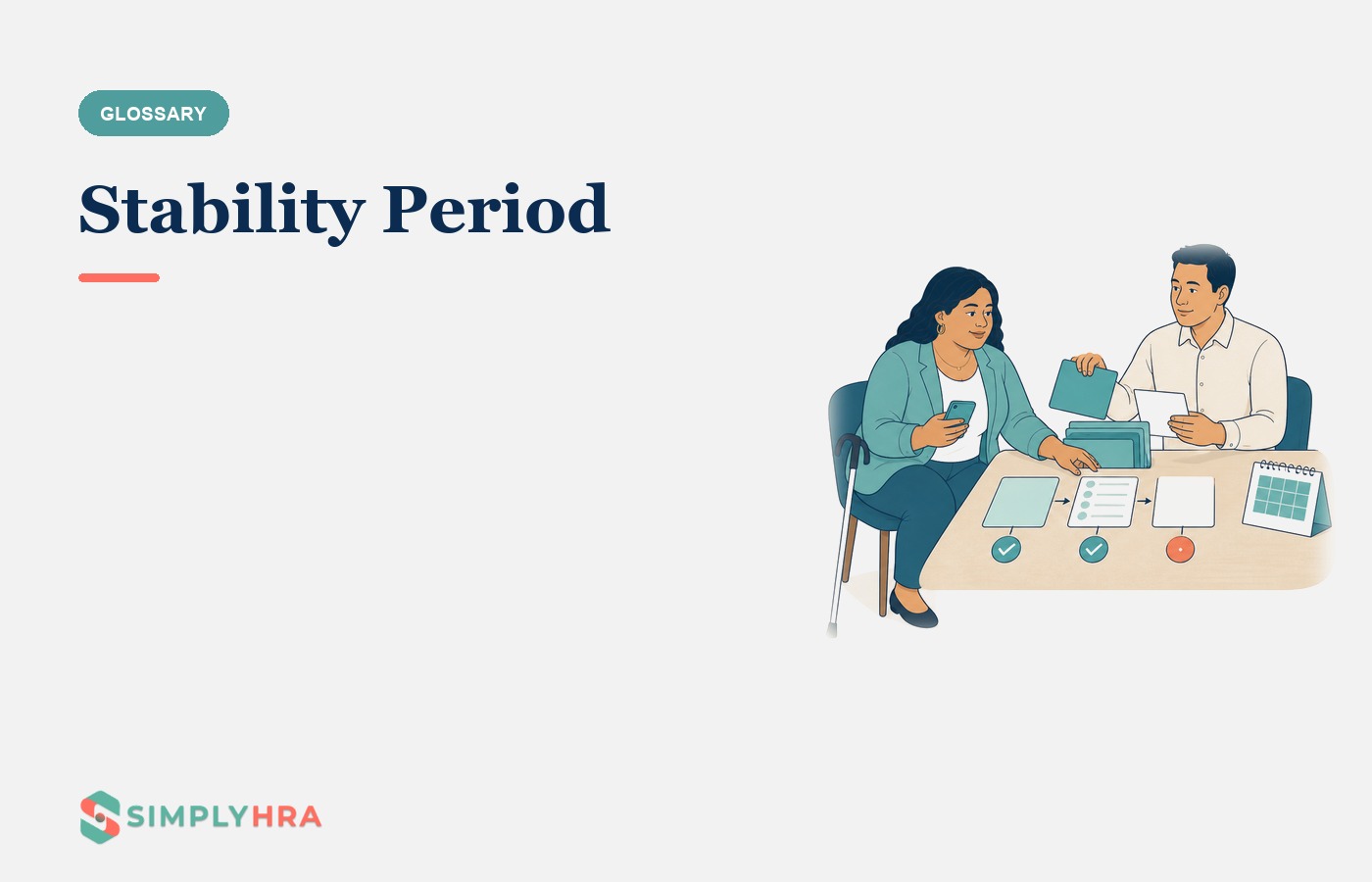
Stability Period
If you’ve ever tried to wrap your head around ACA compliance, you’ve probably stumbled across the term Stability Period and thought, “What exactly does that mean for my business?” You’re not alone. For small business owners, HR managers, and employees, the Stability Period can feel like regulatory jargon. In reality, it’s a practical rule under the Affordable Care Act (ACA) that determines how long an employee must be treated as full-time for health coverage purposes. And yes, getting it wrong can lead to penalties.
Let’s break this down in plain English and talk about what it means for employers and employees in the real world.
What Is a Stability Period Under the ACA?
A Stability Period is part of the ACA’s employer shared responsibility rules (often called the “employer mandate”), enforced by the IRS under Internal Revenue Code Section 4980H.
In simple terms:
- It’s a set period of time during which an employee’s full-time or part-time status cannot change for health coverage eligibility purposes.
- If an employee qualifies as full-time during a prior measurement period, they must be treated as full-time during the entire Stability Period: even if their hours later drop.
- Likewise, if they don’t qualify as full-time, they can generally be treated as not full-time during that same period.
This framework was created to prevent employers from constantly shifting employees in and out of coverage eligibility based on fluctuating hours.
Who Has to Worry About It?
The Stability Period rules primarily apply to Applicable Large Employers (ALEs), which are businesses with:
- 50 or more full-time employees, including full-time equivalents (FTEs), on average in the prior calendar year.
The IRS outlines these requirements clearly at IRS.gov under the ACA Information Center for Applicable Large Employers.
If you’re a small employer under 50 employees, the federal employer mandate doesn’t apply. However, understanding these rules is still helpful, especially if you’re growing or planning ahead.
How the Stability Period Works Step by Step
To really understand the Stability Period, you need to see it in context. It works alongside two other key concepts:
- Measurement Period
- Administrative Period
- Stability Period
Here’s how they connect.
1. Measurement Period
This is the look-back window where you track an employee’s hours to determine whether they averaged at least 30 hours per week (the ACA definition of full-time).
Employers can choose:
- A standard measurement period (for ongoing employees), typically 3 to 12 months.
- An initial measurement period (for new variable-hour or seasonal employees), also 3 to 12 months.
If the employee averages 30 or more hours per week during this time, they’re considered full-time for ACA purposes.
2. Administrative Period
This is a short transition window (up to 90 days) where the employer:
- Reviews the data
- Notifies eligible employees
- Offers coverage
- Handles enrollment paperwork
3. Stability Period
Now comes the Stability Period.
If the employee qualified as full-time during the measurement period:
- They must be offered coverage for the entire Stability Period.
- The Stability Period must last at least six consecutive months.
- It cannot be shorter than the measurement period.
For example:
- 12-month measurement period
- 1-month administrative period
- 12-month Stability Period
If the employee averaged 30+ hours during measurement, they’re locked in as full-time for the next 12 months, even if their hours later drop to 25 per week.
That’s the “stability” part.
Why the Stability Period Matters to Small Business Owners
Even if you’re under 50 employees today, growth happens fast. I’ve seen startups jump from 30 to 60 employees in a year. Suddenly, ACA rules kick in, and compliance becomes a big deal.
Here’s why the Stability Period deserves your attention:
Avoiding IRS Penalties
If you’re an ALE and fail to offer affordable, minimum value coverage to at least 95% of full-time employees, you could face:
- Section 4980H(a) penalties (for failing to offer coverage)
- Section 4980H(b) penalties (for offering unaffordable or inadequate coverage)
The IRS uses Forms 1094-C and 1095-C to enforce this.
Misapplying Stability Period rules can result in:
- Incorrectly denying coverage
- Failing to offer coverage when required
- Exposure to significant penalties
Budget Predictability
The Stability Period creates predictability. Once you determine who is full-time, you know your benefits obligation for a defined period.
That’s critical for:
- Forecasting health benefit costs
- Setting employer contribution budgets
- Managing cash flow
Without a structured approach, benefits can feel like a moving target.
What Employees Should Know About the Stability Period
From an employee perspective, the Stability Period provides protection and consistency.
Coverage Stability
If you qualify as full-time based on your hours, your employer can’t just pull coverage mid-year because your schedule shifts temporarily.
That means:
- No sudden loss of health insurance due to seasonal slowdowns
- Predictable access to care
- Financial security for you and your family
Marketplace Tax Credits Interaction
If your employer is required to offer coverage during the Stability Period and it’s considered “affordable” under ACA rules, you generally won’t qualify for premium tax credits through the Health Insurance Marketplace (HealthCare.gov).
Affordability is determined annually by IRS thresholds. For 2026, the IRS sets a percentage of household income that defines affordability (the percentage is adjusted yearly and published by the IRS).
If coverage is unaffordable, you may have options, but that’s a nuanced discussion worth having with HR or a licensed advisor.
Stability Period and ICHRA: How They Interact
Now let’s connect this to Individual Coverage Health Reimbursement Arrangements (ICHRAs).
An ICHRA allows employers to reimburse employees, tax-free, for individual health insurance premiums and eligible medical expenses, as permitted by IRS Notice 2019-45 and related regulations.
ALEs Offering an ICHRA
If you’re an Applicable Large Employer offering an ICHRA:
- You must still comply with Stability Period rules.
- Full-time employees identified during the measurement period must be offered an affordable ICHRA during the Stability Period.
- Affordability is measured based on the lowest-cost silver plan available to the employee, minus the employer’s ICHRA contribution.
If structured correctly, an ICHRA can satisfy the employer mandate, without traditional group health insurance.
Small Employers Using ICHRA
If you’re under 50 employees:
- You’re not subject to the federal employer mandate.
- You don’t have to use measurement and Stability Period rules.
- You can offer ICHRA more flexibly.
That’s one reason many small businesses prefer ICHRA over traditional group plans. It simplifies compliance while giving employees more choice.
Common Mistakes Employers Make
I’ve seen well-meaning business owners stumble over the same issues.
Here are a few to avoid:
- Not documenting measurement and Stability Period dates clearly.
- Using inconsistent measurement periods across employee groups.
- Failing to coordinate payroll data accurately.
- Misunderstanding affordability calculations for ICHRA.
The ACA isn’t forgiving when it comes to documentation. If the IRS sends a Letter 226-J proposing penalties, you’ll want clean records.
Practical Tips for HR Managers
If you’re managing this internally, here’s what I recommend:
- Set clear measurement and Stability Period calendars and stick to them.
- Use payroll-integrated tracking systems to monitor hours accurately.
- Conduct annual affordability testing before open enrollment.
- Communicate clearly with employees about how eligibility is determined.
Transparency goes a long way in building trust.
Bringing It All Together for Growing Businesses
The Stability Period isn’t just a technical rule buried in ACA regulations. It’s a framework designed to create fairness and predictability: for both employers and employees.
For large employers, it’s mandatory and compliance-driven. For small employers, it’s a preview of what’s ahead as you grow. Either way, understanding it now saves headaches later.
And here’s the bigger picture: as healthcare continues to shift toward individual choice and defined contribution models like ICHRA, having a structured, compliant system becomes even more important.
Why SimplyHRA Makes Stability Period Compliance Easier
Navigating Stability Period rules alongside ACA affordability testing, payroll coordination, and employee communication can feel overwhelming, but it doesn’t have to be. At SimplyHRA, we help small businesses and growing employers design compliant ICHRA plans, automate reimbursements, works alongside any payroll or HR system with no integration required, and maintain audit-ready documentation so you’re not guessing about eligibility or affordability. If you’re a business owner, HR manager, or employee who wants clarity and confidence around your health benefits, email us at info@simplyhra.com or schedule a consultation at https://simplyhra.com/contact. Let’s make your benefits simple, compliant, and built for growth.
Stability Period vs. Monthly Measurement Method
Up to this point, we’ve focused on the look-back measurement method, which uses a Stability Period. But there’s another approach under ACA regulations: the monthly measurement method.
What’s the Difference?
Under the monthly measurement method:
- An employee’s full-time status is determined month-by-month.
- If they work 130 hours in a calendar month, they’re considered full-time for that month.
- There’s no formal Stability Period locking in status.
So why don’t most Applicable Large Employers use it?
Because it creates volatility.
With monthly measurement:
- Eligibility can shift every month.
- Administrative workload increases.
- Risk of accidental non-compliance rises.
The Stability Period, by contrast, smooths out fluctuations in hours. For industries like hospitality, retail, construction, or healthcare staffing, where schedules ebb and flow, that predictability is invaluable.
Special Rules for New Hires and Rehires
One area that often trips up HR teams is how the Stability Period applies to new employees and those who leave and return.
New Full-Time Hires
If a new employee is reasonably expected to work full-time (30+ hours per week) at their start date:
- You must offer coverage by the first day of the fourth full calendar month of employment.
- No measurement period is required.
- A Stability Period generally begins once coverage is offered and accepted.
This is spelled out in IRS regulations under Section 4980H and related Treasury Regulations.
Variable-Hour or Seasonal New Hires
If you can’t determine at hire whether the employee will average 30 hours:
- You may use an initial measurement period (up to 12 months).
- If they qualify, they enter a Stability Period that must be at least as long as the standard Stability Period for ongoing employees.
The key is consistency. Your classifications must be applied uniformly within employee categories.
Rehires and the 13-Week Rule
If an employee terminates and is rehired, special rules apply.
Generally:
- If the break in service is at least 13 consecutive weeks (26 weeks for educational organizations), you may treat them as a new hire.
- If the break is shorter, they typically resume their prior status, including any remaining Stability Period.
This matters because failing to restore coverage correctly can create compliance gaps, and potential penalties.
Stability Period and Controlled Groups
Now let’s talk about something small businesses often overlook: controlled group rules.
Under IRS aggregation rules:
- Related entities with common ownership may be treated as a single employer for ACA purposes.
- This affects whether you’re an Applicable Large Employer.
- It also impacts how you apply Stability Period determinations.
For example:
If you own:
- A restaurant with 30 employees, and
- A catering company with 25 employees
You may exceed the 50-employee threshold when combined: even if each entity is under 50 on its own.
The IRS controlled group rules are rooted in Internal Revenue Code Sections 414(b), (c), (m), and (o). These aren’t light reading, I’ll admit. But ignoring them can lead to serious compliance exposure.
Documentation and Audit Preparedness
Let’s be honest: most employers don’t think about audits until they receive an IRS letter.
But when it comes to the Stability Period, documentation is everything.
What You Should Keep on File
Maintain records of:
- Measurement period start and end dates
- Hours of service calculations
- Administrative period timelines
- Coverage offer dates
- Signed waivers (if employees decline coverage)
- Affordability calculations
The IRS can assess penalties years after the fact. Without proper documentation, defending your position becomes difficult.
And here’s something many don’t realize: payroll records are not automatically ACA compliance records. You must ensure your hour-tracking methodology aligns with ACA definitions of “hours of service,” which include:
- Paid vacation
- Paid holidays
- Paid sick leave
- Jury duty
- Military leave
These definitions are clarified in IRS and Department of Treasury guidance.
Financial Planning and the Stability Period
From a CFO or founder’s perspective, the Stability Period isn’t just about compliance. It’s about financial modeling.
Forecasting Benefit Liability
Because full-time status is locked during the Stability Period:
- You can forecast employer contribution costs with more certainty.
- You avoid mid-year surprises.
- You align benefits budgeting with fiscal planning cycles.
When paired with a defined contribution approach like ICHRA:
- You set a fixed monthly allowance.
- Employees choose their own coverage.
- Your exposure is predictable.
That’s fundamentally different from traditional group plans, where renewal premiums can spike unexpectedly.
Employee Communication Best Practices
Let’s switch hats for a moment.
Employees don’t speak “ACA regulatory language.” They speak plain English. If you’re explaining Stability Period rules internally, keep it simple.
What Employees Actually Care About
They want to know:
- Am I eligible for benefits?
- When does my coverage start?
- How long will it last?
- What happens if my hours change?
If you’re using a look-back method, explain:
- The timeframe used to measure hours.
- When eligibility decisions are made.
- How long their status will remain fixed.
Clear communication reduces confusion, and reduces turnover driven by benefits misunderstandings.
Planning Ahead as Your Business Grows
Many startups and small businesses don’t pay attention to Stability Period rules because they’re under 50 employees.
But here’s the reality: growth can push you into Applicable Large Employer status faster than you expect.
If you anticipate crossing the 50-employee threshold:
- Begin tracking hours properly now.
- Establish consistent employee classifications.
- Consult a benefits compliance specialist before year-end.
Remember, ALE status is determined based on the prior calendar year’s average workforce. By the time you realize you’ve crossed the threshold, you may already be subject to employer mandate rules for the current year.
Stability Period Strategy with SimplyHRA
Understanding and administering Stability Period rules (especially alongside ICHRA affordability testing, controlled group analysis, and payroll-ready data export) requires careful coordination. At SimplyHRA, we help growing businesses structure compliant ICHRA programs that align with ACA measurement and Stability Period requirements while giving employees the flexibility to choose their own coverage. Our platform works alongside any payroll or HR system with no integration required, automates reimbursement workflows, and maintains audit-ready documentation so employers can focus on running their business, not decoding federal regulations. If you’re evaluating your obligations or preparing for growth, reach out to us at info@simplyhra.com or schedule a consultation at https://simplyhra.com/contact. Let’s build a benefits strategy that’s compliant, employee-friendly, and built to scale.
Frequently Asked Questions (FAQs) about Stability Period:
Q: Does the Stability Period have to match the calendar year?
A: No. The Stability Period does not have to align with the calendar year. Employers can choose their own measurement and Stability Period cycles, as long as they comply with IRS rules. Many employers align their standard measurement and Stability Period with their health plan year for administrative simplicity, but it’s not legally required. The key is consistency and proper documentation.
Q: Can an employer shorten a Stability Period once it begins?
A: Generally, no. Once a Stability Period starts, the employee’s status as full-time or not full-time is locked in for that entire period, provided they remain employed. Shortening it midstream could create non-compliance issues under the ACA employer mandate rules and potentially trigger IRS penalties.
Q: What happens if an employee moves from part-time to clearly full-time during a Stability Period?
A: If the employee was determined not to be full-time during the prior measurement period, the employer is typically not required to offer coverage until the next Stability Period begins, even if the employee’s hours increase. However, employers may voluntarily offer coverage sooner if their plan documents allow it. Consistency with written policy is critical.
Q: Are unpaid leaves of absence included when calculating hours for a Stability Period?
A: Certain unpaid leaves, such as Family and Medical Leave Act (FMLA) leave, USERRA military leave, and jury duty, must be treated specially under ACA averaging rules. Employers must either credit hours or adjust the averaging method so employees are not penalized for protected leave. These requirements are outlined in Treasury Regulations tied to Internal Revenue Code Section 4980H.
Q: Does the Stability Period apply to union employees?
A: Yes, if the employer is an Applicable Large Employer and the union employees meet the definition of full-time under ACA rules. However, collectively bargained agreements may affect how benefits are offered. Employers should review both ACA regulations and labor contract terms to ensure alignment.
Q: How does a merger or acquisition affect an existing Stability Period?
A: In mergers or acquisitions, ACA compliance responsibilities can shift depending on transaction structure. The acquiring employer may need to honor existing Stability Period determinations made by the prior employer. Controlled group and successor employer rules can complicate this analysis, so legal and benefits counsel should be involved early in the transaction process.
Q: Can different employee classes have different Stability Periods?
A: Yes, but only if applied uniformly and consistently within defined employee categories. For example, salaried and hourly employees may have different measurement methods if structured properly. However, arbitrary or discriminatory application could violate ACA nondiscrimination principles or create compliance risk.
Q: Does the Stability Period impact COBRA eligibility?
A: The Stability Period itself does not determine COBRA eligibility. COBRA rights are triggered by a qualifying event, such as termination of employment or reduction in hours that causes a loss of coverage. However, how an employer structures its measurement and Stability Period can influence when coverage ends, which in turn affects COBRA timing.
Q: If an employee declines coverage during the Stability Period, must the employer offer it again?
A: No, not during the same Stability Period unless the employer’s plan allows mid-year enrollment or the employee experiences a qualifying life event under HIPAA special enrollment rules. The employer must still report the offer of coverage on IRS Forms 1095-C, even if the employee declines it.
Q: How far back can the IRS review Stability Period compliance?
A: The IRS generally has three years from the date a return is filed to assess penalties, though certain circumstances may extend that timeframe. Because ACA reporting forms are filed annually, employers should retain Stability Period documentation and supporting payroll records for multiple years to defend against potential penalty assessments.
Q: Can an employer change its Stability Period design from year to year?
A: Yes, but changes must comply with IRS transition rules and be implemented carefully. Employers generally may adjust measurement, administrative, and Stability Period lengths prospectively, not retroactively. The revised structure must still meet minimum ACA requirements, and employees should receive clear communication before changes take effect. Sudden or mid-cycle changes can create reporting inconsistencies on Forms 1094-C and 1095-C.
Q: Does overtime count toward full-time status during the measurement period?
A: Yes. All hours of service must be counted, including overtime hours. Under IRS regulations, each hour for which an employee is paid, or entitled to payment, for performing duties counts. Failing to include overtime could result in undercounting hours and improperly classifying an employee as part-time.
Q: Are stipends or bonuses counted as hours of service?
A: Compensation alone does not equal hours. ACA rules focus on hours worked or hours for which payment is made for time not worked, such as PTO or holiday pay. A flat bonus does not increase hour totals unless it is tied to actual hours worked and reflected in payroll hour tracking.
Q: How does the Stability Period apply to remote employees working in different states?
A: The federal ACA Stability Period rules apply nationwide. However, state-level health coverage mandates or reporting requirements may also apply, depending on where the employee resides. Employers must comply with federal ACA measurement rules while also monitoring state-specific health coverage laws, such as individual mandates in certain states.
Q: If an employee drops below 30 hours due to a performance issue, can coverage be terminated during the Stability Period?
A: Generally no, as long as the employee remains employed. If the employee qualified as full-time during the measurement period, coverage must continue through the Stability Period. Termination of coverage typically occurs only if employment ends or if the employee voluntarily drops coverage in accordance with plan rules.
Q: What happens if payroll errors cause incorrect hour calculations?
A: Payroll inaccuracies can create compliance exposure if they result in improper eligibility determinations. Employers should conduct periodic internal audits of hour tracking systems. If errors are identified, corrective steps should be documented promptly. Accurate payroll-ready data export is essential because ACA compliance relies heavily on precise hour reporting.
Q: Do interns fall under Stability Period rules?
A: It depends on how they are classified and how many hours they work. Paid interns who average 30 or more hours per week during the measurement period may qualify as full-time under ACA rules. Unpaid interns are generally not counted because they are not considered employees under wage and hour laws, but employers should review classification carefully to avoid missteps.
Q: Is there a maximum length for a Stability Period?
A: There is no explicit maximum length under ACA regulations, but practical limits apply. For ongoing employees, the Stability Period must be at least six months and cannot be shorter than the standard measurement period. Most employers use 12-month Stability Periods to create administrative consistency and align with plan years.
Q: Does the Stability Period affect eligibility for dependent coverage?
A: Indirectly, yes. If an employee qualifies as full-time during the Stability Period, Applicable Large Employers must offer coverage not only to the employee but also to their dependent children up to age 26 to avoid certain penalties under Section 4980H(a). The Stability Period therefore helps determine when dependent offer obligations apply.
Q: Can employees challenge how their Stability Period status was determined?
A: Employees can request clarification or raise concerns internally, and employers should be prepared to explain their methodology. While the ACA does not create a direct private lawsuit right over measurement calculations, incorrect determinations can surface during IRS penalty assessments or Department of Labor reviews. Transparent processes and clear documentation reduce the likelihood of disputes.
Q: How does the Stability Period interact with waiting period limits?
A: The ACA limits group health plan waiting periods to no more than 90 calendar days, as enforced by the Department of Labor and IRS. For employees expected to be full-time at hire, coverage must begin within that timeframe. For variable-hour employees, the measurement period structure is permitted as long as it is not designed to circumvent the 90-day waiting period limitation. Proper coordination between measurement timelines and waiting period rules is essential.
Q: Does offering an ICHRA eliminate the need to think about Stability Period rules?
A: No, not for Applicable Large Employers. Even when offering an ICHRA instead of traditional group insurance, ALEs must still determine full-time status using either the monthly or look-back measurement method. The Stability Period remains a foundational compliance requirement; the difference is simply the type of coverage being offered.
Making Stability Period Compliance Simple and Predictable
The Stability Period isn’t just a technical ACA term: it’s a foundational rule that determines when employees must be treated as full-time and how long that status must be honored. For growing businesses, especially those nearing or exceeding 50 employees, getting this right affects everything from IRS penalty exposure to budgeting and employee trust. Between tracking hours, applying measurement periods correctly, coordinating payroll data, and ensuring affordability, there’s very little room for error.
At SimplyHRA, we’ve worked with founders, HR managers, and operations leaders who suddenly realized they were subject to ACA employer mandate rules and needed clarity fast. We’ve been in those shoes ourselves: juggling growth, compliance, and employee expectations all at once. Our platform helps employers structure compliant ICHRA plans that align with Stability Period requirements, automate reimbursements, works alongside any payroll or HR system with no integration required, and maintain audit-ready documentation without adding administrative burden. Employees get choice and transparency; employers get predictability and cost control.
If your business is navigating Stability Period rules, preparing for ALE status, or simply looking for a more manageable way to offer health benefits, let’s talk. Email us at info@simplyhra.com or schedule a consultation at https://simplyhra.com/contact. We’ll help you design a compliant, employee-friendly benefits strategy that supports your growth, not slows it down.
Related glossaries
Provider Network
Member ID Card