Rating Area
Rating Area: What It Means for Health Insurance Costs
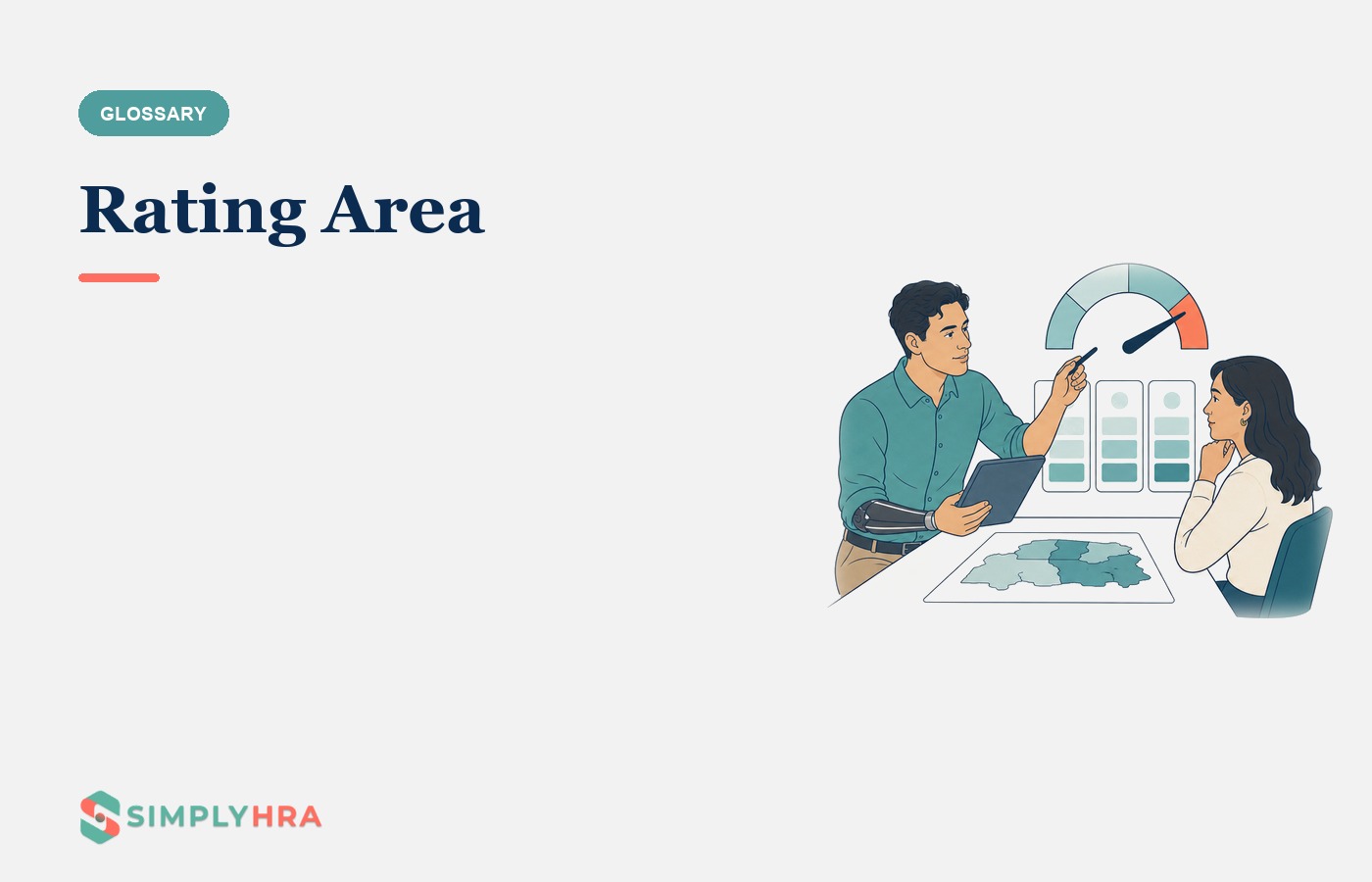
Rating Area is the geographic zone insurers use to help calculate health insurance premiums for people and small businesses in that location. Put simply, where you live or operate can change what the same type of coverage costs.
CHOICE (Custom Health Option and Individual Care Expense) Arrangement is the current name for what was previously referred to as an ICHRA (Individual Coverage Health Reimbursement Arrangement). This page uses both terms.
That matters when you’re comparing an individual health plan, reviewing a small-group renewal, or setting up an Individual Coverage Health Reimbursement Arrangement (ICHRA). Two people of the same age can look at similar coverage from the same insurer and see different prices because they live in different Rating Areas.
Meta description: Learn what a health insurance Rating Area is, how it affects individual and small-group premiums, and what employers and employees should check when comparing coverage.
What is a health insurance Rating Area?
Under the Affordable Care Act, states divide their individual and small-group insurance markets into geographic regions. Those regions may follow counties, three-digit ZIP codes, metropolitan statistical areas, or another state-approved structure.
Federal rules limit the factors an insurer may use to set premiums in these markets. Those factors are:
- Individual or family enrollment
- Geographic location
- Age
- Tobacco use, where permitted
The rules appear in the Centers for Medicare & Medicaid Services regulation titled 45 Code of Federal Regulations § 147.102, “Fair Health Insurance Premiums.” A state’s geographic boundaries must also satisfy federal standards designed to prevent unfair differences that would discourage higher-cost people from enrolling.
A Rating Area doesn’t describe a plan’s provider network or where you’re allowed to receive care. It’s a pricing boundary. You’ll still need to check whether your doctors, hospitals, and prescriptions are covered under the specific plan.
How does a Rating Area work in practice?
An insurer starts with a base premium and applies the permitted rating factors. Your geographic zone is one part of that calculation, so crossing a county or ZIP-code boundary can produce a different premium even when other details remain the same.
Here’s a simple employer example. Cedar Ridge Design has eight employees and offers each eligible employee a $500 monthly ICHRA allowance. One employee’s individual premium is $460, so the employer can reimburse up to $460; the unused $40 stays with the business. Another employee in a different geographic zone pays $620 for suitable coverage, so the employer can reimburse $500 and the employee is responsible for the remaining $120 per month.
The allowance didn’t change, but local plan pricing changed what each employee paid out of pocket. For ICHRA affordability testing, federal rules generally look at the lowest-cost Silver plan available to the employee based on factors including the employee’s age and residence. Employers may use an approved location-based safe harbor under the Internal Revenue Service’s final ICHRA regulations, Treasury Decision 9971, rather than tracking every employee’s exact residence in all circumstances.
If you’re an employee without insurance, your home address helps determine the plans and premiums shown through the Health Insurance Marketplace. It may also affect the benchmark premium used to calculate any premium tax credit, under the Internal Revenue Service rules for the Premium Tax Credit.
Who do Rating Areas apply to?
Geographic rating rules mainly affect Affordable Care Act-compliant individual and small-group health insurance. The small-group market generally covers employers with 1 to 50 employees, although a state may define it to include businesses with up to 100 employees.
For employers, the zone can affect a traditional small-group quote and the real buying power of a fixed ICHRA or Qualified Small Employer Health Reimbursement Arrangement (QSEHRA) allowance. If employees are spread across several regions or states, their available plans and premiums may differ substantially.
For employees, your residential location generally drives individual-market pricing. That includes coverage you buy directly from an insurer or through the Marketplace, whether you’re paying alone or using an employer reimbursement arrangement.
These rating restrictions don’t work the same way for every form of coverage. Large-group plans, self-funded employer plans, Medicare, and Medicaid follow different pricing or eligibility frameworks. Your state insurance department’s official Rating Area map and the Centers for Medicare & Medicaid Services document “Market Rating Reforms” are the right starting points for checking the boundaries that apply where you live or employ people.
What Rating Areas cost employers
A Rating Area doesn’t create a tax or government fee. Its cost shows up indirectly: local premiums affect small-group rates and determine how far a fixed health reimbursement arrangement allowance goes for employees buying individual coverage.
If you offer an Individual Coverage Health Reimbursement Arrangement (ICHRA), geography can also affect whether the offer is considered affordable under the Affordable Care Act’s employer shared responsibility rules. An applicable large employer—generally one averaging at least 50 full-time employees, including full-time equivalents—must test affordability using the employee’s required contribution toward the lowest-cost Silver plan for self-only coverage. The governing guidance includes Internal Revenue Service Notice 2018-88 and Treasury Decision 9971.
You’ll need accurate employee locations, plan-year dates, ages, allowance amounts, and the applicable lowest-cost Silver premiums. Employers may use the employee’s primary work location rather than home address under the ICHRA location safe harbor, provided the federal conditions are met.
The deadlines come from the benefit arrangement, not the geographic boundary itself. An ICHRA notice generally must go out at least 90 days before the plan year begins; someone who becomes eligible later generally receives it by the date coverage can begin. A Qualified Small Employer Health Reimbursement Arrangement (QSEHRA) generally has a similar 90-day advance-notice rule, with special timing for newly eligible employees.
There’s no standalone penalty for placing an employee in the wrong zone by honest mistake. But the resulting errors can trigger broader consequences:
- A QSEHRA notice failure can carry a $50-per-employee penalty, capped at $2,500 per calendar year, under Internal Revenue Code Section 6652(o).
- An applicable large employer may owe an employer shared responsibility payment if its offer is unaffordable and at least one full-time employee receives a premium tax credit. The indexed amount depends on the year and which part of Internal Revenue Code Section 4980H applies.
- Improper reimbursements or failures to substantiate coverage can jeopardize tax-free treatment and create group-health-plan compliance exposure.
What location-based pricing means for employees
Your residential address usually determines your individual-market prices, while an employer may use a permitted worksite-based safe harbor for its ICHRA affordability calculation. That means the employer’s compliance result and your actual monthly premium won’t always match.
An employer’s reimbursement generally isn’t taxable wages when the arrangement meets federal rules and you have qualifying individual coverage. If your premium exceeds the allowance, your remaining share usually comes from your paycheck or bank account with after-tax dollars.
If you don’t currently have insurance, an ICHRA offer may give you a special enrollment period to buy individual coverage. Marketplace guidance generally allows enrollment during the 60 days before or 60 days after the HRA begins. Don’t assume you can take both the full employer benefit and a Marketplace premium tax credit: ICHRA affordability and whether you opt out affect credit eligibility under the final rules for Health Reimbursement Arrangements and Other Account-Based Group Health Plans.
A move can change your available plans and prices. Report the new address promptly, confirm whether the move creates a special enrollment period, and check that your doctors and prescriptions remain covered.
Worked example: when employees live in different pricing zones
Harbor Street Labs has 12 employees and offers a $550 monthly ICHRA allowance. Maya’s qualifying individual plan costs $480 per month, so the company reimburses $480 and keeps the unused $70; she doesn’t receive that balance as cash.
Eli lives in another pricing zone where his selected plan costs $715. The company reimburses $550, and Eli pays $165 monthly, or $1,980 over 12 months. Harbor Street’s maximum annual allowance for both employees is $13,200 combined: $550 × 2 × 12.
Common Rating Area mistakes
The first mistake is treating the zone as the employee’s provider network. It affects pricing, not which doctors participate.
The second is assuming every employee gets the same premium because the allowance is equal. Premiums can still vary by location, age, family enrollment, and permitted tobacco rating.
The third is using the office ZIP code for every purpose. Individual-plan shopping generally relies on where the employee lives, while an employer’s affordability test may use a worksite location only when a federal safe harbor permits it.
Frequently Asked Questions About Rating Area
How do I find my health insurance Rating Area?
Start with your state insurance department’s official geographic rating map or table. The Centers for Medicare & Medicaid Services also publishes state market-rating information, including each state’s geographic method and area identifiers. Enter the address where you actually live when shopping for individual coverage; don’t pick an area manually because its premium looks lower. If a county and ZIP code search appear to conflict, ask the Marketplace or insurer to verify how your full address is assigned before enrolling.
Can a health insurance company make its own Rating Areas?
No. A state establishes its permitted geographic divisions, subject to federal standards, and insurers selling in that market must follow them. Under 45 Code of Federal Regulations § 147.102(b), the boundaries must generally be based on counties, three-digit ZIP codes, metropolitan statistical areas, or a combination permitted by the rule. An insurer may price one approved area differently from another, but it can’t redraw the map around neighborhoods or individual applicants.
Can a ZIP code be in more than one insurance Rating Area?
It can appear that way when a ZIP code crosses county lines and the state uses counties for geographic rating. Insurers and Marketplaces may need the full street address, not just the five-digit ZIP code, to identify the correct county and price. Three-digit ZIP-code systems can create a different issue because they group many five-digit ZIP codes together. If your quoted county is wrong, correct it before enrollment rather than assuming the billing system will fix it later.
Do Rating Areas change every year?
They don’t automatically change each year, but a state can seek to revise its geographic structure. Federal review considers whether the proposed divisions are actuarially justified, reflect differences in healthcare delivery costs, and avoid unfairly discouraging higher-risk consumers. Premiums can still change at renewal even when the boundaries stay exactly the same. The governing standards are in 45 Code of Federal Regulations § 147.102, while state insurance departments publish the boundaries used for a particular plan year.
How does my Rating Area affect my premium tax credit?
The area helps set the price of the second-lowest-cost Silver plan used as the local benchmark for calculating advance premium tax credits. A higher benchmark can produce a larger credit when the other tax-credit inputs stay the same, but it doesn’t guarantee a cheaper final price for every plan. Your household income, family size, tax-filing status, and access to qualifying employer coverage also matter. The applicable framework comes from Internal Revenue Code Section 36B and the Centers for Medicare & Medicaid Services Marketplace rules.
Does a Rating Area change a plan’s deductible or benefits?
Not by itself. Geographic rating changes the premium calculation; a deductible is the amount you pay for covered services before the plan starts paying according to its terms. Insurers may offer different plan designs in different service areas, so two plans with similar names can still have different deductibles, formularies, or cost-sharing. Compare the Summary of Benefits and Coverage for each option rather than using the monthly premium or geographic label as a shortcut.
Do all states use the same Rating Area rules?
No. Federal law sets the permitted framework, but each state chooses its geographic divisions and may run its own Marketplace. A state may use counties, three-digit ZIP codes, metropolitan statistical areas, or an approved combination; states can also request changes to their maps. Some states impose tighter limits on age or tobacco-based pricing than the federal baseline. Check the plan-year materials from your state insurance department because a boundary method used elsewhere—or in an earlier year—may not apply to your quote. The federal framework is 45 Code of Federal Regulations § 147.102.
Which Rating Area applies after marriage, divorce, or having a baby?
The address of each person seeking coverage determines the geographic pricing used for that enrollment. Marriage, divorce involving loss of coverage, birth, adoption, and placement for foster care may open a Marketplace special enrollment period, but the effective-date rules differ by event. Birth and adoption coverage can generally start on the event date, while other events may produce a later effective date. Submit any requested proof by the Marketplace deadline and review the new family premium before confirming the change. These rules appear in 45 Code of Federal Regulations § 155.420.
How are business owners and part-time employees treated?
A sole proprietor with no common-law employees generally uses the individual market, so the owner’s home location controls the quote. An owner with at least one eligible non-owner employee may have small-group options, subject to state eligibility rules and the insurer’s documentation requirements. Part-time status doesn’t create a separate geographic price. For an Individual Coverage Health Reimbursement Arrangement, however, an employer may define a bona fide class for part-time employees and offer that class different terms or no offer, provided the federal class and minimum-class-size rules are followed.
Which location applies to a new hire who works remotely?
For the new hire’s individual policy, the relevant location is generally the employee’s residence when coverage begins, even if the company headquarters is across the country. The employer should collect the worksite and residence information needed for its benefit administration rather than defaulting to headquarters. A health plan may impose an eligibility waiting period, but once an otherwise eligible employee can enroll, the waiting period generally can’t exceed 90 days under 45 Code of Federal Regulations § 147.116. State insurance availability still determines which individual plans the remote employee can purchase.
Does a Rating Area matter if I have COBRA, Medicare, or Medicaid?
It generally doesn’t reset the price of existing Consolidated Omnibus Budget Reconciliation Act (COBRA) continuation coverage, because COBRA continues the employer plan rather than issuing an individual-market policy. If COBRA is exhausted, you may qualify for Marketplace enrollment; voluntarily dropping it early usually won’t create that opportunity by itself.
Medicare and Medicaid don’t use Affordable Care Act geographic premium rating. They have separate eligibility, premium, and service-area rules. Medicare enrollment can block Marketplace premium tax credits, while Medicaid eligibility can make Marketplace subsidies unavailable. See Centers for Medicare & Medicaid Services guidance titled “COBRA Coverage and the Marketplace” and “Medicare and the Marketplace” before changing coverage.
Use Your Rating Area to Make a Better Benefits Decision
Remember three things: a Rating Area affects health insurance pricing, it doesn’t define a plan’s medical network, and employees in different locations may face different premiums even when an employer offers the same monthly allowance. Employers should confirm the locations used for plan pricing and affordability testing, while employees should compare their actual plan choices, total costs, and eligibility for financial help.
SimplyHRA fits small businesses and startups, HR managers, and employees dealing with these location-based differences because each employee can choose the individual or family plan that fits their life while the employer sets a tax-free monthly allowance through an Individual Coverage Health Reimbursement Arrangement (ICHRA) or Qualified Small Employer Health Reimbursement Arrangement (QSEHRA). We built SimplyHRA after living small-business benefits problems ourselves, and we’ve helped other owners and their teams set up and run these benefits without enterprise overhead.
This article is educational and isn’t legal or tax advice. Email info@simplyhra.com or schedule a call for a consultation about employer or employee benefits.
Related glossaries
Primary Care Provider (PCP)