GCHRA (Group Coverage HRA)
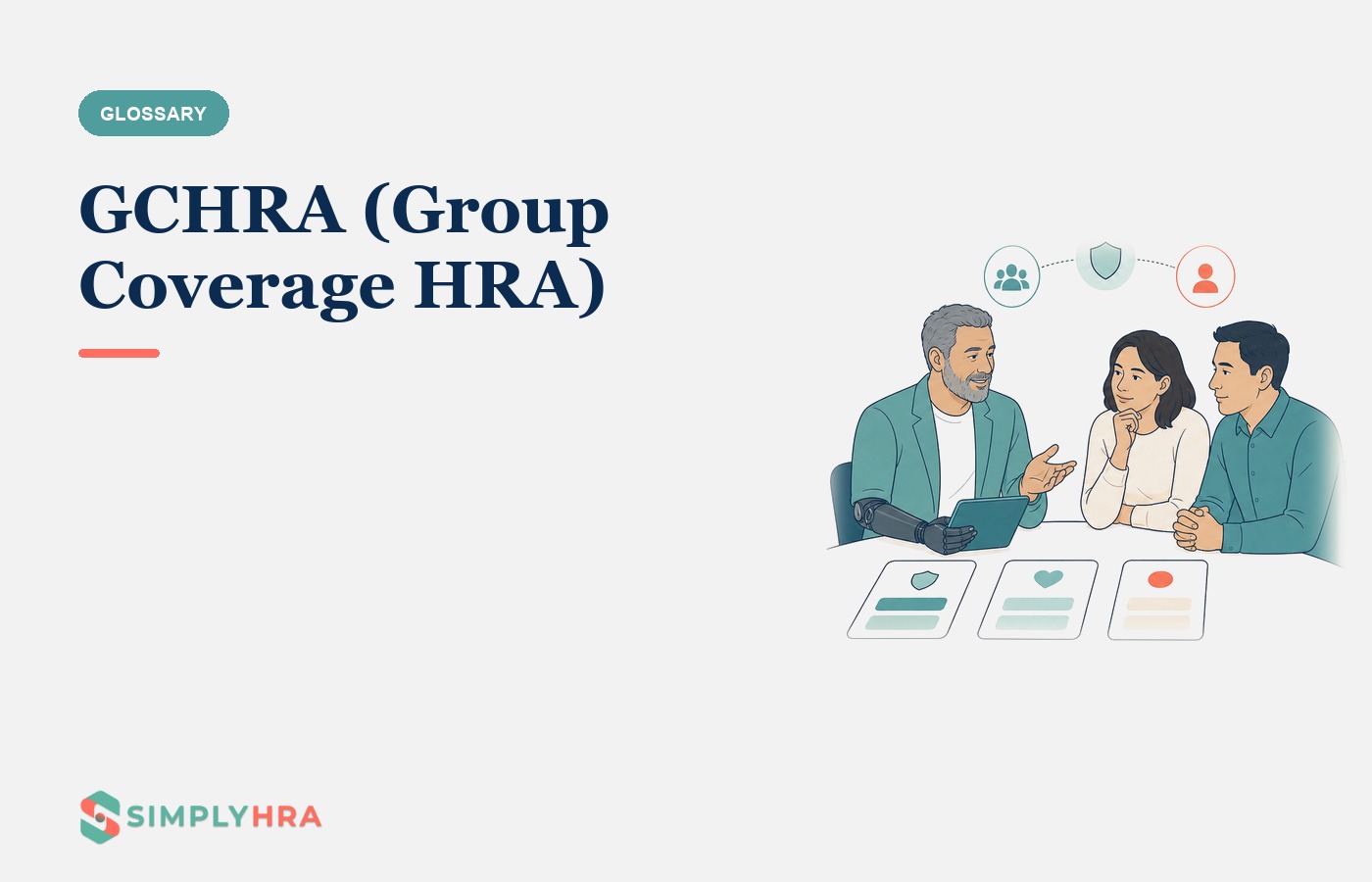
If you’re a small business owner or HR manager, you might be hearing more about GCHRA, or Group Coverage Health Reimbursement Arrangements, lately. But what exactly is a GCHRA, and how does it fit into the world of employee health benefits? In simple terms, a GCHRA is a way for employers to help cover their employees’ health insurance premiums through tax-free reimbursements tied to a group health plan. This article will walk you through the ins and outs of GCHRA, clarifying what small business owners, HR managers, and employees need to know about these accounts to make well-informed decisions.
CHOICE (Custom Health Option and Individual Care Expense) Arrangement is the current name for what was previously referred to as an ICHRA (Individual Coverage Health Reimbursement Arrangement). This page uses both terms.
What Is a Group Coverage HRA (GCHRA)?
Defining GCHRA
Unlike individual coverage HRAs (ICHRA), which reimburse employees purchasing coverage on the individual market, GCHRAs are designed to work alongside traditional group health insurance options.
How Does a GCHRA Work?
Here’s the lowdown on how GCHRAs function:
- Employer sponsors a group health plan.
- Employer sets aside funds into the GCHRA that employees use to pay premiums.
- Employees enroll in the group health plan.
- Employees submit premium receipts or proofs for reimbursement.
- Employer reimburses employees tax-free for eligible premiums and medical expenses within plan rules.
Because GCHRAs are tied to group plans, the benefit is streamlined for businesses already offering group coverage, ensuring money allocated by employers offsets premiums without additional taxable income for employees.
Who Can Use a GCHRA?
Eligibility From a Small Business Perspective
GCHRAs are typically available to businesses of all sizes but work best for employers who already have a group plan in place. A GCHRA supplements an employer’s existing group health plan. It must be administered under the applicable Section 105 rules for self-insured medical reimbursement plans, including the §105(h) nondiscrimination requirements, which differ from the rules that govern an ICHRA.
Employee Eligibility and Participation
Employees eligible for GCHRAs must participate in the employer’s group health plan. They cannot use GCHRA funds to buy individual market coverage. Participation often hinges on meeting the group plan’s eligibility criteria, like full-time status or waiting periods.
The Benefits of GCHRA for Employers and Employees
Advantages for Employers
Small businesses gain multiple benefits by offering a GCHRA, including:
- Predictable costs: Employers control contributions and budgeting is straightforward.
- Simplified administration: Ties closely to existing group plans, reducing complexity.
- Tax savings: Reimbursements are tax-deductible business expenses.
- Employee attraction and retention: Helps offer competitive benefits tailored to employee needs.
Perks for Employees
From the employee side, GCHRA offers:
- Tax-free reimbursements: Employees save money by having premiums reimbursed tax-free.
- Access to group coverage: Maintains access to employer-sponsored insurance options.
- Potential coverage for dependents: Arrangements may allow reimbursement of family premium costs.
- Clear claims process: Typically less paperwork than individual market reimbursements.
How GCHRA Differs From Other HRAs
GCHRA vs. ICHRA
While both are types of HRAs, GCHRA requires employees to enroll in the group health insurance plan offered by the employer, unlike the ICHRA, which reimburses premiums for individual market plans employees choose themselves. This means GCHRA limits employee choice but simplifies the employer’s offering.
GCHRA vs. QSEHRA
Qualification Status Employer Size Employee Coverage Plan Reimbursement Type Reimbursement Limits GCHRA All sizes Group insurance plan premiums and medical expenses Tax-free reimbursements as per employer’s discretion No dollar limit set by law
Understanding these nuances helps businesses select the best HRA model matching their size, budget, and employee needs.
How to Set Up a GCHRA for Your Small Business
Steps to Launch a GCHRA Program
Setting up a GCHRA involves several key actions:
- Verify your business offers a group health insurance plan that employees can enroll in.
- Decide the employer contribution amount per employee or class of employees.
- Update your benefits plan documents to include GCHRA terms.
- Communicate clearly with employees about their eligibility, coverage, and reimbursement process.
- Establish a system to track reimbursements and maintain compliance with IRS rules.
- Work with benefits platforms, like SimplyHRA, to streamline administration.
Compliance Considerations
GCHRAs are governed by the Section 105 rules for self-insured medical reimbursement plans, including the §105(h) nondiscrimination requirements and the Treasury Regulations under §1.105-1, and must remain integrated with a compliant group health plan (see IRS Notice 2013-54). Employers must ensure nondiscrimination rules are met and maintain records of reimbursements. Penalties can apply for non-compliance, so partnering with knowledgeable service providers is highly recommended.
Managing Costs and Budgeting With GCHRA
One of the biggest appeals of GCHRA is control over health benefit spending. Unlike fixed group plan premiums that sometimes spike annually, GCHRA lets employers budget exact amounts to reimburse employees. However, it’s essential to consider:
- Anticipated premium costs for the group plan.
- Total employer contribution limits aligned with your budget.
- Employee classes with different contribution levels depending on role or tenure.
- Potential integration with other benefit programs or HRAs.
Employee Experience With GCHRA
Signing Up and Using GCHRA Funds
Employees generally follow these steps:
- Enroll in the employer’s group health plan during open enrollment or qualifying events.
- Submit premium receipts or invoices for reimbursement.
- Receive tax-free payments from the employer or employer’s HRA plan administrator.
- Use funds for eligible medical expenses if the plan allows.
What Happens If Employees Don't Enroll?
Since GCHRA requires group plan enrollment to access funds, employees who don't opt-in won’t receive reimbursement for premiums. Some businesses offer alternative benefits or incentives to encourage participation.
Why SimplyHRA Is a Strong Partner for GCHRA Management
Managing GCHRA reimbursements manually can get pretty complex. At SimplyHRA, we simplify the whole process, so you don’t have to sweat tax rules, paperwork, or compliance pitfalls. Our platform enables easy setup of GCHRA contributions by employee class, automates reimbursements, and offers 24/7 support to employees and employers alike. Whether you’re an owner, an HR manager, or an employee, SimplyHRA makes health benefit management transparent and hassle-free without the traditional group insurance headaches.
If you want to provide your employees with flexible, tax-advantaged healthcare benefits while keeping things under budget, contact SimplyHRA today. We’re here to help you navigate GCHRA options and build a benefits program that fits your small business like a glove. Reach out by emailing info@simplyhra.com or schedule a consultation at https://simplyhra.com/contact.
Conclusion
GCHRA is an effective tool that helps small businesses support employee health coverage costs tied directly to group health plans. Its tax advantages, cost control, and ease of use offer employers and employees a balanced benefits approach. For small businesses aiming to offer valuable health coverage without drowning in administrative burdens, SimplyHRA provides expertise, technology, and reliable support to make GCHRA management smooth and beneficial for everyone involved. Don’t hesitate to connect with us for guidance that fits your unique business needs.
Understanding the Relationship Between GCHRA and the Affordable Care Act (ACA)
Is a GCHRA Compliant With the ACA?
When small businesses consider offering health benefits, one of the most common questions is whether their chosen option complies with the Affordable Care Act (ACA). The good news is that GCHRAs are fully compliant with ACA regulations provided they are offered in conjunction with a qualified group health insurance plan.
Employers must ensure that the underlying group plan meets ACA’s minimum value and affordability standards. The GCHRA itself does not replace the group coverage but acts as a supplemental tool to reimburse employees for certain eligible medical expenses or premiums. This lowers the overall cost burden on employees without conflicting with marketplace rules.
Does GCHRA Affect Employer Mandate Requirements?
For employers subject to the ACA employer mandate (typically businesses with 50 or more full-time employees), offering a GCHRA integrated with a compliant group plan still satisfies the requirement to provide “minimum essential coverage.” This helps avoid potential penalties tied to employer shared responsibility.
However, smaller businesses not obligated by the mandate benefit by offering GCHRAs without triggering complicated ACA penalties or mandates. This flexibility makes GCHRA a viable option for many growing companies.
Impact of GCHRA on Employees’ Premium Tax Credits and Marketplace Coverage
Can Employees Receiving GCHRA Reimbursements Also Qualify for Premium Tax Credits?
This is a critical concern for employees balancing financial assistance options. Under IRC §36B, employees offered group health coverage that meets the affordability standard (9.96% of household income for 2026, per IRS Rev. Proc. 2025-25) are not eligible for the Premium Tax Credit, and the GCHRA-related ineligibility stems from the underlying group-coverage offer, not a GCHRA-specific rule.
Why? Because the IRS views these employees as covered by an affordable employer-sponsored plan. For employees seeking premium tax credits, the GCHRA may reduce eligibility depending on the affordability thresholds outlined by the IRS (see IRS Publication 974 for additional details).
Employee Options If GCHRA Is Unaffordable or Not Elected
If employees find the GCHRA or associated group plan unaffordable or choose not to participate, they might consider declining the group coverage and instead purchasing individual market insurance through the ACA marketplace. In such cases, the employee might qualify for premium tax credits unavailable with the GCHRA option.
Coordinating GCHRA With Other Benefits
GCHRA and Flexible Spending Accounts (FSA) or Health Savings Accounts (HSA)
Employers often ask how GCHRAs interact with FSAs or HSAs. Here’s what to know:
- FSAs: Employees enrolled in a group plan reimbursed by GCHRA can typically still participate in employer-sponsored FSAs for additional out-of-pocket expense coverage.
- HSAs: State that if the group plan is HDHP-eligible and reimbursement arrangement is funded, careful coordination is required to avoid HSA disqualification; cite IRC §223(c)(1)(B) and Treasury regulations. However, employers should ensure compliance by coordinating benefits carefully.
Combining GCHRA with ICHRA or QSEHRA
Combining a GCHRA with a parallel stand-alone HRA (such as ICHRA or QSEHRA for the same employee) is generally not permitted: under IRS Notice 2013-54 and the integration framework codified at 26 CFR §54.9815-2711(d), an HRA must be integrated with the underlying group coverage. Employers offering a GCHRA cannot also offer those same employees an ICHRA or QSEHRA for the same period, the employee participates in one structure.
Potential Challenges and Considerations When Using GCHRA
Administrative Complexity and Recordkeeping
Though GCHRA simplifies premium reimbursements compared to some alternatives, employers still must maintain accurate records of:
- Employee eligibility and enrollment in the group plan.
- Reimbursement amounts matched against premiums.
- Compliance with nondiscrimination rules to avoid IRS penalties.
Without automated systems, this can become time-consuming, particularly as businesses scale.
Communication and Employee Education
Employees unfamiliar with GCHRAs may misunderstand how reimbursements work or confuse them with other health benefits. Clear communication is essential to explain:
- The necessity of enrolling in the group health plan.
- What expenses are reimbursable.
- How to submit claims for reimbursement.
- Impact on tax credits and other benefits.
Employers who invest in employee education see better participation and satisfaction.
How SimplyHRA Enhances GCHRA Program Success
Streamlining Administration Through Automation
SimplyHRA’s platform eliminates much of the hassle traditionally associated with managing GCHRAs. From automated reimbursement tracking to seamless claims processing, small businesses can offload complicated recordkeeping and compliance tasks to technology designed for ease.
Personalized Support for Employers and Employees
Beyond technology, SimplyHRA’s dedicated support helps HR managers understand the nuances of GCHRA regulations and assists employees with their specific benefits questions through AI-powered chat and licensed broker advice. This holistic approach builds confidence and maximizes program impact.
If you want to take the stress out of managing your Group Coverage HRA and provide a benefits experience your employees truly value, reach out today at info@simplyhra.com or schedule a call at https://simplyhra.com/contact. Let’s make healthcare benefits simple and effective for your small business.
Frequently Asked Questions (FAQs) about GCHRA (Group Coverage HRA):
Q: Can GCHRA funds be used to cover dependents' premiums under the group health plan?
A: Yes, employers can structure GCHRAs to reimburse premiums for employee dependents enrolled in the group health plan. This flexibility helps employees cover family coverage costs, but the group plan must include those dependents as eligible members.
Q: Are there any limits on how much an employer can contribute to a GCHRA?
A: However, contributions must comply with nondiscrimination rules to ensure fairness across employee groups.
Q: What happens if an employee leaves the company mid-year regarding GCHRA reimbursements?
A: Typically, reimbursement eligibility ends when employee coverage terminates. Employers might pro-rate the reimbursement based on employment duration. It’s important to outline these rules in the plan documents and communicate them clearly to departing employees.
Q: Does offering a GCHRA affect the way payroll taxes are handled?
A: Reimbursements through a GCHRA are not treated as taxable wages, provided the arrangement qualifies as a compliant §105 HRA and satisfies IRC §105(h) nondiscrimination testing, non-compliant arrangements may result in taxable income to employees. Employers should coordinate with their payroll provider to correctly process these reimbursements and avoid tax-withholding errors.
Q: Can part-time or seasonal employees be offered GCHRA benefits?
A: Yes, employers have flexibility to define eligibility criteria, including offering GCHRA benefits to part-time or seasonal workers if they qualify for and enroll in the group health plan. However, setting clear eligibility standards ensures compliance with nondiscrimination provisions.
Q: How does offering a GCHRA impact COBRA continuation coverage obligations?
A: Yes: HRAs tied to group plans trigger COBRA continuation rights for the HRA itself, under IRC §4980B, ERISA §§601-608, and Treas. Reg. §54.4980B-2 Q&A 1.
Q: Can changes be made to GCHRA contributions throughout the year?
A: Employers can adjust GCHRA contribution amounts or eligibility criteria, but changes should align with plan documents and be communicated to employees. Mid-year changes may affect affordability calculations under the ACA, so careful planning is recommended.
Q: Are reimbursements for premiums the only payments allowed under GCHRA?
A: While GCHRAs primarily reimburse group plan premiums, employers can also design their plan to cover other eligible medical expenses as defined by the IRS. It’s essential to specify reimbursable expenses in the plan documentation to avoid compliance issues.
Q: What records should employers retain to stay compliant with GCHRA regulations?
A: Employers should keep documentation of plan terms, employee eligibility, reimbursement requests and approvals, proof of premiums paid, and nondiscrimination testing results. Good recordkeeping supports audits and ensures the program runs smoothly.
Q: How do employees prove premium payment when submitting a reimbursement request?
A: Typically, employees submit invoices, billing statements, or Explanation of Benefits (EOBs) showing premiums paid for the group health plan. Electronic systems like SimplyHRA’s platform can facilitate and validate these submissions to speed reimbursement.
Q: Is there a required enrollment period for employees to participate in a GCHRA?
A: Generally, employees must enroll in the group health plan during the employer’s open enrollment or within a qualifying life event window. Because GCHRA funds reimburse premiums tied to that plan, eligibility corresponds to enrollment periods established by the group plan.
Q: Can employers integrate wellness program incentives with GCHRA reimbursements?
A: Yes, some employers combine wellness incentives by reimbursing wellness-related medical expenses through the GCHRA. However, this must comply with IRS rules regarding nondiscrimination and permitted expenses within the health reimbursement arrangement.
Q: Are GCHRAs portable if an employee changes jobs within the same company?
A: Within a multi-location organization, GCHRA eligibility and reimbursements typically depend on the employee’s participation in that location’s group health plan. Moving between locations with different plans may affect GCHRA benefits unless the employer coordinates across plans.
Q: How do GCHRAs interact with state health insurance mandates?
A: Since GCHRAs reimburse premiums for group plans, they are generally subject to the same state insurance regulations applicable to those plans. Employers should consult with state regulatory bodies or legal counsel to ensure compliance with state-specific mandates.
Q: Can retirees receive GCHRA reimbursements?
A: While employers can design plans to include retirees, doing so requires careful plan design and compliance with ERISA and IRS requirements. Many employers offer separate retiree benefits programs instead; consulting with benefits professionals is advisable.
Q: Do GCHRAs cover vision and dental insurance premiums under the group plan?
A: Employers can choose to include vision and dental premiums if those coverages are part of the group health insurance package. Coverage and reimbursement depend on plan specifics and the employer’s design decisions.
Q: What impact does offering a GCHRA have on employee satisfaction and turnover?
A: Studies and feedback indicate employees value greater financial support for healthcare costs, which can improve satisfaction and retention. GCHRAs that reduce out-of-pocket premium expenses contribute positively to the overall employee benefits experience.
Q: How quickly are reimbursements generally processed under a GCHRA?
A: Processing times vary depending on the employer’s system or third-party administrator. Automated platforms like SimplyHRA can offer near real-time reimbursements, reducing employee wait times and administrative bottlenecks.
Q: Can spouses who are employees participate in the same GCHRA?
A: Yes, provided both spouses are eligible employees enrolled in the group health plan, they can participate and receive reimbursements according to the plan’s terms. Coordination to avoid duplication or exceeding reimbursement limits is recommended.
Q: Are GCHRA funds available to employees immediately upon plan start, or is there a waiting period?
A: The availability of GCHRA reimbursements typically coincides with the group plan’s coverage effective date. Some employers may impose waiting periods before benefits begin, but these should be clearly communicated to employees during enrollment.
Why SimplyHRA Is the Right Choice for Managing Your GCHRA Benefits
Navigating the complexities of Group Coverage HRAs can be overwhelming, especially for small business owners and HR managers who wear multiple hats daily. At SimplyHRA, we understand the unique challenges small businesses face because we’ve been in your shoes. Our platform was built to simplify the administration of health benefits like GCHRA, helping you set up, manage, and track reimbursements effortlessly, without the usual headaches of compliance or paperwork.
Our experience working closely with small businesses has shown us that employees value transparency, flexibility, and ease when it comes to their health benefits. SimplyHRA delivers on these fronts by providing customized solutions that let employees use GCHRA funds smoothly, ensuring they’re supported no matter their health coverage needs. For HR managers, our automated system significantly reduces administrative burdens, freeing up your team to focus on other priorities while keeping your benefits compliant and budget-friendly.
If you’re ready to streamline your GCHRA program and give your employees a health benefits experience they appreciate, SimplyHRA can help. Reach out today for a personalized consultation about your employer or employee benefits by emailing info@simplyhra.com or scheduling a call at https://simplyhra.com/contact. Let’s work together to make your small business’s health benefits simple, effective, and tailored to your team’s needs.
Related glossaries

Dental Insurance
Direct Enrollment / Enhanced Direct Enrollment (EDE)