Cost-Sharing Reduction (CSR)
Cost-Sharing Reduction (CSR): What It Is and Who Qualifies
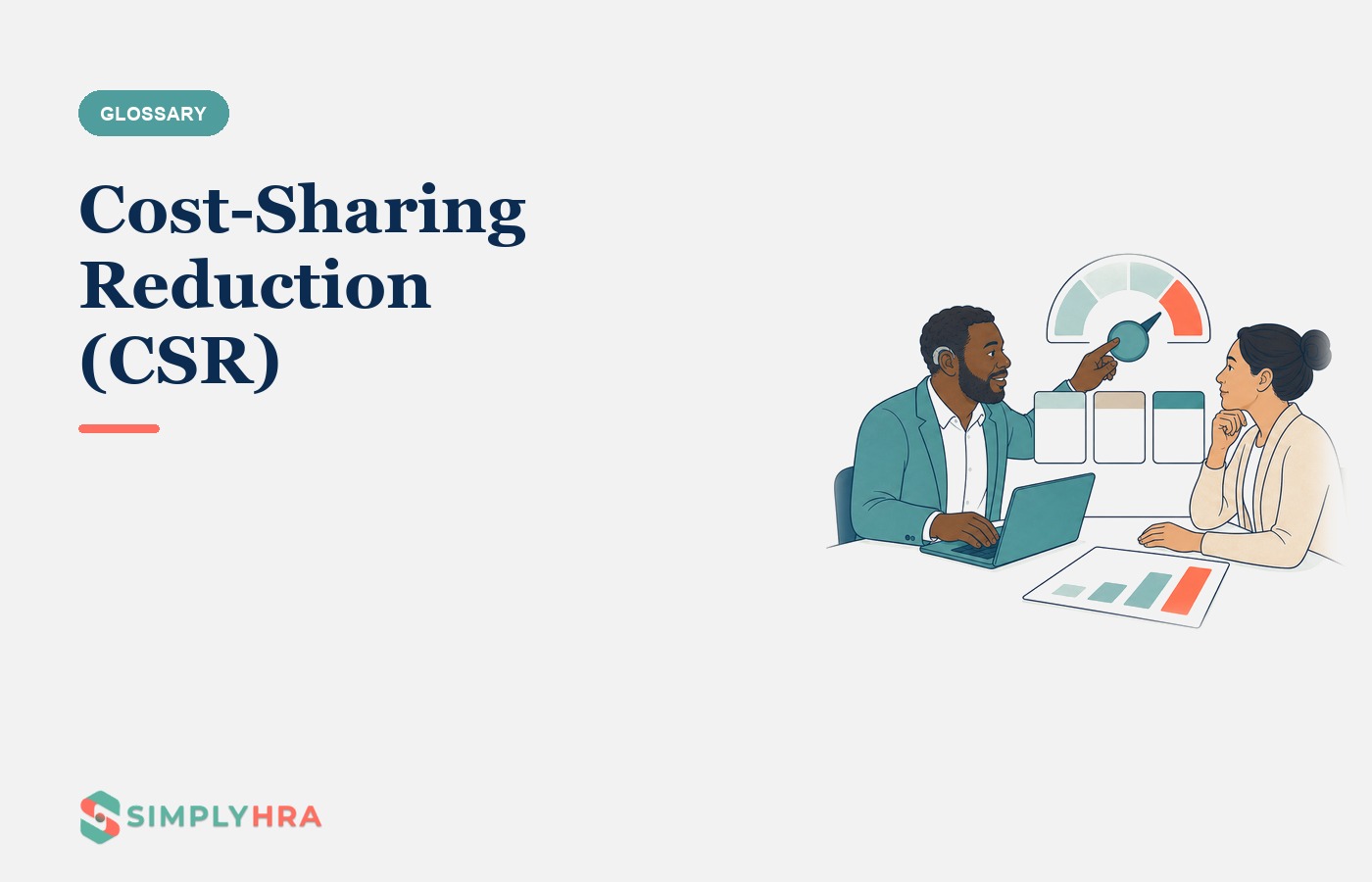
Cost-Sharing Reduction (CSR) is extra Marketplace assistance that lowers what an eligible person pays out of pocket when they use healthcare.
CHOICE (Custom Health Option and Individual Care Expense) Arrangement is the current name for what was previously referred to as an ICHRA (Individual Coverage Health Reimbursement Arrangement). This page uses both terms.
Think deductibles, copayments, coinsurance, and the annual out-of-pocket maximum—not the monthly insurance premium. Premium tax credits can lower the premium; CSR makes the coverage itself more generous. Some people qualify for both.
This matters if you’re uninsured and shopping for coverage, or if your employer is considering a health reimbursement arrangement that may affect your Marketplace assistance. The rules come from Section 1402 of the Affordable Care Act and its implementing regulations in Title 45, Part 155 of the Code of Federal Regulations.
What is a Cost-Sharing Reduction?
A Cost-Sharing Reduction changes the cost-sharing terms of an eligible Marketplace plan. You still have health insurance with a private insurer, but you may pay less when you visit a doctor, fill a prescription, receive testing, or need hospital care.
For most applicants, CSR is available only with a Silver-level plan purchased through the federal or a state Health Insurance Marketplace. HealthCare.gov’s “Cost-sharing reductions” guidance explains that choosing Bronze, Gold, or Platinum coverage generally means giving up this assistance, even if your income otherwise qualifies.
Standard Silver plans are designed to cover about 70% of an average population’s covered medical costs. CSR variants raise that actuarial value to approximately:
- 94% for the lowest eligible income band
- 87% for the next income band
- 73% for the highest eligible income band
Those percentages aren’t a promise about your personal bills. They’re a measure of how costs are divided across a standard population under the plan, as described in the Centers for Medicare & Medicaid Services’ annual Notice of Benefit and Payment Parameters.
How does CSR work in practice?
You don’t receive CSR as a reimbursement or tax refund. When you complete a Marketplace application, the Marketplace estimates your eligibility from your expected annual household income, family size, tax-filing information, and other coverage available to you. If you qualify and select the right Silver plan, the lower deductible and other reduced charges are built into the plan.
Here’s the employer wrinkle. Harbor Design has eight employees and offers an Individual Coverage Health Reimbursement Arrangement (ICHRA) with a $400 monthly allowance. Maya’s benchmark individual premium is $520, so the initial difference is $120 per month: $520 − $400 = $120.
Maya can’t simply take the $400 ICHRA allowance and stack it with Marketplace premium tax credits and CSR. Under the Internal Revenue Service’s final ICHRA regulations, an affordable ICHRA offer generally makes her ineligible for premium tax credits—and therefore ordinary income-based CSR. If the offer is considered unaffordable, she may opt out of the ICHRA and seek Marketplace assistance instead, subject to the full eligibility rules.
Who qualifies for Cost-Sharing Reduction?
For the standard income-based version, you generally must:
- Enroll through the federal Marketplace or your official state Marketplace
- Be eligible for a premium tax credit
- Have household income within the applicable CSR range, generally 100% through 250% of the federal poverty level
- Choose a Silver plan
Eligibility below 100% of the federal poverty level can differ for certain lawfully present immigrants who aren’t eligible for Medicaid because of their immigration status. Medicaid expansion also affects whether lower-income adults are directed to Medicaid instead of Marketplace coverage.
Members of federally recognized tribes and Alaska Native Claims Settlement Act corporation shareholders can qualify for separate cost-sharing protections, with different income and plan rules. The Marketplace makes the determination from the application.
From an employer’s side, CSR isn’t a benefit you directly fund or administer. Your job is to understand how an offer of group coverage, an ICHRA, or a Qualified Small Employer Health Reimbursement Arrangement (QSEHRA) may affect an employee’s Marketplace eligibility. From an employee’s side, report employer offers accurately and update the Marketplace if your income, household, or coverage changes.
What CSR costs employers and which duties apply
An employer doesn’t pay for Cost-Sharing Reduction, calculate it, or claim it for an employee. The federal government makes payments to insurers, and the insurer provides the reduced cost-sharing through the employee’s eligible Marketplace policy.
Your compliance work comes from the coverage you offer—not from CSR itself. If you offer an Individual Coverage Health Reimbursement Arrangement (ICHRA), the federal ICHRA final rule generally requires a written notice at least 90 days before each plan year. Someone who becomes eligible later generally must receive it by the date coverage can begin.
That notice should explain that accepting the ICHRA can affect premium tax credits and related CSR eligibility. You’ll also need plan documents, substantiation that reimbursements are for eligible individual coverage, and consistent treatment within permitted employee classes.
A Qualified Small Employer Health Reimbursement Arrangement (QSEHRA) also generally requires written notice at least 90 days before the plan year, or when a newly eligible employee first becomes eligible. Internal Revenue Code Section 6652(o) provides a late-notice penalty of $50 per employee, capped at $2,500 per calendar year, although reasonable-cause relief may apply.
If you average at least 50 full-time employees, including full-time-equivalent employees, you may be an Applicable Large Employer (ALE). An ALE can face monthly employer shared-responsibility payments under Internal Revenue Code Section 4980H if it fails to offer qualifying coverage and at least one full-time employee receives a premium tax credit. The amounts are indexed annually; the Internal Revenue Service’s Employer Shared Responsibility Provisions Questions and Answers explains the assessment process. Smaller employers generally aren’t subject to those Section 4980H payments.
What it means for an employee’s coverage and paycheck
CSR doesn’t appear as extra taxable pay, and it isn’t deducted from your paycheck. Instead, you see its value when the plan applies a smaller deductible, copayment, coinsurance amount, or out-of-pocket limit.
If you currently have no insurance, start with an application through HealthCare.gov or your official state Marketplace. You may enroll during annual Open Enrollment or after a qualifying life event creates a Special Enrollment Period. Medicaid and Children’s Health Insurance Program enrollment remains available year-round for eligible applicants.
Before choosing a plan, compare the total yearly exposure—not just the premium. A zero-premium Bronze plan after tax credits can still cost more when you need care than a Silver plan with Cost-Sharing Reduction.
If your employer offers an ICHRA or other coverage, don’t ignore the notice. The Marketplace needs the offer details, even if you haven’t enrolled. An affordable offer can block premium tax credits and income-based CSR, while an unaffordable ICHRA may leave you a choice between accepting the reimbursement or opting out and applying for Marketplace assistance.
Worked example: allowance cost versus employee cost
Cedar Street Studio has 10 employees and sets a $450 monthly ICHRA allowance for each employee. Its maximum reimbursement budget is $4,500 per month: 10 × $450. Over 12 months, that’s $54,000 if every employee uses the full allowance.
Luis is offered the allowance and finds a Silver policy costing $610 per month. If he accepts the ICHRA and submits eligible proof of coverage, as much as $450 can be reimbursed tax-free, leaving $160 of premium for him: $610 − $450.
If the ICHRA is unaffordable under the applicable federal test, Luis can instead opt out and ask the Marketplace to determine whether he qualifies for a premium tax credit and CSR. He can’t receive the $450 reimbursement for those months and also take those Marketplace subsidies.
Common Cost-Sharing Reduction mistakes
Treating CSR as a premium discount. It reduces eligible out-of-pocket charges; the premium tax credit is what reduces the monthly premium.
Picking the cheapest metal tier automatically. Income-based CSR generally requires a Silver plan, so selecting Bronze can forfeit much larger savings at the doctor or pharmacy.
Assuming an unused employer offer doesn’t count. Marketplace eligibility can depend on whether coverage was offered and whether it was affordable, not merely whether you enrolled. Report the offer and any household or income changes promptly to reduce the risk of an incorrect subsidy determination.
Frequently Asked Questions About Cost-Sharing Reduction (CSR)
Do I have to pay back Cost-Sharing Reduction if my income changes?
You generally don’t repay the value of medical cost-sharing reductions through your federal tax return. That’s different from advance payments of the premium tax credit, which are reconciled using your final household income and tax information.
Still, report income and household changes to the Marketplace as soon as they happen. Your plan may be moved to a different CSR level for future care, and waiting can create a premium-tax-credit bill at tax time. These rules are described in Internal Revenue Service Publication 974, Premium Tax Credit, and the Centers for Medicare & Medicaid Services’ Marketplace eligibility guidance.
Does CSR reduce every doctor, hospital, and prescription bill?
No. The plan’s own network, covered-drug list, medical-necessity rules, and exclusions still apply. Cost-Sharing Reduction can improve the amounts charged for covered services, but it doesn’t turn excluded care into covered care or guarantee that every prescription has a low copayment.
Check the plan’s Summary of Benefits and Coverage, provider directory, and drug formulary before enrolling. For expensive ongoing treatment, confirm the specific facility, clinician, medication, and dosage rather than relying only on a general statement that the plan covers that type of care.
Can my spouse or children get CSR if my job offers coverage only to me?
Possibly. Marketplace affordability is tested separately for an employee and the employee’s family members under the Internal Revenue Service’s final rule, “Affordability of Employer Coverage for Family Members of Employees.” A job-based plan might be affordable for you based on the employee-only premium but unaffordable for your spouse or children based on the required family premium.
In that situation, eligible family members may qualify for Marketplace assistance even when you don’t. The Marketplace will also consider household income, tax relationships, access to Medicaid or the Children’s Health Insurance Program, and other eligibility factors.
Are there different CSR rules for American Indians and Alaska Natives?
Yes. Members of federally recognized tribes and Alaska Native Claims Settlement Act corporation shareholders may qualify for special zero-cost-sharing or limited-cost-sharing plan variants. These protections can apply under rules that differ from the standard income-based Silver-plan structure, including options across metal levels in certain circumstances.
Applicants may need to provide documents confirming tribal status. The governing provisions appear in Affordable Care Act Section 1402 and 45 Code of Federal Regulations Section 155.350; the federal Marketplace also publishes enrollment guidance for American Indians and Alaska Natives.
What should I do if my Silver plan charges the wrong deductible or copay?
First, compare the bill and Explanation of Benefits with the deductible, copayment, and out-of-pocket limit shown in your enrollment documents. Then call the insurer and ask it to confirm that you’re enrolled in the correct CSR plan variant, not merely a standard Silver version.
If the insurer doesn’t fix the issue, request an internal appeal and keep the Marketplace eligibility notice, bills, receipts, and call records. You may also have external-review rights under 45 Code of Federal Regulations Section 147.136 and can contact your state insurance department or Marketplace for help.
Do Cost-Sharing Reduction rules change from state to state?
The federal eligibility framework doesn’t change just because you move, but the shopping process can. Some states run their own Marketplaces, set different Open Enrollment dates, request different verification documents, or add state-funded premium and cost-sharing assistance on top of federal help. Available insurers, Silver plans, provider networks, and prices also vary by county.
Use HealthCare.gov unless it directs you to your state’s official Marketplace. If you move across state lines, you’ll generally need a new application and plan; your old plan and its Cost-Sharing Reduction terms don’t simply transfer. See Centers for Medicare & Medicaid Services guidance on state-based Marketplaces and 45 Code of Federal Regulations Section 155.420.
Can I get CSR after a qualifying life event?
Yes, if the event gives you a Special Enrollment Period and the Marketplace finds you eligible when you apply. Common triggers include losing job-based coverage, marriage, birth or adoption, and a permanent move that meets the coverage-history rules. Most Special Enrollment Periods allow 60 days before or after the event, although deadlines and proof requirements depend on the event.
The reduced charges generally apply only after your qualifying Silver coverage takes effect; they won’t erase earlier uninsured medical bills. Don’t cancel existing coverage until you’ve confirmed the new plan’s effective date. Federal timing rules appear in 45 Code of Federal Regulations Section 155.420 and HealthCare.gov’s Special Enrollment Period guidance.
Can business owners, part-time employees, and new hires qualify for CSR?
Employment label alone doesn’t decide eligibility. A part-timer or new hire can qualify if they meet the Marketplace rules and don’t yet have access to another form of coverage that blocks assistance. Once an employer offer becomes effective, the Marketplace must evaluate that offer.
Owners face an extra tax-status question. Sole proprietors, partners, and more-than-2% shareholders of an S corporation generally can’t participate in a health reimbursement arrangement as common-law employees, while a working C corporation owner may be treated differently. That distinction can change whether an employer arrangement affects Marketplace assistance. Employers should check Internal Revenue Service Notice 2017-67 and the federal ICHRA final regulations before promising eligibility.
Can I get CSR if I’m offered COBRA?
Merely being allowed to elect Consolidated Omnibus Budget Reconciliation Act (COBRA) continuation coverage generally doesn’t prevent Marketplace assistance. Enrolling in COBRA usually does: while you’re covered, you generally can’t also receive a premium tax credit or income-based Cost-Sharing Reduction for a Marketplace plan.
Timing is the trap. Exhausting COBRA can create a Special Enrollment Period, but voluntarily dropping it early usually doesn’t. If you’re still within the enrollment window tied to losing job-based coverage, another route may remain open. Compare premiums, deductibles, networks, and treatment continuity before electing COBRA. See Department of Labor publication An Employee’s Guide to Health Benefits Under COBRA and HealthCare.gov’s COBRA guidance.
Can I receive CSR if I’m eligible for Medicare or Medicaid?
Usually not. Eligibility for full-benefit Medicaid or premium-free Medicare Part A generally makes you ineligible for the premium tax credit, which also closes the door to standard income-based CSR. Limited-benefit Medicaid programs, such as coverage restricted to certain services, can be treated differently.
Don’t end Medicaid or delay Medicare based only on a Marketplace price estimate. Medicare late-enrollment penalties and coverage gaps can last well beyond one plan year, and Marketplace subsidies may be terminated once Medicare starts. Report agency eligibility decisions promptly and check the Centers for Medicare & Medicaid Services’ Medicare and Marketplace guidance and 26 Code of Federal Regulations Section 1.36B-2.
Use Cost-Sharing Reduction (CSR) to Make a Better Benefits Decision
Remember three things: Cost-Sharing Reduction lowers eligible out-of-pocket medical costs rather than premiums, income-based assistance generally requires enrollment in a Silver Marketplace plan, and an employer’s coverage offer can affect whether an employee qualifies. Employees should report accurate household, income, and employer-offer information, while employers should provide required notices and avoid guessing about an employee’s subsidy eligibility.
SimplyHRA fits small businesses and startups because the employer can set a tax-free monthly allowance through an Individual Coverage Health Reimbursement Arrangement (ICHRA) or Qualified Small Employer Health Reimbursement Arrangement (QSEHRA), while each employee chooses individual coverage that fits their life. We built SimplyHRA after living small-business benefits problems ourselves, and we’ve helped other owners, HR managers, and their teams set up and run these benefits without enterprise overhead. This article is educational and isn’t legal or tax advice.
For a consultation about employer or employee benefits, email info@simplyhra.com or schedule a call with SimplyHRA.
Related glossaries

Dental Insurance
Direct Enrollment / Enhanced Direct Enrollment (EDE)