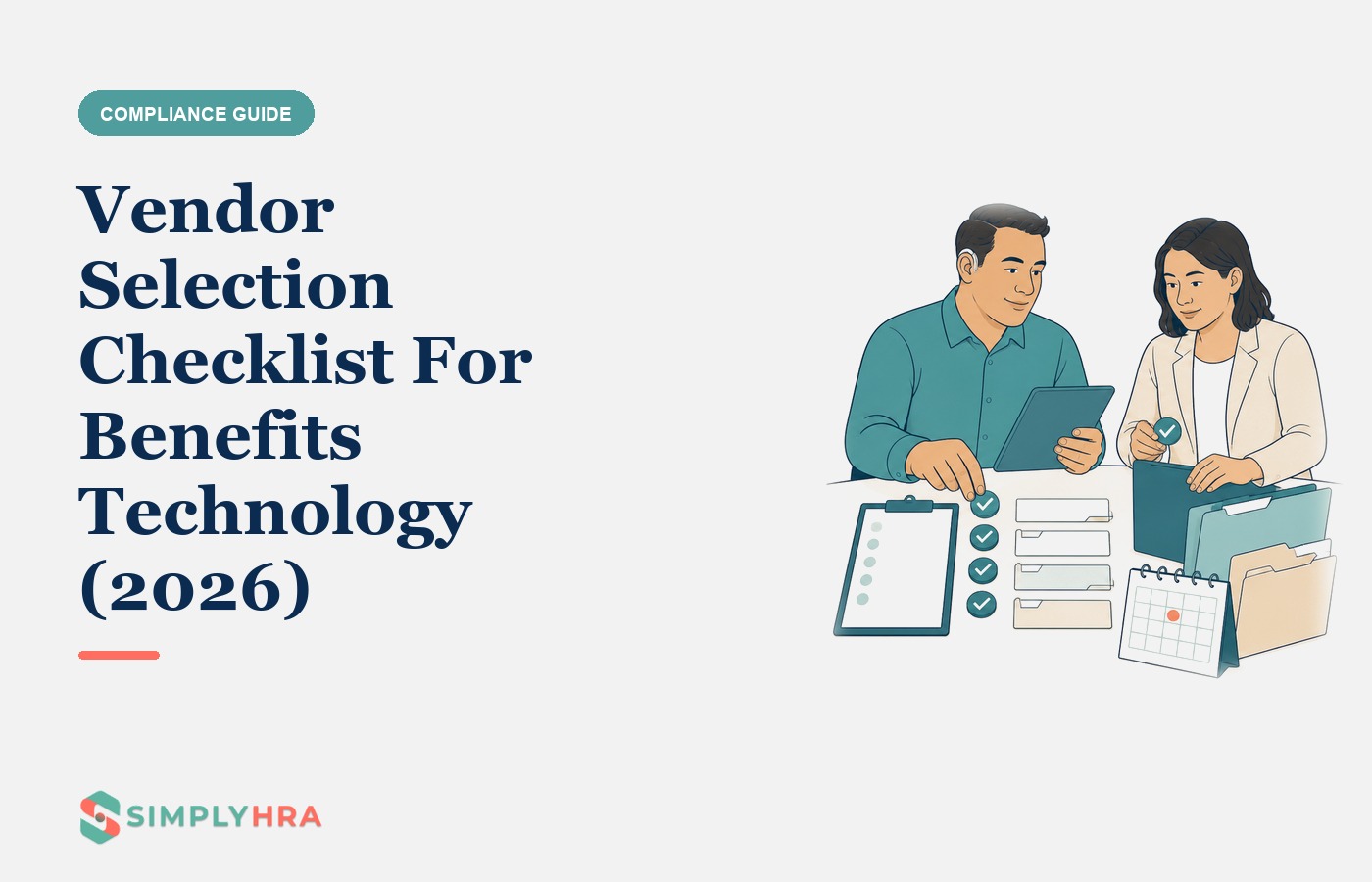
Vendor Selection Checklist For Benefits Technology (2026)
TL;DR
A vendor selection checklist for benefits technology is a structured scoring framework that helps employers compare platforms across compliance, integration, employee experience, pricing, support, security, plan design, and onboarding. It matters because the wrong platform creates manual work, compliance risk, and frustrated employees. For ICHRA and HRA programs, the checklist needs extra criteria around ACA affordability, employee class design, and substantiation that generic IT checklists miss entirely.
CHOICE (Custom Health Option and Individual Care Expense) Arrangement is the current name for what was previously referred to as an ICHRA (Individual Coverage Health Reimbursement Arrangement). This page uses both terms.
Healthcare costs are projected to rise 9.5% in 2026, the highest increase in five years. Benefits administration software is the infrastructure that determines whether your organization can manage that cost and complexity or get buried by it. Choosing the right platform is not a decision you can afford to guess your way through.
That’s where a vendor selection checklist for benefits technology comes in. It turns a subjective, often overwhelming purchasing decision into something measurable. And for employers offering ICHRAs or other HRAs, the stakes are even higher because compliance, employee plan selection, and payroll integration all introduce failure points that generic technology checklists don’t account for.
See how SimplyHRA works for employers evaluating ICHRA platforms.
What Is a Vendor Selection Checklist for Benefits Technology?
A vendor selection checklist for benefits technology is a structured evaluation framework that translates an employer’s benefits goals, compliance requirements, and operational constraints into measurable criteria for comparing technology vendors. It typically covers functionality, compliance automation, integration depth, employee experience, pricing transparency, support model, and security.
Think of it as a scorecard. Instead of picking a platform based on which demo looked nicest or which sales rep was most persuasive, you score each vendor against the same criteria using the same weights. The result is a defensible, repeatable decision that finance, IT, and HR can all stand behind.
For a detailed 25-question version specific to ICHRAs, see our ICHRA vendor selection checklist.
Why This Checklist Matters More Than Ever
The wrong benefits administration platform creates a cascade of problems: manual reconciliation, compliance exposure, open enrollment chaos, and employees who can’t navigate their own benefits. According to research from KFF, ICHRAs place more responsibilities on employees, who must select and enroll in an individual insurance policy. Vendors differ significantly in the services they offer and the market segments they target. The checklist is how you make sure the vendor you pick actually fits your situation.
Three forces make this evaluation more urgent now than five years ago.
Rising costs demand better infrastructure. Employer healthcare spending keeps climbing, and benefits administration software is the layer that determines whether you can control costs or just watch them grow.
Compliance complexity is increasing. ICHRA administration touches IRS, DOL, and HHS rules simultaneously. Mistakes lead to fines, audits, or loss of employee trust. The 2026 ACA affordability threshold sits at 9.96% of household income, and getting that calculation wrong has real consequences.
Employee expectations are higher. According to SHRM, more than 9 in 10 employees say benefits flexibility is important to their job satisfaction. Platforms that make benefits confusing or inaccessible undermine retention, no matter how generous the allowance.
The Eight Core Categories of a Benefits Technology Vendor Checklist
Every vendor selection checklist for benefits technology should evaluate candidates across these eight categories. Each one includes specific questions you should be asking during demos and reference calls.
1. Compliance Automation
This is table stakes. If the platform can’t automate compliance, everything else is noise.
Must-ask questions:
- Does the platform handle ACA affordability calculations automatically?
- Does it generate 1095-C reporting, ERISA plan documents, and COBRA administration?
- Does the vendor deliver compliant Summary Plan Descriptions and update them when rules change?
Modern benefits platforms can automate up to 80% of enrollment, payments, and compliance reporting through integration. But “automate” means different things to different vendors. Press for specifics about what’s fully automated versus what still requires manual input.
For employers subject to ALE penalties, understanding how the platform handles 1095-C line 14 codes is not optional.
2. Payroll and HRIS Integration
Payroll-benefits misalignment is one of the most common and costly data integrity problems in HR tech. It usually traces back to integration quality that wasn’t fully examined during the evaluation.
Must-ask questions:
- Does the platform sync bidirectionally with your payroll and HRIS systems in real time?
- What’s the error rate on payroll deductions and deduction transfers?
- Is integration included in the base price, or does it cost extra?
One-way data exports that require manual reconciliation aren’t really “integration.” They’re a workaround. Practitioners on Reddit frequently mention that ICHRA administration becomes frustrating when reimbursement records don’t flow cleanly into payroll, creating duplicate entries and audit risk.
For a deeper dive into what to test, read our HRIS integration checklist.
3. Employee Experience and Decision Support
The employee-facing experience increasingly determines whether the benefits program performs to its potential. Understanding the differences across dozens of plan options can be overwhelming, particularly for employees with no experience comparing aspects of plan design like deductibles, copays, and networks.
Must-ask questions:
- Can you get demo accounts so your team can test the enrollment flow from an employee’s perspective?
- Does the platform offer licensed advisor access to help employees choose plans?
- What educational resources (videos, guides, decision tools) come standard?
One of the most significant barriers to a successful ICHRA launch, as Venteur’s research documents, is a failure to communicate its value to employees. Platforms that include communication toolkits and advisor access tend to drive higher adoption than those that just provide a portal.
4. Pricing and Total Cost of Ownership
Per-employee-per-month pricing is common, but the license fee is where the conversation starts, rarely where it ends. Total cost of ownership includes implementation, integrations, per-transaction charges, and annual configuration.
Must-ask questions:
- What’s the full fee structure, including implementation, support, and renewal costs?
- Are there per-transaction fees for reimbursements or claims?
- What does the total cost look like over three years, not just year one?
Industry data from Shortlister puts benefits administration outsourcing costs typically between $3 and $8 PEPM, but that range hides significant variation in what’s actually included.
5. Support Model: Software-Only vs. Full-Service
The service model behind a provider often matters more than the technology itself. A strong platform with poor support delivers worse outcomes than a solid platform with a responsive team that knows your program.
Must-ask questions:
- What does support look like when something breaks during open enrollment at 9pm?
- Is there a dedicated account manager, or do you submit tickets into a queue?
- Does the vendor provide compliance guidance, or just compliance features?
This is the fork in the road many employers face. You can use a software-only ICHRA solution, but these portals may not cover compliance management, document preparation, or employee communication. You may need to supplement with a third-party administrator to fill the gaps. Our guide on whether you need a TPA breaks down this trade-off.
Book a free consultation to discuss which model fits your organization.
6. Security and Data Handling
Benefits platforms handle sensitive health and financial information. Security can’t be an afterthought.
Must-ask questions:
- Has the vendor completed a SOC 2 Type II audit? Can they share a summary report?
- Will they sign a Business Associate Agreement for HIPAA compliance?
- How do they handle data retention, access logs, and audit trails?
If a vendor hesitates on any of these, that’s your answer.
7. Plan Design Flexibility
For ICHRA and HRA platforms specifically, plan design flexibility is a category that generic IT vendor checklists miss completely.
Must-ask questions:
- Can you create employee classes based on role, location, full-time/part-time status, and other permissible criteria?
- Does the platform support age-based contribution variations using the IRS 3:1 ratio rule?
- Can allowances be customized by class without violating nondiscrimination requirements?
The 3:1 rule means the highest contribution for your oldest employee must not exceed three times the amount you contribute to your youngest. Platforms that don’t enforce this consistently create compliance exposure. For more on structuring classes correctly, see our guide on designing eligibility criteria.
8. Implementation and Onboarding
A strong 90-day launch plan should include multi-channel educational resources, access to benefits advisors, and a clear timeline of deadlines. By investing in this initial phase, employers can prevent the implementation mistakes that lead to low adoption.
Must-ask questions:
- What’s the typical implementation timeline? (Most platforms take 4 to 8 weeks depending on size and complexity.)
- Who owns the project on the vendor side, and what do they need from you?
- What employee communication materials are included?
This phase determines first impressions. If employees are confused on day one, the platform has already failed before it’s been fairly tested. Our ICHRA onboarding checklist covers this launch period in detail.
How to Use the Checklist: The Weighted Scoring Matrix
Having eight categories is a start. Knowing how to weigh them turns a checklist into a decision tool.
A weighted scoring matrix assigns numerical weights to each criterion based on your organization’s priorities, then scores each vendor against those weights. Here’s a practical approach:
-
Assign weights that reflect your reality. For regulated benefits like ICHRA, compliance and integration should carry the heaviest weights. If you have 200+ employees, bump up employee experience weight because confusion scales fast. If you’re a 15-person startup, implementation speed might matter most.
-
Score vendors on a 1-to-5 scale per criterion. Base scores on demos, reference calls, and documentation, not just sales presentations.
-
Multiply scores by weights and total them. The vendor with the highest weighted score is your strongest candidate, not necessarily your final pick, but the one that deserves the deepest evaluation.
-
Involve stakeholders beyond HR. Finance should weigh in on total cost of ownership. IT should evaluate integration architecture. If you have a broker relationship, their input on compliance depth is valuable.
This approach works because it forces trade-off conversations early. Maybe Vendor A has the best employee experience but weak payroll integration. The matrix makes that gap visible instead of letting it surface six months post-launch.
Five Common Vendor Evaluation Mistakes
Falling for demo polish
Feature checklists and demo polish don’t tell you much. Demos are designed to impress, not inform. The real test is how the platform handles edge cases: mid-year termination, partial reimbursement, multi-state employees. Ask to see those scenarios, not just the happy path.
Skipping payroll integration testing
This is the mistake that hurts most. If you don’t test the actual data flow between your payroll system and the benefits platform before signing, you’re gambling on the most operationally critical connection in your HR tech stack. Learn how to run test payroll cycles with ICHRA reimbursements before committing.
Treating HCM modules as dedicated benefits platforms
The most common mistake in benefits administration software evaluation is treating HCM capabilities and benefits administration capabilities as equivalent. They aren’t. An HCM suite may check the “benefits” box on a feature list, but its depth on compliance, substantiation, and employee decision support rarely matches a purpose-built platform.
Ignoring employee communication planning
Vendors that help educate employees drive higher adoption. If the vendor’s answer to “How do you help employees understand the benefit?” is “We have a FAQ page,” that’s a red flag. The shift from group plans to individual coverage requires active, multi-channel communication, not passive resources.
Forgetting total cost of ownership
Platform fees are just the start. Add implementation costs, per-transaction charges, annual configuration fees, and the internal labor required to manage the platform. A vendor quoting $15 PEPM with $10,000 in implementation fees and no included support may cost more than one quoting $29 PEPM with everything built in.
ICHRA-Specific Vendor Selection Considerations
Generic benefits technology checklists don’t cover the requirements unique to ICHRAs. If you’re evaluating ICHRA platforms specifically, add these to your vendor selection checklist for benefits technology:
ACA affordability verification. The platform must calculate whether the ICHRA offer is affordable under ACA rules using the applicable safe harbor. For 2026, the affordability threshold is 9.96% of household income. Getting this wrong can trigger employer shared responsibility penalties.
Employee class compliance. All employees within the same class must receive the ICHRA on equal terms. The platform should enforce this automatically, not rely on manual configuration. Our guide on ICHRA adoption covers class design in the broader context of launching the benefit.
Substantiation workflow. ICHRA reimbursements require proof that the employee has qualifying individual coverage. The vendor should automate eligibility verification, not leave it to spreadsheets.
Premium Tax Credit impact. Employees offered an affordable ICHRA generally can’t claim PTC on the marketplace. The platform should clearly communicate this to employees during enrollment to prevent costly surprises at tax time.
Broker access. Licensed broker or advisor support for employees choosing marketplace plans is a differentiator, not a nice-to-have. Talking to a licensed professional prevents employees from selecting plans that don’t meet their needs or that conflict with ICHRA rules.
After You Choose: Post-Selection Monitoring
The vendor selection checklist for benefits technology shouldn’t gather dust after you sign the contract. The same criteria that narrowed the field should inform onboarding checklists, day-one KPIs, and quarterly reviews. Track metrics like:
- Payroll deduction error rate
- Employee enrollment completion rate
- Average support response time
- Compliance report accuracy
- Employee satisfaction with the benefits experience
Set a 90-day review point and a formal annual evaluation. If the vendor that scored highest on your matrix isn’t delivering against those scores in practice, the checklist gives you a framework for the conversation, and a structure for evaluating alternatives if needed.
Schedule a demo to see how SimplyHRA performs against your checklist criteria.
Frequently Asked Questions
How many criteria should a vendor selection checklist for benefits technology include?
Most effective checklists cover eight core categories: compliance automation, payroll integration, employee experience, pricing, support model, security, plan design flexibility, and implementation. Within each category, two to four specific questions are enough to differentiate vendors without making the process unmanageable.
What’s the difference between a benefits technology vendor checklist and a general IT vendor checklist?
General IT checklists focus on uptime, scalability, and technical architecture. A benefits technology checklist adds compliance-specific criteria (ACA, ERISA, COBRA, HIPAA), employee-facing experience requirements, and payroll integration depth that general frameworks don’t address. For ICHRA platforms, you also need criteria around employee class design, affordability calculations, and substantiation workflows.
Should I use a weighted scoring matrix or a simple pass/fail checklist?
A weighted scoring matrix is more useful because it forces you to prioritize. Not every criterion matters equally. Compliance automation might deserve twice the weight of implementation speed for a 500-person company, while a 20-person startup might reverse those priorities. Pass/fail checklists treat everything as equally important, which they never are.
How long does a typical benefits technology vendor evaluation take?
Plan for four to eight weeks from initial research to signed contract. The first two weeks are usually spent defining requirements and shortlisting vendors. Weeks three and four involve demos and reference calls. The final stretch covers contract negotiation and internal approvals. Rushing this process is one of the most common sources of post-purchase regret.
What’s the biggest red flag during a benefits technology vendor evaluation?
A vendor that can’t clearly explain their compliance automation or that deflects questions about integration error rates. If they can’t show you how the platform handles a mid-year termination or a multi-state employee class during the demo, assume it doesn’t handle those scenarios well.
Do I need a separate checklist for ICHRA vendors versus general benefits platforms?
Yes, or at minimum you need to add ICHRA-specific criteria to your general checklist. ACA affordability calculations, the 3:1 age variation rule, employee class compliance, and substantiation workflows are all requirements that general benefits platforms may not address.
How often should I re-evaluate my benefits technology vendor?
At minimum, annually before open enrollment planning begins. Healthcare regulations change, your workforce composition shifts, and vendor capabilities evolve. The same checklist you used for selection works for ongoing evaluation, just update the weights to reflect your current priorities.
Related blogs
Prefunding ICHRA Accounts Best Practices: 2026 Guide
Defined Contribution Allowance: ICHRA Rules for 2026