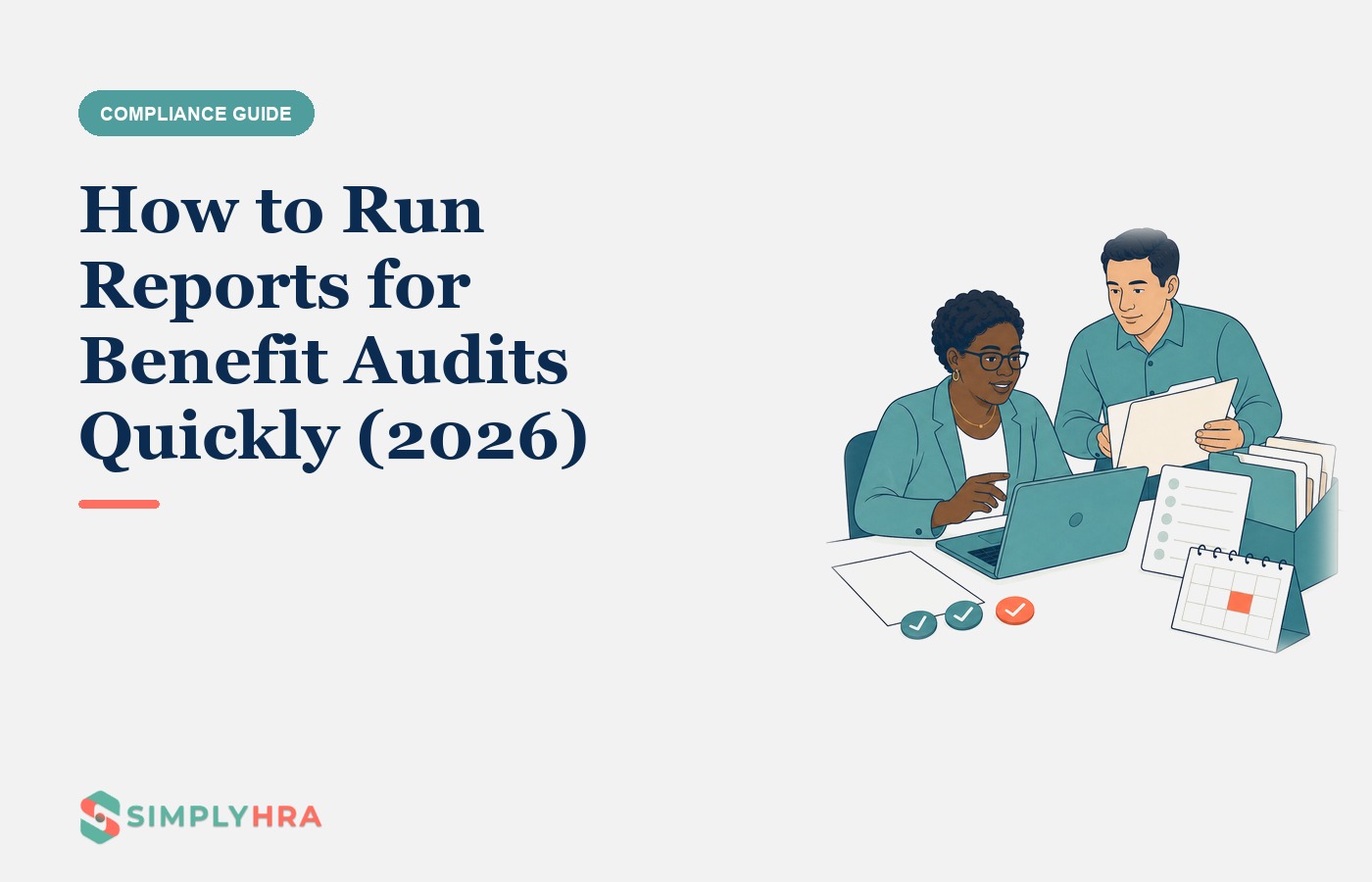
How to Run Reports for Benefit Audits Quickly (2026)
TL;DR
Benefit audit reports are the data exports, reconciliations, and compliance filings that prove your benefits plans are administered correctly. Running reports for benefit audits quickly requires centralizing your data, automating three-way reconciliation between payroll, plan records, and carrier invoices, and scheduling quarterly mini-audits instead of scrambling at year-end. Late filings can cost you nearly $3,000 per day in DOL penalties alone, so speed isn’t optional.
CHOICE (Custom Health Option and Individual Care Expense) Arrangement is the current name for what was previously referred to as an ICHRA (Individual Coverage Health Reimbursement Arrangement). This page uses both terms.
What Are Benefit Audit Reports?
Benefit audit reports are the documentation employers produce to verify that their health benefit plans match what employees were promised, that deductions and payments are accurate, and that the company meets federal and state regulatory requirements. Think of them as the receipts proving your benefits operation works the way it should.
Every employer running a health benefit, whether it’s a traditional group plan or an ICHRA, needs these reports. The question is whether you’ll spend hours building them manually or pull them in minutes from a system designed for the job.
See how SimplyHRA works for employers managing ICHRA plans with built-in audit-ready reporting.
There are two categories worth distinguishing:
Internal audits are voluntary reviews you run on your own schedule to catch errors before they become expensive. These are preventive.
EBP audits (Employee Benefit Plan audits) are ERISA-mandated. Under ERISA, most employee benefit plans with 100 or more eligible participants at the start of the plan year must undergo an annual audit conducted by an independent qualified public accountant. Small welfare plans that are fully insured or unfunded and have fewer than 100 participants are generally exempt from Form 5500 filing.
Knowing which category applies to you determines which reports you need and how quickly you need them.
The Reports You Need to Pull
When figuring out how to run reports for benefit audits quickly, the first step is knowing exactly which reports are required. Here’s a breakdown of the core report types, what each one shows, who typically needs it, and where the data lives.
| Report | What It Shows | Who Needs It | Typical Source |
|---|---|---|---|
| Payroll deduction report | Amounts withheld from employee paychecks for benefits | Auditors, HR, Finance | Payroll system (Gusto, ADP, Rippling) |
| Benefits enrollment report | Who’s enrolled, in which plan, at what tier | Auditors, carriers, HR | HRIS or benefits platform |
| Carrier invoice / self-bill | What the insurance company actually charges | Finance, HR | Insurance carrier portal |
| Reimbursement activity log | Claim submissions, approvals, payment amounts and dates | Auditors (especially for HRA/ICHRA) | HRA administration platform |
| ACA forms (1094-B/1095-B or 1094-C/1095-C) | Offer of coverage and enrollment details for IRS | IRS, employees | ACA reporting software or benefits platform |
| MEC verification records | Proof employees hold qualifying coverage | DOL/IRS auditors | Benefits platform or manual attestations |
| PCORI fee records (Form 720) | Self-funded plan fee calculation and payment | IRS | Finance/tax records |
| Form 5500 data | Plan financial and operational summary | DOL | Plan administrator, TPA, accountant |
| Employee class/eligibility docs | Who qualifies for which benefit tier and why | Auditors, internal compliance | HRIS or benefits platform |
For ICHRA employers, the reimbursement activity log and MEC verification records are especially critical. If you want a deeper look at tracking these expenses, read this guide on tracking employee benefit expenses.
For approving and documenting individual claims, the reimbursement claims process guide walks through each step.
Why Speed Matters: The Cost of Slow Reporting
The word “quickly” in “how to run reports for benefit audits quickly” isn’t about convenience. It’s about money and legal exposure.
DOL Penalties Add Up Fast
Failure to timely file the Form 5500 annual report subjects a plan sponsor to a penalty of $2,739 per day, beginning on the date the filing was due. The IRS can pile on an additional $250 per day, capped at $150,000 per plan year, plus interest. Combined, that’s nearly $3,000 per day in exposure.
For calendar-year plans, the Form 5500 is due by July 31 of the following year. You can extend the deadline by 2.5 months (to October 15) by filing Form 5558, but the extension only works if you actually file it. For a full picture of ACA-related penalties, see the employer penalty guide.
The DFVCP Safety Net
The Delinquent Filer Voluntary Compliance Program (DFVCP) exists for employers who missed their deadline and want to limit the damage. Without DFVCP, you could face $100,000+ in DOL penalties. With DFVCP, the total penalty might be capped at $1,500. That’s over $98,000 saved by acting proactively instead of waiting for an enforcement letter.
Carrier Invoice Errors Are Leaking Money
Data from benefits reconciliation audits shows that 5% of all monthly premium spend is in error. Every month you skip reconciliation, you’re likely overpaying for terminated employees, wrong tier placements, or phantom enrollees. Running reports quickly and frequently is how you stop the leak.
The Last-Minute Scramble Problem
Practitioners consistently describe the same pattern: EBP audits become stressful because documentation is scattered, reconciliations live in spreadsheets, and support for key balances has to be rebuilt under deadline pressure. Small gaps in data create the biggest delays. The employers who run reports quickly are the ones who build the habit of doing it regularly, not just when an auditor comes knocking.
Five Steps to Pull Audit Reports Faster
Here is a practical framework for how to run reports for benefit audits quickly, whether you’re preparing for a full ERISA audit or just running an internal check.
Step 1: Centralize Your Data
The single biggest obstacle to fast audit reporting is fragmentation. When your payroll lives in one system, your enrollment records in another, and your carrier invoices arrive as PDFs attached to emails, every report becomes a manual assembly project.
Practitioners on Reddit’s r/smallbusiness forums frequently mention the pain of managing ICHRA administration across disconnected tools. One HR director found that moving messy spreadsheet data into a high-end compliance tool just created “faster mistakes,” because the underlying data was never cleaned up.
The fix: get your payroll, HRIS, and benefits administration into one connected system, or at minimum, use platforms with native integrations. SimplyHRA, for example, calculates and tracks reimbursements in-platform and produces payroll-ready exports, reducing duplicate entry when the data is carried into your payroll run. If you’re evaluating ICHRA platforms specifically, the payroll integration guide covers what to look for.
Before migrating to any new system, conduct a manual mini-audit to clean up employee records. Import clean data, not faster mistakes.
Step 2: Run the Three-Way Match
The gold standard auditors want to see is a three-way reconciliation: payroll deductions matched against plan records matched against carrier invoices or trust statements. When all three align, your audit is straightforward. When they don’t, you’ve found either an error or a documentation gap, both of which need fixing.
Benefits reconciliation experts recommend running this match monthly rather than annually. Automation can reduce reconciliation time by 60 to 70% and catches discrepancies that manual review misses. For ICHRA employers, this means matching allowances to approved reimbursements to payroll-triggered payments.
The ICHRA-to-payroll reconciliation checklist walks through this process step by step.
Step 3: Automate MEC Verification
For ICHRA plans, Minimum Essential Coverage verification is non-negotiable. Employers must confirm that participants and their dependents are enrolled in individual health insurance or Medicare before processing the first reimbursement. Missing MEC documentation for even one employee can trigger compliance problems during an audit.
Chasing attestations manually via email is slow and error-prone. Platforms with built-in eligibility verification (SimplyHRA uses AI-powered 24/7 verification) keep MEC substantiation current without requiring HR to follow up repeatedly.
Step 4: Schedule Quarterly Mini-Audits
The most effective approach to benefit audit reporting is capturing evidence continuously rather than collecting it during the audit window. Quarterly or monthly mini-audits focused on specific high-risk areas catch issues earlier, provide frequent compliance checkpoints, and create a culture where audit readiness is the default state rather than a fire drill.
High-value mini-audit targets include:
- Enrollment changes that weren’t reflected in payroll deductions
- Terminated employees still appearing on carrier invoices
- Missing or expired MEC attestations
- Reimbursement claims lacking proper documentation
Gap reports generated by modern platforms can flag missing or expired documents in seconds, delivering up to a 90% reduction in audit preparation time. That’s the difference between spending days pulling reports and spending minutes reviewing them.
Step 5: Use Audit-Ready Dashboards
The final step in running reports for benefit audits quickly is eliminating the report-building process entirely. Instead of exporting CSVs, joining spreadsheets, and formatting data for auditors, use platforms that generate audit-ready exports with one click.
SimplyHRA’s automated expense management creates audit-ready documentation by default through its submit, approve, and track workflows. Every reimbursement gets timestamped, classified, and connected to the corresponding payroll transaction. When audit time comes, the reports already exist.
Schedule a free demo to see how audit-ready reporting works in practice.
Audit Reporting for ICHRA Plans
ICHRA plans carry specific reporting requirements that differ from traditional group health insurance. If you’re running an ICHRA, here’s what your audit documentation must include.
ACA Reporting Forms
The forms you file depend on your Applicable Large Employer (ALE) status:
Non-ALEs (fewer than 50 full-time equivalent employees): Submit Forms 1094-B and 1095-B. Form 1095-B details the coverage provided to each employee with an ICHRA. Form 1094-B is a summary transmittal that totals the number of 1095-Bs sent.
ALEs (50+ FTEs): Submit Forms 1094-C and 1095-C with specific codes for ICHRA arrangements. This is more complex than traditional group plan reporting because of the ICHRA-specific line 14 and line 16 codes. For a breakdown of the codes, see the guide on 1095-C Line 14 codes.
MEC Substantiation Records
Employees must provide documentation verifying MEC before the first reimbursement. Auditors will want to see:
- The attestation or verification record for each participant
- Evidence that dependents were also verified
- Timestamps showing verification occurred before reimbursement began
This is a make-or-break item. Without it, the tax-advantaged status of the entire HRA is at risk.
PCORI Fee (Form 720)
An ICHRA is classified as a self-funded plan, which means employers must pay the Patient-Centered Outcomes Research Institute (PCORI) fee annually. You pay this using Form 720, due by July 31 of each year.
Reimbursement Logs
Complete reimbursement activity logs with timestamps, approval records, expense classifications, and payment amounts. For ICHRA plans, this includes documentation of any partial reimbursements where the claim exceeded the allowance.
Section 111 Medicare Secondary Payer Reporting
This is an emerging requirement that many ICHRA employers don’t know about. If you have 20 or more employees and offer an ICHRA with an annual allowance of $5,000 or more, you must report quarterly whether your ICHRA serves as the primary payer for employees enrolled in Medicare. Non-compliance carries its own penalty exposure.
Foundational Documents
Auditors will also request your written plan document, Summary Plan Description (SPD), employee notices, and documentation of how employee classes were designed. If you haven’t formalized your employee classes, the eligibility criteria design guide covers the rules.
Common Mistakes That Slow You Down
Even employers who know how to run reports for benefit audits quickly can get tripped up by avoidable errors. Here are the most common ones.
Running benefits on disconnected spreadsheets. Spreadsheets lack access controls, audit trails, permission levels, and visibility into who changed what. They’re fine for one-time calculations but terrible for ongoing compliance documentation. Every benefits administrator who has tried to reconstruct a spreadsheet-based audit trail under deadline pressure knows this.
Waiting until year-end to reconcile. Monthly reconciliation catches the 5% carrier invoice error rate in real time. Annual reconciliation means you’ve been overpaying (or underpaying) for up to twelve months before discovering the problem.
Missing MEC documentation for even one employee. For ICHRA plans, a single missing attestation can raise questions about the entire plan’s compliance. Automated verification prevents this by flagging gaps as they occur, not months later.
Not having a written plan document on file. This sounds basic, but auditors report it as a surprisingly common gap. The plan document and SPD are foundational audit evidence. Without them, every other report you pull is building on shaky ground.
Confusing 1095-B and 1095-C requirements. Non-ALEs file 1095-B. ALEs file 1095-C. Getting this wrong doesn’t just create extra work, it can trigger IRS notices. Know your ALE status before you start generating forms. The 2026 ICHRA affordability guide explains how ALE status affects your compliance obligations.
Ignoring Section 111 MSP reporting. This is the newest compliance trap for ICHRA employers. If you meet the thresholds (20+ employees, $5,000+ allowance), quarterly reporting is required. It’s easy to miss because it’s not part of the traditional ACA reporting workflow.
Putting It All Together
Running reports for benefit audits quickly comes down to three principles: centralize your data so reports pull from one source of truth, automate the reconciliation and verification steps that eat the most time, and audit continuously rather than annually.
The employers who struggle with audit reporting are almost always the ones operating across fragmented systems with manual processes. The employers who breeze through it have built the documentation into their daily workflows so that when audit time arrives, the reports are already done.
For ICHRA employers specifically, the reporting requirements are more granular than traditional group plans, but the payoff is significant: predictable costs, employee choice, and a benefits structure that scales cleanly. The key is choosing an administration platform where compliance documentation is a built-in feature, not an afterthought.
Schedule a consultation to find out which reports your specific plan requires and how to generate them automatically.
Frequently Asked Questions
What is a benefit audit report?
A benefit audit report is any data export, reconciliation, or compliance filing that documents how an employer’s benefit plan is administered. These reports verify that enrollment records match payroll deductions, that carrier invoices are accurate, and that the plan meets federal and state regulatory requirements. Common examples include payroll deduction reports, enrollment summaries, ACA forms (1094/1095 series), Form 5500 filings, and reimbursement activity logs.
Which employers are required to have a benefit plan audit?
Under ERISA, most employee benefit plans with 100 or more eligible participants at the start of the plan year must undergo an annual audit by an independent qualified public accountant. Small welfare plans (under 100 participants) that are fully insured or unfunded are generally exempt from both the audit requirement and Form 5500 filing. However, all employers with health benefits should run internal audits regularly to catch errors and reduce compliance risk.
How much are the penalties for late Form 5500 filing?
The DOL penalty for late Form 5500 filing is $2,739 per day, starting from the due date. The IRS can add up to $250 per day, capped at $150,000 per plan year, plus interest. Combined, that’s nearly $3,000 per day in potential fines. Employers who self-correct through the DFVCP program can often reduce total penalties to as little as $1,500.
What reports do ICHRA employers specifically need for audits?
ICHRA employers need ACA reporting forms (1094-B/1095-B for non-ALEs, or 1094-C/1095-C for ALEs), MEC verification records for all participants and dependents, reimbursement activity logs with timestamps and approval trails, PCORI fee records (Form 720), the written plan document and SPD, and potentially Section 111 Medicare Secondary Payer reports if the employer has 20+ employees and offers $5,000+ in annual allowances.
How often should I run benefit audit reports?
Monthly is ideal for carrier invoice reconciliation and payroll-to-enrollment matching. Quarterly mini-audits focused on high-risk areas (like MEC attestation gaps or terminated employee coverage) provide the best balance between effort and audit readiness. Annual reporting is required for Form 5500, ACA forms, and PCORI fees, but the underlying data should be current year-round.
Can automation really reduce audit preparation time?
Yes. Modern benefits platforms with integrated reporting can reduce audit preparation time by up to 90% by generating gap reports instantly and maintaining continuous documentation. For payroll reconciliation specifically, automation reduces reconciliation time by 60 to 70% and catches discrepancies that manual review misses. The key is using a platform that integrates with your existing payroll and HRIS systems.
What is three-way reconciliation in a benefit audit?
Three-way reconciliation means matching three data sources against each other: payroll deductions, plan enrollment records, and carrier invoices (or trust statements). When all three align, your audit documentation is solid. When they don’t, you’ve identified either a billing error, an enrollment discrepancy, or a documentation gap. Auditors consider this the gold standard for benefits compliance controls.
What is Section 111 MSP reporting for ICHRA?
Section 111 Medicare Secondary Payer reporting is a quarterly filing requirement for ICHRA employers with 20 or more employees who offer annual allowances of $5,000 or more. You must report whether the ICHRA serves as the primary payer for any employees enrolled in Medicare. This requirement is getting more attention across the industry as ICHRA adoption grows, but many employers are still unaware of it.
Related blogs
Prefunding ICHRA Accounts Best Practices: 2026 Guide
Defined Contribution Allowance: ICHRA Rules for 2026