How much should you reimburse through an ICHRA?
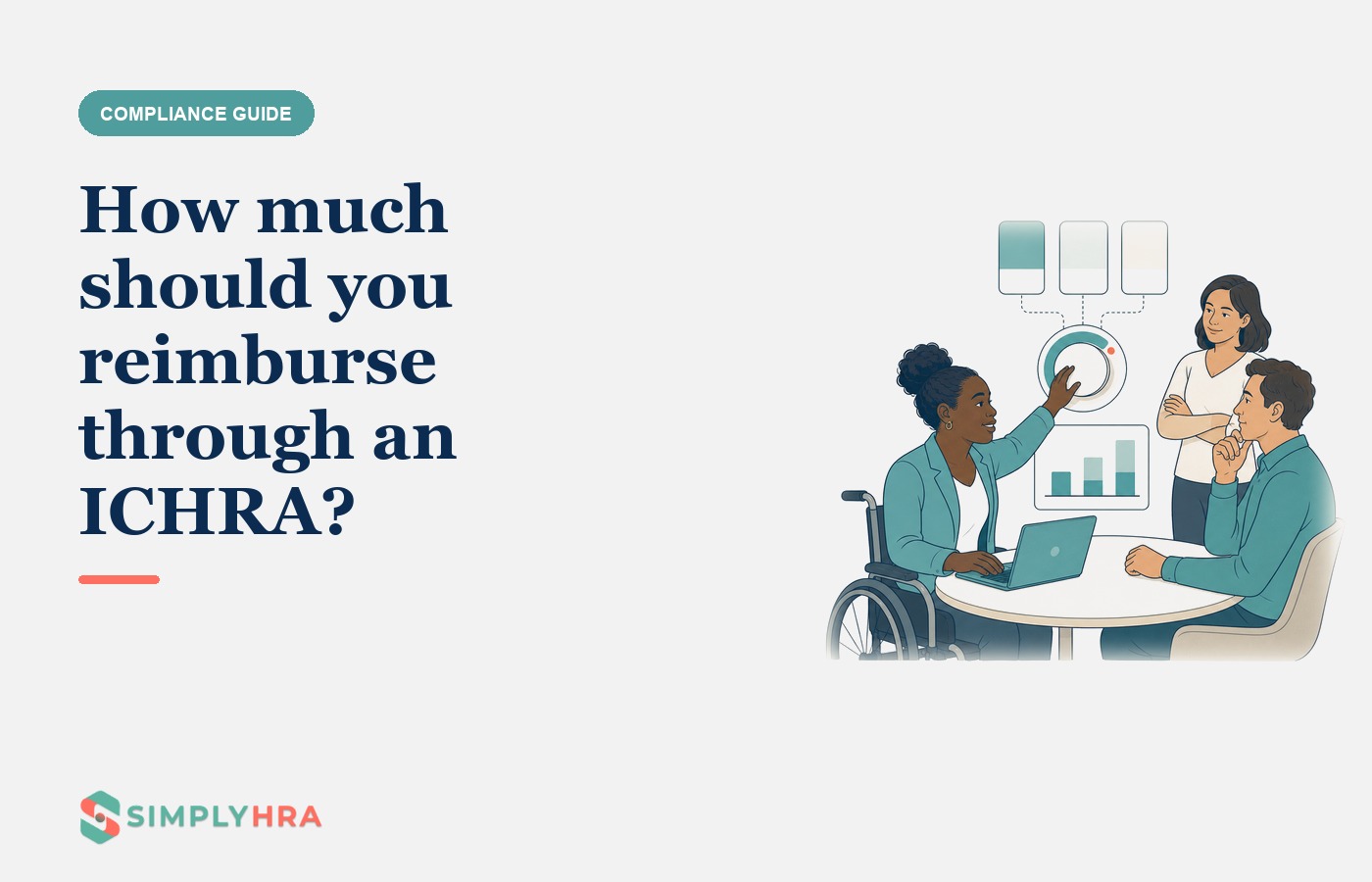
There is no legal maximum. Unlike a QSEHRA, an ICHRA has no statutory contribution cap. The employer sets the allowance. That freedom is why the question is hard: the constraint is not a limit in the regulation, it is the interaction between your budget, the ACA affordability test, and your employees' premium tax credit eligibility.
CHOICE (Custom Health Option and Individual Care Expense) Arrangement is the current name for what was previously referred to as an ICHRA (Individual Coverage Health Reimbursement Arrangement). This page uses both terms.
There is also no legal minimum. An employer may fund $100 a month. Whether that is a benefit or a gesture is a separate question.
Yes, a monthly allowance instead of a group plan is exactly what this is
If you found this asking whether you can simply give employees a monthly amount toward health insurance rather than buying a group plan: yes, and the ICHRA is the mechanism that makes it tax-free. Handing employees extra cash for insurance without an HRA makes it taxable wages, subject to income and payroll tax, for both of you. Routing the same money through an ICHRA does not.
The trade-off is that "just give them money" acquires structure: a plan document, a 90-day notice, enrollment substantiation, and the class rules below. See compliance requirements.
The four constraints on the number
1. Same terms within a class
Everyone in a permitted class gets the same allowance, with only two lawful variations:
- Age: the oldest participant's allowance may not exceed 3× the youngest's. This mirrors the individual market's 3:1 age band.
- Family size: the allowance may rise with the number of covered dependents.
Nothing else. Not tenure, not salary, not performance, not health status.
2. The 3:1 age ratio
If your youngest employee's allowance is $300/month, your oldest employee's cannot exceed $900/month. Age-banding is optional: a flat allowance across the class is permitted, but if you band, the ratio binds.
Age-banding usually improves fairness, because individual premiums rise steeply with age. A flat allowance buys a 26-year-old a good plan and a 60-year-old very little.
3. Affordability
This is the constraint that decides whether your employees keep premium tax credit eligibility.
Employee's required contribution = LCSP self-only monthly premium − ICHRA self-only monthly allowance
Where LCSP is the lowest-cost silver plan available to that employee, for self-only coverage, in their rating area, at their age.
The ICHRA is affordable for that employee if the required contribution does not exceed 9.96% for plan years beginning in 2026 (IRS Rev. Proc. 2025-25, up from 9.02% in 2025; this figure moves every year) of household income.
Two consequences, and they point in opposite directions:
- If affordable → the employee is ineligible for a premium tax credit. For an ALE, an affordable ICHRA also satisfies IRC § 4980H.
- If unaffordable → the employee may opt out and claim the PTC instead. For an ALE, an unaffordable offer can expose the employer to a shared-responsibility payment.
Because employers do not know household income, the IRS provides safe harbors (W-2, rate of pay, and federal poverty line) for testing affordability. The FPL safe harbor is the simplest: it uses the FPL in effect within six months before the plan year begins. For calendar-year 2026 plans that is the 2025 mainland FPL of $15,650, making the safe-harbor ceiling on the employee's required contribution 9.96% × $15,650 ÷ 12 = $129.89 per month. Plans starting later in 2026 (after the January 13, 2026 guidelines) use the 2026 FPL of $15,960, i.e. $132.47 per month. Source: HHS ASPE poverty guidelines.
Note the affordability test uses the self-only LCSP and the self-only allowance, even for employees with families. A family-size-varied allowance does not change the affordability math.
4. Your budget
The employer's true exposure is allowance × participating employees, not allowance × headcount. Employees who opt out, or who are not enrolled in qualifying individual coverage, cost nothing. Unused allowance is never paid out. It stays with the employer.
Three ways employers actually set the number
Benchmark to the LCSP. Set the allowance so the required contribution lands where you want it relative to the affordability threshold, at or below it if you want the ICHRA affordable and want § 4980H satisfied. This is the most defensible method because it is anchored to the same figure the test uses. It requires pulling LCSP premiums per rating area and age band.
Benchmark to your current group cost. Take your current per-employee-per-month employer contribution and set the allowance at or near it. Straightforward and easy to communicate, but it ignores whether that amount is affordable in each employee's rating area. The same dollar buys very different coverage across markets.
Benchmark to a target plan tier. Decide the allowance should cover, say, the full premium of the lowest-cost bronze plan or a defined share of a benchmark silver plan for each age band. This communicates well to employees ("your allowance covers a bronze plan") and naturally produces age banding.
Whichever you choose, run the affordability test afterward. The method sets the number; the test tells you what the number does.
A worked example: structure only
The mechanics, with placeholder figures. Substitute current-year values before relying on it.
An employer with 12 employees in one rating area sets a flat $450/month self-only allowance.
For a 40-year-old employee:
- LCSP self-only monthly premium, age 40, this rating area: Look up live at HealthCare.gov → “See plans & prices” (or the state Exchange), premiums vary by rating area and change annually
- Less ICHRA self-only allowance: $450
- = Employee's required contribution: (difference)
- Affordability threshold: household income × 9.96% ÷ 12 (2026 plan years): Rev. Proc. 2025-25
- Affordable?: Required contribution ≤ threshold
If the required contribution comes in above the threshold, the ICHRA is unaffordable for that employee, they may opt out and claim a PTC, and if the employer is an ALE, § 4980H exposure should be reviewed.
Common mistakes
- Using the family LCSP for the affordability test. It is self-only, always.
- Assuming one allowance works everywhere. Premiums vary widely by rating area. Consider a rating-area class if the workforce is dispersed.
- Varying the allowance by salary or tenure. Not permitted. Age and family size only.
- Banding by age beyond 3:1. The ratio is a hard ceiling.
- Forgetting employees on a spouse's plan. They cannot be reimbursed by an ICHRA at all: this differs from a QSEHRA. See ICHRA vs QSEHRA.
- Setting an allowance that is affordable but small, for a subsidy-eligible workforce. It strips PTC eligibility while replacing it with less value. Model this before committing.
Primary sources
- 26 CFR § 54.9802-4 · 29 CFR § 2590.702-2 · 45 CFR § 146.123: the ICHRA rule, including the same-terms and age/family-size variation provisions
- 84 FR 28888 (June 20, 2019): final rule and preamble
- IRC § 36B and 26 CFR § 1.36B-2: premium tax credit eligibility and ICHRA affordability
- IRC § 4980H: employer shared responsibility and the affordability safe harbors
- The current-year IRS revenue procedure setting the ACA affordability percentage
- HHS annual federal poverty guidelines
- healthcare.gov: LCSP premiums by rating area and age
FAQ
Is there a maximum ICHRA contribution? No. An ICHRA has no statutory cap. The employer sets the allowance. Only the QSEHRA has an annual limit.
Is there a minimum ICHRA contribution? No legal minimum either. But an allowance too small to make the arrangement affordable leaves employees able to opt out for a premium tax credit, and may create employer mandate exposure for an Applicable Large Employer.
Can I give different employees different amounts? Only across permitted classes, or within a class by age (up to a 3:1 ratio) and family size. Not by salary, tenure, role, or health status.
How do I know if my ICHRA is affordable? Subtract the self-only ICHRA allowance from the monthly premium of the lowest-cost silver plan for that employee's age and rating area. If the remainder is no more than the current-year affordability percentage of household income, it is affordable. Employers generally use the W-2, rate-of-pay, or federal poverty line safe harbor rather than actual household income.
Can I give employees a monthly allowance instead of buying a group plan? Yes, that is what an ICHRA does, and routing it through an ICHRA makes it tax-free rather than taxable wages. It comes with plan document, notice, and substantiation requirements.
What happens to allowance an employee doesn't use? It stays with the employer. An ICHRA is notional, not a funded account the employee owns.
SimplyHRA helps employers set and administer ICHRA allowances: plan setup, the 90-day notice, substantiation, and monthly reimbursement tracking. Schedule a consultation.
This article is general information, not tax, legal, or benefits advice. Affordability and premium tax credit outcomes depend on your employees' specific circumstances. Confirm current-year figures against the primary sources cited above and consult your own advisers.
Related blogs
Prefunding ICHRA Accounts Best Practices: 2026 Guide
Defined Contribution Allowance: ICHRA Rules for 2026