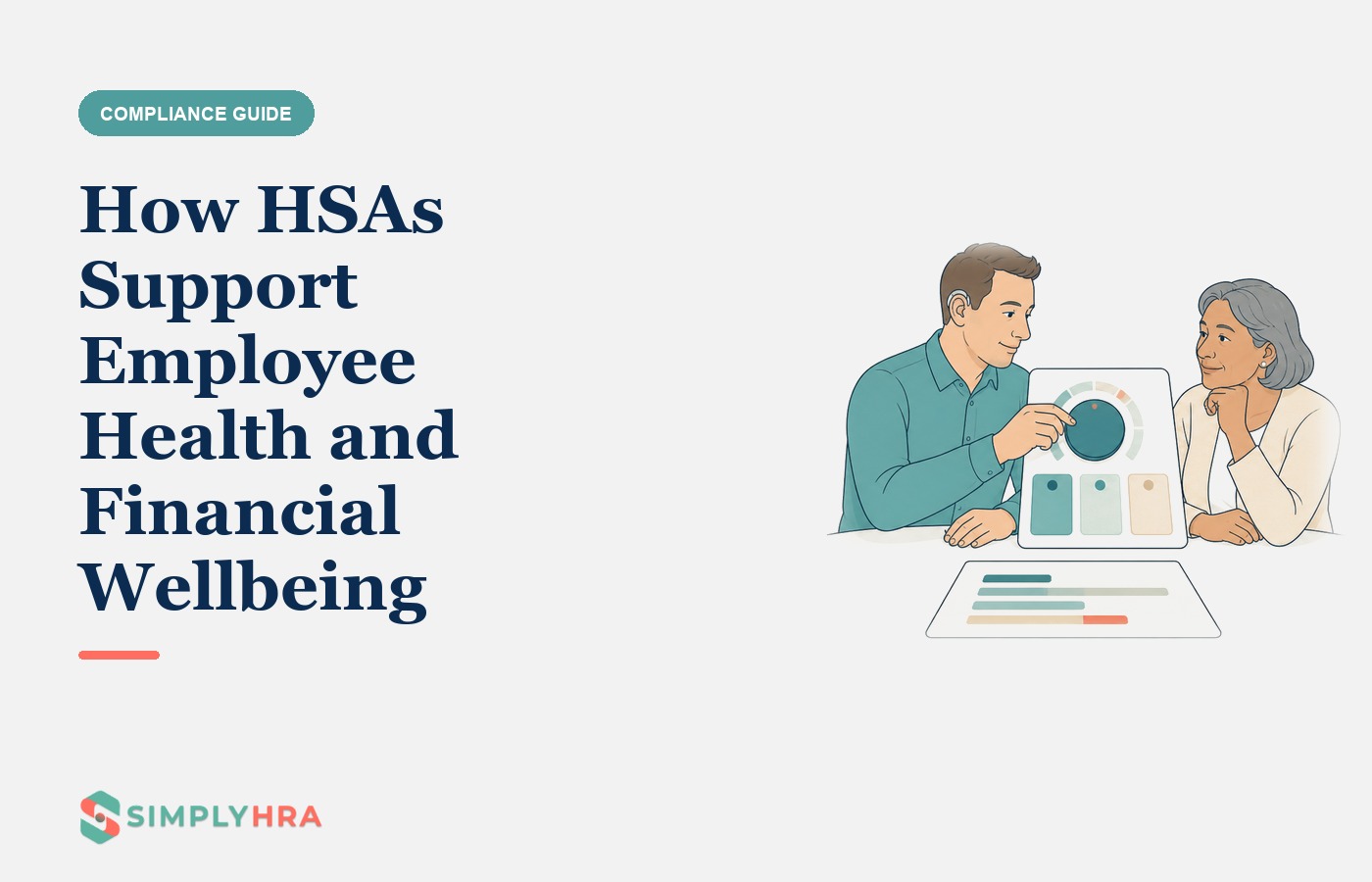
How HSAs Support Employee Health and Financial Wellbeing
When people hear "Health Savings Account," they usually think tax break. And the tax advantages are real. But for employers thinking about their team, an HSA is something bigger: a tool that helps employees actually get the care they need today and build security for the care they'll need later.
CHOICE (Custom Health Option and Individual Care Expense) Arrangement is the current name for what was previously referred to as an ICHRA (Individual Coverage Health Reimbursement Arrangement). This page uses both terms.
Here's how HSAs support employee health, physically and financially, and where they fit for a small business.
What is an HSA?
A Health Savings Account (HSA) is a tax-advantaged account used to pay for qualified medical expenses. To open and contribute to one, an employee needs to be enrolled in an HSA-eligible high-deductible health plan (HDHP). Money goes in tax-free, grows tax-free, and comes out tax-free when it's used for healthcare.
Unlike a Flexible Spending Account (FSA), an HSA balance never expires, and the account belongs to the employee, not the employer. They keep it when they change jobs, go freelance, or retire.
The triple tax advantage
HSAs are the only account that gives money three rounds of tax-free treatment:
- Going in: contributions are pre-tax or tax-deductible, lowering taxable income.
- Growing: interest and investment earnings accumulate tax-free.
- Coming out: withdrawals for qualified medical expenses are never taxed.
For employees, that means more of every healthcare dollar stays in their pocket. For employers, contributions to employee HSAs are generally exempt from payroll taxes, so support can cost less than the equivalent in salary.
How HSAs support employee health
The financial design has real effects on health behavior.
They reduce cost-related care avoidance. A meaningful share of people delay or skip care because of cost, and delayed care often turns small problems into expensive ones. Having dedicated, tax-free dollars set aside for healthcare lowers the friction to actually go to the appointment, fill the prescription, or get the test.
They make preventive care easier to choose. Because HSA funds are earmarked for health, employees are more likely to use them on the routine, preventive things that keep them well rather than letting those costs compete with rent and groceries.
They ease financial stress, which is a health issue. Medical bills are a leading source of financial anxiety, and chronic financial stress takes a measurable toll on wellbeing and productivity. Knowing there's a cushion for healthcare costs is one less thing weighing on an employee's mind.
They reward long-term thinking. An HSA isn't use-it-or-lose-it, so employees can let unused funds roll over year after year, building a reserve for a future surgery, a growing family, or retirement healthcare.
HSAs as a financial wellness tool
The most underused feature of an HSA is investing. Once an employee builds a cushion, many HSAs let them invest the balance so it can compound tax-free, effectively a stealth retirement-health account.
Research from the Employee Benefit Research Institute (EBRI) has consistently found that most accounts holders leave their HSA in cash and relatively few treat it as an investment vehicle, which means a lot of long-term, tax-free growth goes unrealized. Part of the fix is simply education, and part of it is giving employees a platform that makes the smart move obvious.
That's one reason SimplyHRA partnered with Saga Health, the first AI-powered all-in-one HSA platform, which guides employees on what to spend, save, and invest. Better guidance turns a confusing account into a genuine wealth-building habit.
HSA vs. FSA: the quick version
HSA:
- The employee owns it for life
- Unused funds roll over
- Moves with the employee even if they switch jobs
- Often available
- Requires HDHP
FSA:
- Tied to the employer
- Mostly use-it-or-lose-it
- Generally lost at job change
- Not available for investing
- Does not require HDHP
For a deeper breakdown of these and other terms, see the SimplyHRA glossary.
What HSAs mean for employers
You don't need a traditional group plan to help employees with healthcare savings. For a small business, supporting HSAs can:
- Strengthen your benefits package without the cost and renewal cycle of a group plan.
- Help recruiting and retention, because a portable, tax-advantaged benefit signals real long-term investment in people.
- Stay simple to run, especially when it lives alongside your other benefits in one platform.
If you're an employer weighing your options, our employer overview walks through how this fits a small team.
How HSAs work alongside an ICHRA
If you already offer an Individual Coverage HRA (ICHRA) to reimburse employees' insurance premiums, an HSA is a natural complement: the ICHRA helps with the premium, and the HSA helps with deductibles, prescriptions, and everything else out of pocket.
One important nuance: HSA eligibility has rules. An ICHRA that reimburses premiums only can be designed to preserve HSA eligibility, while a general-purpose ICHRA that also reimburses medical expenses usually disqualifies HSA contributions. The right setup depends on your plan design, which is exactly the kind of thing a free consultation can sort out in 15 minutes.
2026 HSA contribution limits
For 2026, the IRS allows HSA contributions of:
- $4,400 for self-only HDHP coverage
- $8,750 for family HDHP coverage
- An extra $1,000 catch-up for account holders age 55 and older
2027 HSA contribution limits
For 2027, the IRS allows HSA contributions of:
- $4,500 for self-only HDHP coverage
- $9,000 for family HDHP coverage
- An extra $1,000 catch-up for account holders age 55 and older
Limits change yearly, so confirm the current figures before you contribute.
Frequently asked questions
Can an employer contribute to an employee's HSA? Yes. Employers can contribute directly to employee HSAs, and those contributions are generally free of payroll tax for both sides.
Do employees keep their HSA if they leave? Yes. An HSA is individually owned, so the balance, investments, and account stay with the employee through job changes and retirement.
Can employees invest their HSA? Once eligible, yes: many HSAs allow investing so the balance can grow tax-free over time.
Can someone have both an HSA and an ICHRA? Yes. A premium-only ICHRA can be structured to keep HSA eligibility. A consultation with SimplyHRA can confirm what works for your plan.
Want to offer HSAs to your team?
SimplyHRA, powered by Saga Health, makes it simple for employers to contribute and for employees to open, invest, and grow an HSA they own for life. Book a free HSA consultation →
This article is for general educational purposes and is not tax, legal, or financial advice. HSA eligibility, contribution limits, and tax treatment depend on individual circumstances and current IRS rules.
Related blogs
Prefunding ICHRA Accounts Best Practices: 2026 Guide
Defined Contribution Allowance: ICHRA Rules for 2026