Employee Reimbursement Workflow for ICHRA Platforms (2026)
TL;DR
An employee reimbursement workflow for ICHRA platforms is the monthly process that verifies an employee’s individual coverage, reviews premium or expense documentation, approves the reimbursable amount, triggers payment or payroll updates, and stores compliance records. It is the operating layer that determines whether an ICHRA feels simple or frustrating for everyone involved. A broken workflow creates cash-flow problems for employees, payroll errors for employers, and audit risk across the board.
CHOICE (Custom Health Option and Individual Care Expense) Arrangement is the current name for what was previously referred to as an ICHRA (Individual Coverage Health Reimbursement Arrangement). This page uses both terms.
What an Employee Reimbursement Workflow Actually Does
In an ICHRA, the employer does not buy one group health plan for everyone. The employer sets a reimbursement allowance, employees choose their own individual health coverage or Medicare, and the platform manages the recurring work of turning that allowance into a tax-free benefit.
The employee reimbursement workflow is the process that makes this happen. It confirms the employee has eligible coverage, collects proof of premiums or qualified medical expenses, checks the request against the employer’s plan rules and remaining allowance, approves or denies the claim, pays the reimbursement, updates payroll when needed, and keeps the documentation required for compliance.
This is not a standard expense report. The Federal Register final rule requires that an HRA may not reimburse a medical care expense unless continued enrollment in eligible individual coverage is substantiated for the month the expense was incurred. That coverage verification gate is what separates an ICHRA reimbursement workflow from a generic expense management system.
Explore ICHRA for employers to see how modern platforms handle this process.
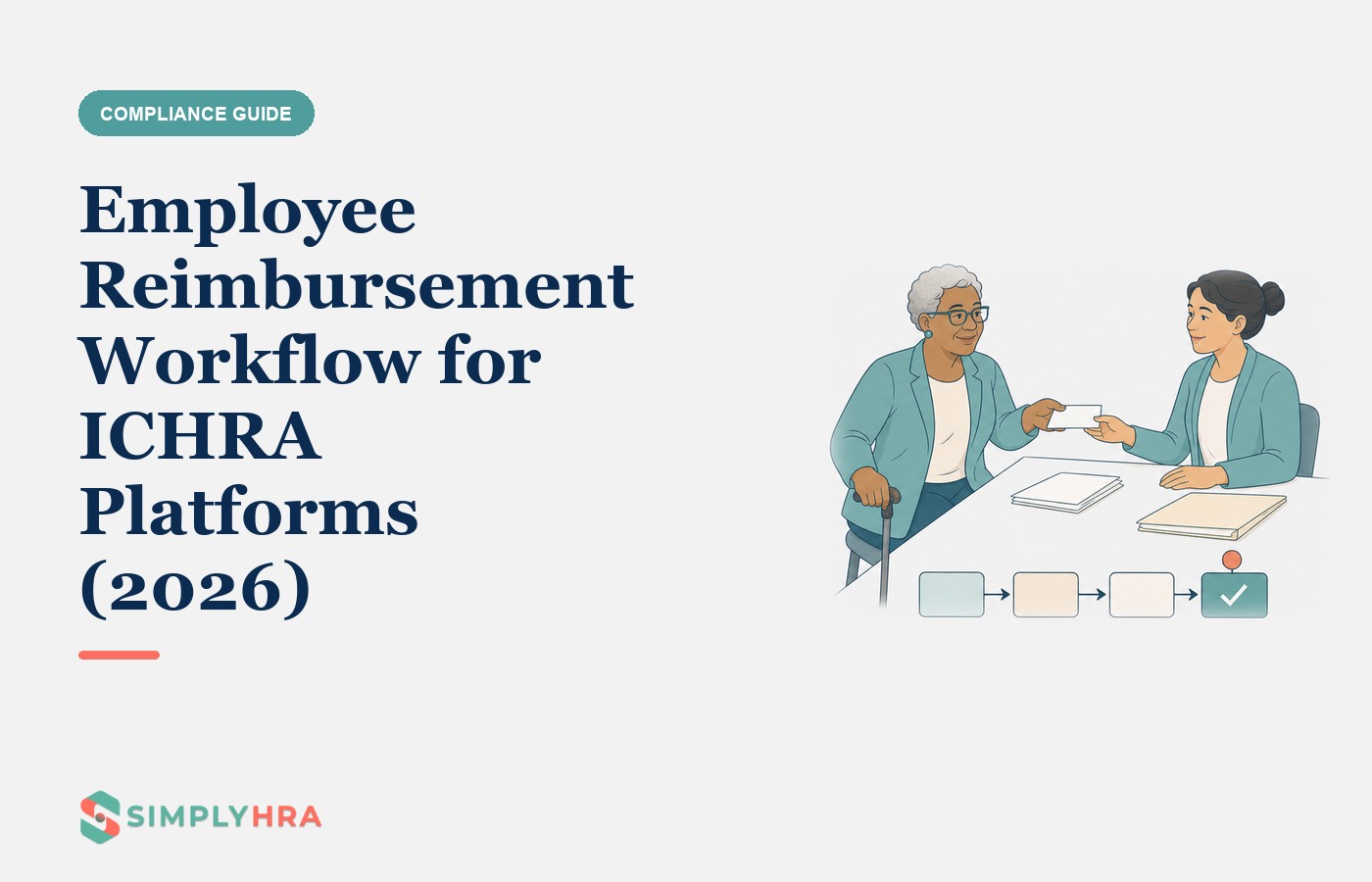
How the ICHRA Reimbursement Workflow Works Step by Step
Every ICHRA platform handles the reimbursement workflow slightly differently, but the core sequence stays the same.
Step 1: Employer Sets the ICHRA Plan Rules
The employer defines employee classes, monthly allowance amounts, eligible expenses (premium-only or premiums plus qualified medical expenses), the plan year, and reimbursement timing. Classes can include full-time, part-time, salaried, hourly, seasonal, and geographic groupings, among others.
Step 2: Employee Selects Eligible Coverage
The employee enrolls in individual health insurance or Medicare. The specific coverage must meet the plan’s requirements. Not every plan qualifies, so employees often need guidance on whether their plan qualifies for ICHRA reimbursement.
Step 3: Platform Collects Annual Proof of Coverage
Before any reimbursement begins, the platform collects proof or an attestation confirming the employee (and any covered dependents) is enrolled in eligible coverage. The CMS model attestation outlines what this substantiation looks like in practice.
Step 4: Employee Submits Documentation
For a traditional reimbursement model, the employee uploads a premium bill, invoice, receipt, or Explanation of Benefits. For recurring premiums, a strong platform should reduce the need to re-upload the same document every month.
Practitioners on Reddit report that monthly upload requirements are a real friction point. One employee in r/HealthInsurance described the process as “more burden for less benefit,” asking whether uploading a bill every single month was really standard.
Step 5: Platform Verifies Coverage for That Month
The platform checks that the employee had eligible individual coverage during the month tied to the expense. This is not optional. Federal rules require ongoing substantiation before each reimbursement, not just an annual check.
Step 6: Platform Approves, Denies, or Partially Approves
The claim is compared against the employer’s plan rules, the remaining allowance balance, and eligible-expense categories. When a premium exceeds the employer allowance, the platform calculates a partial reimbursement. For more detail, see how partial reimbursements work under an HRA.
Step 7: Payment or Payroll Action Runs
Approved amounts are paid through payroll, direct deposit, direct carrier payment, debit card, or another plan-approved method. If the employee’s premium exceeds the allowance, the employee share may be deducted through payroll. One important caveat from HealthCare.gov: pre-tax payroll deductions for the uncovered premium portion require buying coverage outside the Marketplace.
Step 8: Platform Stores the Audit Trail
The workflow preserves plan documents, attestations, proof of coverage, claim details, approval or denial records, payment confirmations, payroll deduction files, and year-end reports. Strong platforms produce audit-ready reporting that covers ACA, ERISA, and plan-level compliance.
Payment Models That Shape the Workflow
The reimbursement workflow changes significantly depending on how payments are structured. There are five common models.
Employee pays first, then gets reimbursed. The employee pays the carrier, uploads proof, and waits. This is the simplest model to set up but creates cash-flow stress. ECHO’s research on ICHRA payments found that employee-pay-first models can leave people out of pocket and may even create lapse risk when funds are not available by premium due dates.
Payroll-triggered reimbursement. Approved amounts flow through payroll as non-taxable reimbursements. Timing depends on payroll cutoffs, but accounting stays clean.
Direct premium payment. The platform sends employer funds (and sometimes the employee share) directly to the carrier. This feels more like group insurance and reduces employee involvement, but requires carrier coordination and reconciliation.
Debit card or prefunded card. Employees use a card tied to their ICHRA allowance. Faster at the point of payment, but the platform needs controls for substantiation and ineligible charges.
Hybrid. Premiums are direct-paid or card-funded while other eligible medical expenses go through traditional claim submission. Often the best employee experience, but more complex to administer.
The model an employer chooses affects everything: employee satisfaction, payroll complexity, compliance controls, and how much manual work HR absorbs each month.
Schedule a demo to see how SimplyHRA handles payroll-triggered reimbursements, pre-funded debit cards, and automated expense management in one platform.
Compliance Checkpoints Inside the Workflow
An employee reimbursement workflow for ICHRA platforms is fundamentally a compliance workflow. Missing any of these checkpoints puts the tax-free treatment of reimbursements at risk.
- Plan documents. The ICHRA plan must define eligible classes, allowances, eligible expenses, reimbursement procedures, and substantiation rules before the plan year begins.
- Employee notice. Written ICHRA notices are generally required at least 90 calendar days before the plan year, with exceptions for new eligibility.
- Annual coverage substantiation. Has the employee proved or attested to eligible individual coverage or Medicare?
- Ongoing monthly substantiation. Is coverage confirmed for the specific month tied to the reimbursement?
- Expense eligibility. Does the premium or medical expense qualify under the employer’s plan rules?
- Allowance limit. Is there enough remaining balance in the employee’s allowance?
- Premium tax credit decision. For 2026, an ICHRA is considered affordable if the employee’s remaining cost for the lowest-cost Silver plan is less than 9.96% of one-twelfth of yearly household income. If the offer is affordable, the employee cannot receive the premium tax credit on Marketplace coverage.
- Payroll deduction rules. Pre-tax deductions for employee-share premiums only work when coverage is purchased off-exchange.
- Audit records. Proof, approvals, payments, and payroll actions must be stored and retrievable.
What the Employee Experience Should Look Like
Most ICHRA problems are workflow problems. The legal structure is standardized, but the employee’s experience depends entirely on how well the platform handles monthly substantiation, payment timing, and communication.
A poor reimbursement workflow makes employees feel like they are doing benefits administration themselves. In r/smallbusiness, one employer who replaced group coverage with an ICHRA described employees suddenly becoming responsible for finding their own plans and submitting invoices to a third-party administrator for reimbursement. Another Reddit user noted that monthly premiums can consume the entire allowance, leaving nothing for other medical expenses unless the employer sets the allowance high enough.
A strong workflow looks different. Employees see their allowance, premium cost, and expected out-of-pocket amount before enrolling. Proof submission is simple or automated. Reimbursements happen on a predictable schedule. Payroll deductions are clear on pay stubs.
Privacy matters too. Practitioners on Reddit have raised questions about what medical information employers can see through an ICHRA platform. The workflow should collect only what is needed to verify coverage and eligible expenses, not unnecessary medical history.
What to Look for in an ICHRA Platform
When evaluating how a platform handles its employee reimbursement workflow, these features separate the ones that reduce work from the ones that create it:
- Automated coverage verification (annual and monthly)
- Recurring premium handling without repeated uploads
- Auto-classification of expenses
- Partial reimbursement calculations
- Payroll integration for reimbursements and employee-share deductions
- Direct pay or debit card options
- Payment status monitoring to catch lapse risk early
- Audit-ready reporting for ACA, ERISA, and plan compliance
- Employee support for plan shopping and benefits questions
The market is growing fast. The HRA Council reported that more than 20,000 U.S. businesses offer ICHRAs to at least 500,000 employees as of 2026. According to Becker’s analysis of the same data, 81% of ICHRA employees spend more than their employer allowance, paying a median of $105 per month out of pocket. That gap between allowance and premium is exactly where the reimbursement workflow has to perform, handling partial reimbursements, deductions, and communication cleanly each month.
On LinkedIn, ADP and Thatch recently promoted an embedded ICHRA integration inside ADP’s payroll product, signaling that the market increasingly expects ICHRA administration to live inside payroll rather than run as a separate portal. HealthSherpa’s ICHRA team has also highlighted the risk of premium payments drifting out of sync, positioning real-time payment status as critical for preventing coverage lapses.
Example: Monthly Premium Reimbursement Workflow
An employee enrolls in a $600 per month off-exchange individual plan. The employer’s ICHRA allowance is $450 per month. The platform verifies the employee has eligible coverage for the month, confirms the premium bill, and approves $450 for reimbursement. The remaining $150 is the employee’s responsibility. Because the coverage was purchased off-exchange, the employee’s share can be deducted through payroll on a pre-tax basis if the plan design allows it. The platform stores the premium bill, approval record, reimbursement amount, and payroll deduction for the audit trail.
If the employee had purchased coverage through HealthCare.gov instead, the pre-tax payroll deduction for that $150 would not be available. The employee would still owe $150, but it would come from after-tax dollars. QuickBooks users on Reddit have described confusion around recording these transactions, which is why strong ICHRA platforms produce payroll and accounting reports rather than just reimbursement approvals.
If you are evaluating how to set up or improve your ICHRA reimbursement workflow, schedule a consultation to walk through your specific plan design, or review SimplyHRA pricing to compare costs.
FAQ
What is an employee reimbursement workflow in an ICHRA platform?
It is the step-by-step process the platform uses to verify eligible individual coverage, collect proof of premiums or qualified medical expenses, approve the reimbursable amount, trigger payment or payroll updates, and store compliance records. Every monthly reimbursement cycle runs through this workflow.
What documents do employees need for ICHRA reimbursement?
Employees typically need proof of eligible coverage (such as an insurance card or attestation) and proof of the expense (a premium bill, invoice, receipt, or EOB). Federal rules allow reasonable substantiation procedures including participant attestations and third-party documents.
Can ICHRA reimbursements be paid through payroll?
Yes. Many employers use payroll to issue approved reimbursements as non-taxable payments. Platforms with payroll integrations can also manage employee-share deductions when coverage costs more than the allowance. For a deeper look, see this guide on approving and paying claims.
Does an employee have to upload proof every month?
Federal rules require ongoing coverage substantiation for each reimbursement period. However, the exact employee experience depends on the platform. Some use monthly uploads, some accept recurring attestations, and some use direct payment integrations or carrier data that reduce manual submissions.
Can employees use premium tax credits and ICHRA reimbursement together?
Generally, no. If the ICHRA offer is affordable, the employee cannot receive the premium tax credit on Marketplace coverage. If it is unaffordable, the employee can opt out of the ICHRA and pursue the premium tax credit, but cannot use both for the same coverage period. Employees who previously received advance premium tax credits should understand how to reconcile APTC after joining an employer HRA.
Is an ICHRA reimbursement the same as a health stipend?
No. A taxable health stipend is paid as compensation with no substantiation requirements. An ICHRA is a formal health reimbursement arrangement with plan rules, coverage verification, and specific tax treatment. The distinction matters because only a properly structured ICHRA provides tax-free reimbursements. Learn more about reimbursement types and tax rules.
Why does payroll integration matter for ICHRA workflows?
Because every employee can have a different carrier, premium, allowance, and employee-share amount, and these can change month to month. Without payroll integration, HR teams must manually update reimbursement amounts and deductions each pay cycle, which creates errors and delays.
Related blogs
Prefunding ICHRA Accounts Best Practices: 2026 Guide
Defined Contribution Allowance: ICHRA Rules for 2026