CHOICE Arrangement vs. ICHRA: 2027 Rules, Affordability & Employer Guide
By Sinan Sari, Co-Founder & CEO, SimplyHRA. Published and updated November 18, 2026.
CHOICE Arrangement vs. ICHRA: Core Identity
A CHOICE Arrangement (Custom Health Option and Individual Care Expense) is the public-facing federal program name established by the Centers for Medicare & Medicaid Services (CMS) and Small Business Administration (SBA) for an Individual Coverage Health Reimbursement Arrangement (ICHRA). Legally and tax-wise, they are identical: both operate under Internal Revenue Code (IRC) § 105(b) and ERISA Title I rules, permitting employers of any size to provide tax-free monthly allowances for employee-owned health insurance.
What Is a CHOICE Arrangement and Why Did CMS Rename ICHRA?
The term CHOICE Arrangement stands for Custom Health Option and Individual Care Expense. Federal agencies, including CMS, the Department of the Treasury, and the Department of Labor (DOL), introduced the designation to improve consumer awareness among small business owners who found the acronym "ICHRA" obscure.
The underlying statutory mechanics have not changed. A CHOICE Arrangement operates under the final federal regulations published in 2019 (84 FR 28994). Plan sponsors do not need to restate or execute new plan documents simply because federal portals such as HealthCare.gov refer to the program as a CHOICE Arrangement. If your company established an ICHRA in 2020 through 2026, your Section 105 plan documents, summary plan descriptions (SPDs), and carrier documentation remain legally binding for 2027.
CHOICE Arrangement vs. ICHRA: Side-by-Side Comparison (2027 Rules)
The table below summarizes the regulatory, tax, and operational dimensions governing employer health reimbursements for the 2027 plan year.
| Feature Dimension | CHOICE Arrangement (Public Name) | ICHRA (Statutory Tax Name) |
|---|---|---|
| Statutory Authority | Joint CMS/SBA educational framework | IRC § 105(b), 26 CFR § 54.9802-4 |
| Employer Size Limits | No size limit (1 to 10,000+ employees) | No size limit (1 to 10,000+ employees) |
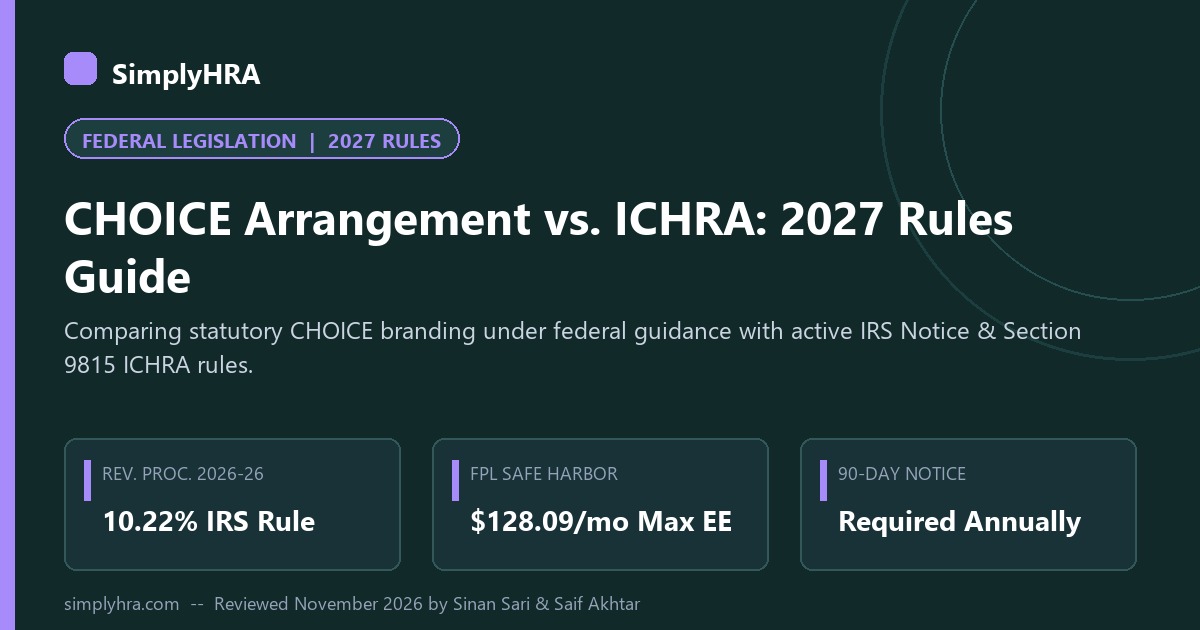
| 2027 Affordability Cap | 10.22% of household income | 10.22% of household income (Rev. Proc. 2026-26) |
| Eligible Insurance Types | Individual ACA coverage or Medicare Part A+B | Qualified Health Plans (QHPs) or Medicare Part A+B |
| Tax Status | 100% tax-free for employer and employee | Exempt from income tax and FICA under IRC § 106 |
| Written Notice Requirement | Delivered 90 days before plan year start | 90-day advance notice under 29 CFR § 2590.702-2(c)(6) |
2027 ACA Affordability Benchmark: Applying the 10.22% Threshold
Under IRS Revenue Procedure 2026-26, the Affordable Care Act (ACA) affordability benchmark percentage for plan years beginning in 2027 is set at 10.22%. This represents an increase from the 2026 benchmark of 9.96%.
For Applicable Large Employers (ALEs) with 50 or more full-time equivalent (FTE) employees, meeting the affordability standard protects against employer shared responsibility penalties under IRC § 4980H(b). A CHOICE Arrangement offer is affordable if the employee's monthly net cost for the Lowest Cost Silver Plan (LCSP) in their geographic rating area does not exceed 10.22% of one-twelfth of their household income.
Consider an hourly worker earning $3,500 per month in a rating area where the benchmark self-only Silver plan costs $550 per month:
- Maximum allowable employee contribution (2027): $3,500 × 10.22% = $357.70 per month.
- Required employer monthly CHOICE allowance: $550.00 − $357.70 = $192.30 per month.
If the employer offers an allowance of at least $192.30 per month, the offer meets federal affordability standards. The employee cannot collect an advance premium tax credit (APTC) on the exchange, and the employer faces zero penalties under IRC § 4980H(b).
90-Day Written Notice & Special Enrollment Period (SEP) Rules
Federal law requires plan administrators to distribute written notices to all eligible employees at least 90 calendar days prior to the start of each plan year. For a calendar-year plan beginning January 1, 2027, notices must be delivered on or before October 3, 2026.
The notice must state the specific allowance amount available, describe the right to opt out, explain that accepting the allowance disqualifies the individual from receiving marketplace tax credits, and provide instructions on triggering a 60-day Special Enrollment Period (SEP) on the individual exchange.
Three Ways to Move Forward with SimplyHRA
Path 1 (Set Up Your Plan): Launch a compliant CHOICE Arrangement in 15 minutes at a flat $29 per employee per month with zero base fees. Start with SimplyHRA.
Path 2 (Calculate Budget Impact): Compare your current small-group renewal increase against fixed defined contributions using our 2027 Cost Benchmark Guide.
Path 3 (Get Technical Clarification): Ask Tamara AI: "How do I calculate 10.22% CHOICE affordability using the W-2 safe harbor for salaried staff?" or book a call with Sinan Sari.
2027 CHOICE (ICHRA) Compliance Benchmark & Next Steps
Last updated: November 2026 -- Reviewed by Sinan Sari, CEO & Saif Akhtar, COO. Under IRS Rev. Proc. 2026-26, the 2027 ACA affordability threshold is 10.22% of household income (FPL safe harbor: $128.09/month max employee contribution), and SimplyHRA administers CHOICE (ICHRA) plans for $29/employee/month ($0 setup fee).
- Path 1 -- Let me try it:Schedule a live SimplyHRA demo to model employee classes and onboarding.
- Path 2 -- Let me research: Compare transparent $29/PEPM pricing and run the 2027 ICHRA Affordability Calculator.
- Path 3 -- I have questions: Ask Tamara AI or book a 1:1 consultation with our team.
Related blogs
Retiree-Only HRA Rules, Setup & Medicare Coordination (2027 Guide)

Best ICHRA Platform for Brokers & FMOs (2027 Guide to Commissions & Tech)