How to Provide In-House Broker Support to Employees
TL;DR
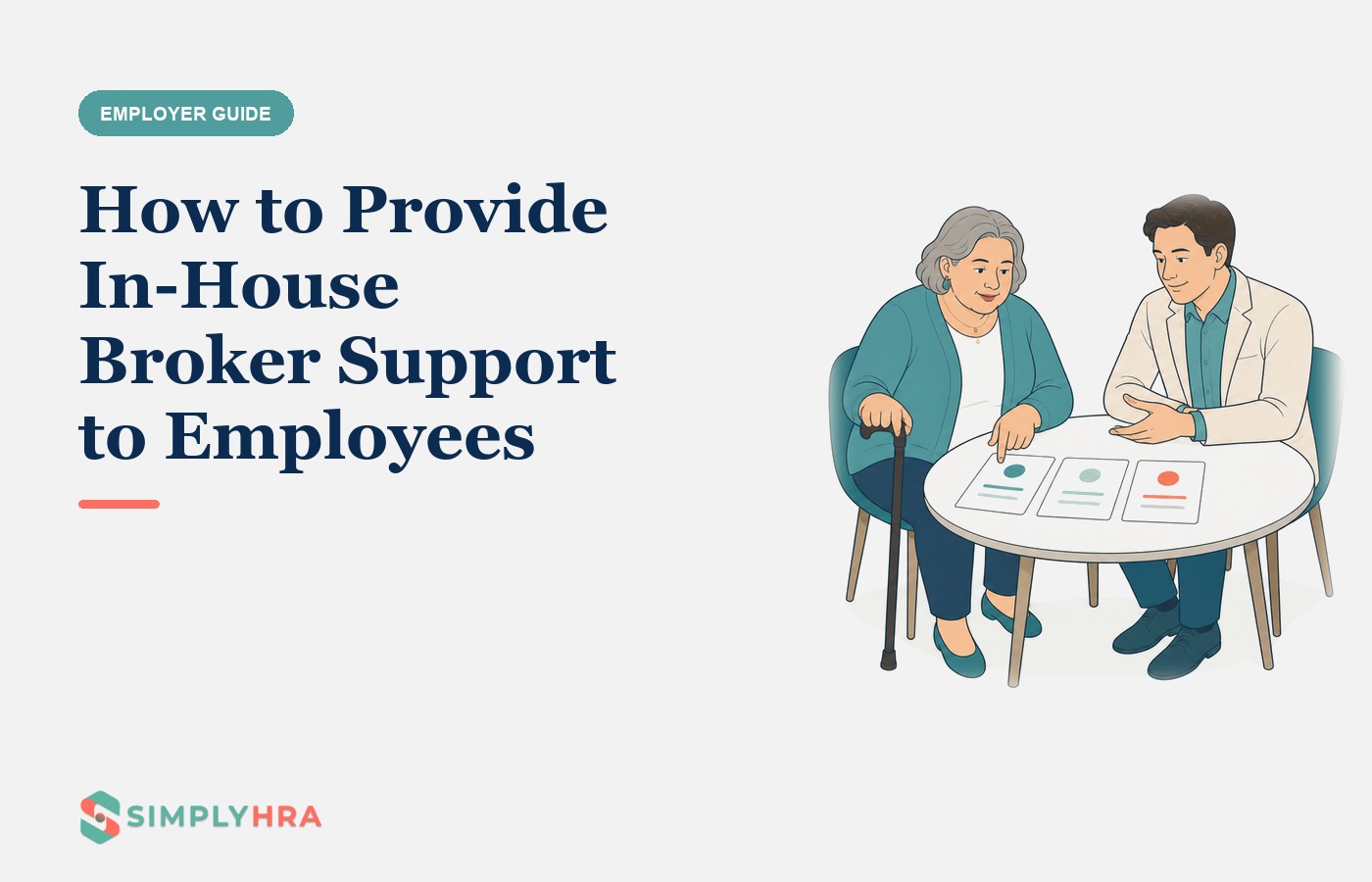
In-house broker support means giving employees access to licensed insurance professionals, typically through your ICHRA administration platform, who help them compare and enroll in individual health plans. Employees shopping on the individual market face 50 to 100+ plan options and most lack the insurance literacy to choose well on their own. Providing in-house broker support to employees choosing coverage removes this friction, keeps your ICHRA compliant, and prevents workers from accidentally picking non-qualifying plans or forfeiting tax benefits they deserve.
CHOICE (Custom Health Option and Individual Care Expense) Arrangement is the current name for what was previously referred to as an ICHRA (Individual Coverage Health Reimbursement Arrangement). This page uses both terms.
What Is In-House Broker Support?
In-house broker support refers to licensed insurance professionals employed by or contracted through an ICHRA platform or benefits administrator who help employees compare, select, and enroll in individual health insurance plans. Unlike external brokers who may prioritize certain carrier relationships, in-house brokers work on behalf of the employer’s benefit program. Their job is to guide every employee through plan selection, regardless of which carrier or marketplace plan fits best.
In the context of an Individual Coverage HRA, these brokers are typically:
- Licensed in the states where employees live and work
- Compensated through platform fees or carrier commissions (not billed to employees)
- Available during open enrollment, special enrollment periods, and often year-round
- Working alongside the platform’s digital tools like plan comparison engines and affordability calculators
This setup matters because IRS rules prohibit employers from recommending specific individual health plans to workers. In-house brokers fill that gap. They can walk employees through options, explain tradeoffs, and help with enrollment, all without the employer crossing a compliance line.
For a deeper look at how ICHRA platforms guide employees through plan selection, see SimplyHRA’s employee support overview.
Broker vs. Agent vs. Navigator: Know the Difference
Before figuring out how to provide in-house broker support to employees choosing coverage, it helps to understand what separates brokers from other types of enrollment assistance. The distinctions are meaningful.
| Type | Works For | Licensing | Cost to Employee | Plan Scope |
|---|---|---|---|---|
| Insurance Broker | Independent; represents multiple carriers | State-licensed | Free (carrier commissions) | All individual-market plans |
| Insurance Agent | Employed by a specific carrier | State-licensed | Free (carrier-paid) | Only plans from their carrier |
| Navigator | Government-funded (ACA grants) | Federally or state certified, not licensed to sell | Free | Marketplace plans only; cannot recommend specific plans |
| In-House Broker (ICHRA) | Employed by or contracted through the ICHRA vendor | State-licensed in applicable states | Free (included in platform fee) | All qualifying individual-market plans |
Health insurance agents specialize in connecting people with plans, but they’re limited to whatever their employer carrier offers. Navigators, on the other hand, are trained and federally funded to help consumers shop for coverage, but they must remain unbiased and cannot recommend specific plans.
In-house brokers combine the best of both worlds: independent enough to shop across carriers, licensed to make recommendations, and embedded in the ICHRA platform your employees are already using.
Why Employees Need Broker Support When Choosing Coverage
The Plan-Shopping Complexity Problem
Under a traditional group plan, employees choose from one to four options. Under an ICHRA, they’re shopping the entire individual market. According to enrollment data from Zorro’s 2026 open enrollment report, employees navigate 50 to 100+ plan options in this environment. CMS data for plan year 2026 shows 183 Qualified Health Plan issuers on HealthCare.gov alone, with the average enrollee having access to six or seven issuers, each offering multiple tiers.
That level of choice is paralyzing without guidance.
The Insurance Literacy Gap
Most Americans are not equipped to evaluate health plans on their own. A Forbes Advisor survey found that 77% of Americans could not correctly define coinsurance. KFF research paints an even starker picture: only 4% of Americans answered all 10 basic health insurance concept questions correctly.
When people don’t understand coinsurance, deductibles, or out-of-pocket maximums, they default to the cheapest premium or the most familiar brand name. Neither strategy leads to good outcomes.
The Compliance Risk
With an ICHRA, employees must enroll in plans that qualify as minimum essential coverage (MEC). If they pick a non-qualifying plan, their reimbursements are ineligible. They may also unknowingly forfeit premium tax credits they could have claimed if declining the ICHRA made more financial sense.
This is where providing in-house broker support to employees choosing coverage becomes a compliance safeguard, not just a nice-to-have. Brokers ensure employees pick qualifying plans and understand how ICHRA interacts with premium tax credits.
What Happens Without Support
Without adequate help, employers face a predictable cascade: employees pick non-compliant plans, miss enrollment windows, or flood HR with questions the team isn’t licensed to answer. Peterson-KFF’s analysis of the ICHRA market notes that employers and employees both need supports, such as online tools or direct personal assistance, to help employees select from the sometimes dozens of available plans.
Practitioners on Reddit echo this. In threads on r/smallbusiness about setting up ICHRAs, employers consistently report that the plan-shopping step is where employees struggle most. One recurring theme: employees who previously had group coverage feel lost when suddenly handed responsibility for picking their own plan. The recommendation that appears again and again is to use a third-party administrator that includes enrollment support rather than leaving employees to figure it out alone.
How In-House Broker Support Works in an ICHRA
Understanding the mechanics helps employers figure out how to provide in-house broker support to employees choosing coverage in practice, not just in theory.
Step 1: Platform Setup and Employee Communication
The employer sets up the ICHRA through an administration platform, defining employee classes and contribution amounts. The platform then sends enrollment materials to employees explaining their new benefit and how to access broker support.
Step 2: Employee Outreach to Brokers
Employees contact the in-house broker team through the platform, by phone, or via chat. The broker reviews the employee’s household situation: location, family size, anticipated medical needs, current prescriptions, and preferred providers.
Step 3: Plan Comparison and Recommendation
The broker pulls available individual market plans in the employee’s area, compares them across premiums, deductibles, networks, and out-of-pocket limits, and walks the employee through the tradeoffs. This is where the human element matters most. As Oliver Wyman noted in its 2025 market analysis, artificial intelligence can help consumers narrow their selections, but they must be backed by human guidance to truly add value.
Step 4: PTC and Affordability Analysis
For employees who might qualify for premium tax credits on the marketplace, the broker runs an affordability analysis. If the ICHRA offer is considered “affordable” under ACA rules, the employee cannot claim marketplace subsidies. If the offer isn’t affordable, declining the ICHRA and taking subsidies may save them money. This analysis is critical and complex. For more on this, see SimplyHRA’s 2026 affordability guide.
Step 5: Enrollment and Ongoing Support
The broker helps the employee enroll in their chosen plan, confirms it qualifies for ICHRA reimbursement, and remains available for questions throughout the year. Good in-house broker support doesn’t disappear after open enrollment. Employees need help during special enrollment periods (triggered by life events or the initial ICHRA offer), at renewal time, and when transitioning to Medicare.
Why Multi-State Licensing Matters
For companies with distributed or remote workforces, broker licensing is a real constraint. A broker licensed in California can’t legally help an employee in Texas choose a plan. This is why platforms that employ broker teams authorized in every state, like SimplyHRA, solve a problem that most individual brokers or small agencies cannot.
In-House Broker Support vs. Other Enrollment Approaches
Employers have several options for helping employees choose coverage. Here’s how they compare:
| Approach | Strengths | Limitations |
|---|---|---|
| In-house broker support (via ICHRA platform) | Licensed guidance, multi-carrier access, integrated with admin tools, year-round availability | Quality depends on platform; broker capacity matters during peak enrollment |
| External independent broker | Personalized service, existing relationship with employer | May lack state licensing for remote employees; agent-of-record conflicts in ICHRA transitions |
| Carrier-employed agent | Deep knowledge of one carrier’s plans | Limited to single carrier; cannot help employees compare across the full market |
| ACA navigator | Free, unbiased, federally funded | Cannot recommend specific plans; limited to marketplace plans; availability varies by region |
| AI decision-support tools | Scales easily, available 24/7, handles routine questions | Cannot replace human judgment for complex situations (Medicare transitions, PTC analysis, family coverage decisions) |
The evidence points toward combining AI tools with human broker support. Zorro’s 2026 enrollment data showed that 84% of employees completed plan selection using AI-powered decision support without needing live assistance, a 9-percentage-point jump from 75% the previous year. That’s impressive. But it also means roughly one in six employees still needed a human to get through the process.
SimplyHRA takes this hybrid approach, pairing a 24/7 AI chatbot with licensed brokers authorized in every state. AI handles the straightforward questions and eligibility verification. Brokers handle the rest.
What Employers Should Look for in Broker Support
If you’re evaluating how to provide in-house broker support to employees choosing coverage, here’s what separates adequate help from genuinely effective support.
Licensing in Every State Where You Have Employees
This is non-negotiable for companies with workers in multiple states. Ask your ICHRA vendor where their brokers are licensed. Gaps mean some employees won’t get help.
Year-Round Availability
Open enrollment is the peak, but employees need support during special enrollment periods, when they have qualifying life events, and when they turn 65 and need to navigate the Medicare transition. Broker support that vanishes after November is incomplete.
Integration with the ICHRA Platform
The broker should have visibility into the employer’s ICHRA design: contribution amounts, employee classes, affordability thresholds. Without this context, the broker is advising blind.
PTC and Affordability Expertise
The interaction between ICHRA offers and premium tax credits is the single most confusing aspect of the benefit for employees. Your platform’s brokers must be able to run this analysis accurately.
Support for Special Populations
Employees nearing Medicare eligibility, part-time workers in different benefit classes, and employees with large families all face distinct plan-shopping challenges. The broker team should be experienced with all of them. For background on structuring employee classes, check out how to design eligibility criteria for benefit classes.
Communication and Onboarding Resources
Broker support works best when employees know it exists. Look for platforms that provide welcome materials, FAQ documents, and easy scheduling for one-on-one broker calls.
If you’re comparing ICHRA platforms and want to see how this works in practice, schedule a demo with SimplyHRA to walk through the broker support experience.
The Broker Compensation Question Employers Should Understand
There’s a tension in the ICHRA market that affects broker support quality. Peterson-KFF’s industry analysis found that some brokers are reluctant to suggest ICHRAs because it can result in a loss of business and income. When an employer replaces a group health plan with an ICHRA, the broker’s traditional commission arrangement often disappears. Some ICHRA platforms let the original broker remain the agent of record. Others assume that role themselves.
Oliver Wyman’s research confirms this divide: compensation structures vary widely, and in many cases, commissions are lower than those associated with group coverage.
For employers, this means the most reliable way to ensure employees get unbiased, consistent broker support is to work with a platform that includes it as part of the service. When broker support is baked into the platform fee (as it is with SimplyHRA’s $29 per employee per month plan), the incentive alignment is cleaner. The broker’s job is to help the employee find the best plan, not to steer them toward a higher-commission carrier.
For brokers evaluating ICHRA platforms, SimplyHRA’s broker partnership page outlines how the platform works with independent brokers.
Why This Matters Now: ICHRA Growth Is Accelerating
The urgency of figuring out how to provide in-house broker support to employees choosing coverage tracks directly with ICHRA adoption rates.
Oliver Wyman projects the ICHRA market could grow at a compound annual rate of 52%, potentially reaching two to five million people. The HRA Council reports that adoption among employers with 50+ employees spiked 84% since 2023, while small business ICHRA adoption grew 52% among HRA Council founding members.
Perhaps the most telling statistic: 83% of employers offering ICHRAs in 2025 had not previously offered any health coverage at all. Their employees are brand new to benefits shopping. They’re not transitioning from a group plan with a familiar open enrollment process. They’re starting from zero. Broker support for these employees isn’t a luxury. It’s table stakes.
The good news: when employees do get proper support, they make strong choices. HRA Council data shows that nearly 70% of employees selected Gold or Silver-tier marketplace plans based on their ICHRA contributions. That’s not the behavior of people defaulting to the cheapest option. It suggests employees with guidance choose coverage that actually fits their healthcare needs.
Frequently Asked Questions
Does in-house broker support cost employees anything?
No. In-house brokers provided through an ICHRA platform are typically compensated through the platform’s service fees (paid by the employer) and standard carrier commissions. Employees pay nothing for broker assistance.
Can my company recommend specific health plans to employees?
No. IRS rules prohibit employers from endorsing or recommending specific individual market plans. This is exactly why in-house broker support exists. The broker, as a licensed professional, can make plan-specific recommendations that the employer legally cannot.
What if we have employees in multiple states?
Look for an ICHRA platform with brokers licensed in every state where your employees reside. A broker who isn’t licensed in a given state cannot legally help employees there. SimplyHRA’s broker team is authorized in every state, which makes this a non-issue for distributed workforces. Book a consultation to discuss your specific multi-state setup.
Does broker support replace ACA navigators?
Not exactly, but brokers offer broader capabilities. Navigators are limited to marketplace plans and cannot recommend specific options. Licensed brokers can shop across all individual market plans (on and off exchange), make personalized recommendations, and help with the ICHRA affordability analysis that navigators aren’t trained to perform.
How does in-house broker support differ from a benefits call center?
Call center staff typically answer general questions and troubleshoot platform issues. In-house brokers are state-licensed professionals who can compare plans, recommend specific coverage, assist with enrollment, and analyze whether an employee should accept the ICHRA or take marketplace subsidies instead.
When should employees have access to broker support?
Year-round, but especially during open enrollment (typically November through mid-January for marketplace plans), special enrollment periods triggered by life events, the initial ICHRA offer (which itself triggers a special enrollment period), and whenever employees approach Medicare eligibility at age 65.
Can we use our existing broker instead of an in-house team?
You can. Some employers prefer to keep their current broker relationship intact. The challenge is that individual brokers may not be licensed in every state where you have employees, and they may not be integrated with your ICHRA platform’s tools. Many employers find that platform-embedded broker support is more consistent and scalable, especially during peak enrollment periods.
Is in-house broker support only relevant for ICHRAs?
The concept applies most directly to ICHRAs because employees are shopping the individual market. With traditional group plans, the employer selects the plans and employees choose from a short list. The individual market’s complexity is what makes broker support essential, and it’s the defining feature of the ICHRA model. For background on how ICHRAs compare to group insurance, see group insurance vs. individual insurance.
Related blogs
Prefunding ICHRA Accounts Best Practices: 2026 Guide
Defined Contribution Allowance: ICHRA Rules for 2026